AI Chatbots for Customer Service in Australian Enterprises
 AI & Customer Experience
AI Chatbots for Customer Service in Australian Enterprises
Australian enterprises are turning to AI chatbots for customer service to manage rising support volumes without growing headcount at the same rate. Unlike the rule based bots of a few years ago, today's AI chatbots use natural language understanding to resolve genuine customer questions, hand off complex cases to human agents with full context, and operate around the clock across web, app, and messaging channels. For enterprises already exploring AI contact center solutions in Australia, chatbots are often the fastest entry point into AI powered service delivery. This guide explains how AI chatbots work and how to deploy them successfully.
Key Takeaways
AI chatbots powered by natural language understanding resolve routine enquiries instantly while escalating complex cases to human agents with full conversation context.
Australian enterprises deploying AI chatbots report faster response times, lower cost per interaction, and stronger after hours coverage across digital channels.
Successful chatbot deployment depends on system integration, clear escalation paths, and compliance with Australian privacy obligations from day one.
What Are AI Chatbots and How Do They Work in Enterprise Customer Service?
AI chatbots are software agents that use natural language processing and machine learning to understand customer intent and respond conversationally, rather than following rigid decision trees. Where legacy chatbots matched keywords to scripted replies, modern AI chatbots interpret meaning, context, and sentiment, which lets them handle a far wider range of enquiries without a human agent.
In an enterprise setting, an AI chatbot typically sits across a company's website, mobile app, and messaging channels such as WhatsApp or Facebook Messenger, connected to the same knowledge base and case management system that human agents use. When a customer asks a question, the chatbot searches approved knowledge sources, checks account or order details where authorised, and either resolves the query directly or prepares a summary for a human agent to take over.
This connected architecture matters more than the chatbot interface itself. A chatbot that cannot see order history, account status, or prior interactions will frustrate customers by asking them to repeat information. Enterprises that integrate chatbots with their core systems, including CRM, billing, and case management platforms, see far higher resolution rates than those that deploy a chatbot as an isolated widget.
Most enterprise AI chatbots also include confidence scoring, which determines whether the bot is certain enough to answer directly or should defer to a human agent. This safeguard is particularly important in regulated industries such as banking and insurance, where an incorrect automated answer carries real compliance risk. Well designed confidence thresholds keep the chatbot fast for simple queries while protecting customers and the business on anything ambiguous or high stakes.
Key Capabilities of Modern AI Chatbots for Australian Enterprises
The capabilities that separate enterprise grade AI chatbots from basic web widgets fall into four categories: understanding, action, escalation, and learning.
Understanding covers natural language processing that interprets intent across varied phrasing, spelling errors, and even mixed language enquiries, which matters for Australia's culturally diverse customer base. Leading platforms also detect sentiment, flagging frustrated customers for priority handling before the conversation escalates.
Action capability determines how much a chatbot can actually do beyond answering questions. The strongest enterprise deployments let chatbots check order status, process simple refunds, update account details, and book appointments directly within the conversation, rather than just pointing customers to a self service page. This is where choosing the right conversational AI platform becomes critical, since not every vendor supports deep transactional integration.
Escalation capability ensures that when a chatbot reaches its limit, the handoff to a human agent is seamless. The best implementations pass the full conversation transcript, detected intent, and customer sentiment to the receiving agent, so the customer never has to repeat themselves. Poorly designed escalation is one of the most common reasons enterprise chatbot projects underperform.
Learning capability closes the loop. Enterprise chatbots should be reviewed regularly against unresolved queries, corrected responses, and changing product information, with retraining built into standard operations rather than treated as a one off project. Enterprises that treat chatbot tuning as an ongoing discipline consistently outperform those that deploy once and leave the system static.
Business Benefits and ROI of AI Chatbots in Customer Service
The business case for AI chatbots rests on three measurable outcomes: cost, speed, and coverage.
Cost per interaction drops sharply when routine enquiries, such as order status, password resets, and billing questions, are resolved without agent involvement. Enterprises typically see AI chatbots deflect 30 to 60 percent of inbound volume once the bot is properly trained on their most common enquiry types, freeing agents to focus on complex or high value interactions.
Speed improves because chatbots respond instantly, with no queue time, and can handle unlimited simultaneous conversations. This is particularly valuable during peak periods such as end of financial year, product launches, or service outages, when call and chat volumes spike beyond what a human team can absorb without long wait times.
Coverage extends service availability to 24 hours a day, seven days a week, without the cost of a round the clock human team. For enterprises serving customers across multiple time zones or industries with after hours urgency, such as insurance claims or IT support, this alone often justifies the investment. This connects directly to the future of intelligent customer interactions, where AI capabilities extend beyond chat into voice and identity verification.
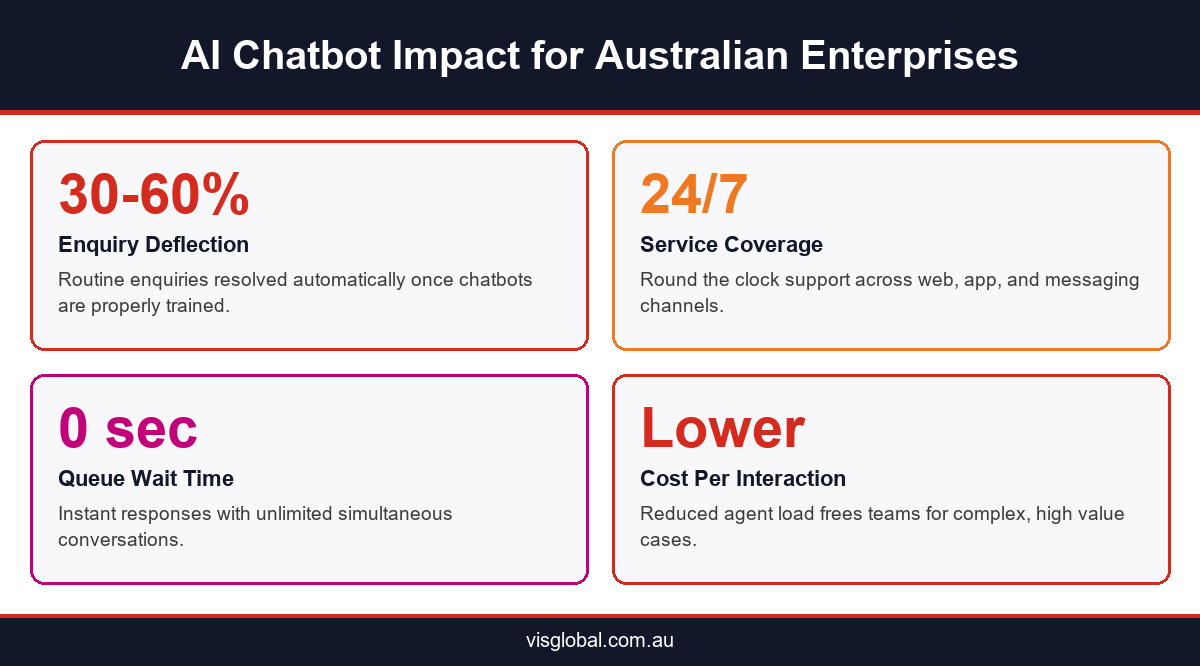
These gains compound when chatbots are measured properly. Enterprises should track deflection rate, containment rate, customer satisfaction on bot resolved conversations, and average handle time reduction for agents no longer fielding routine queries, rather than judging success on chatbot usage volume alone.
Deploying AI Chatbots the Right Way: Compliance and Best Practices for Australian Enterprises
Deploying an AI chatbot in an Australian enterprise requires more than selecting a vendor and enabling a website widget. Data handling, escalation design, and ongoing governance all need to be built in from the start.
Every chatbot that collects or references personal information must comply with the Australian Privacy Principles set out under the Privacy Act 1988. This means customers should be told when they are speaking with a bot, personal data collected through the conversation must be handled according to the enterprise's existing privacy policy, and sensitive queries should be routed to secure, authenticated channels rather than answered in an open chat window. Enterprises can review current guidance through the Office of the Australian Information Commissioner before finalising chatbot data handling design.
Responsible AI governance is equally important as chatbots take on more autonomous decision making. Australia's National AI Centre provides guidance on responsible AI practices that enterprises can apply to chatbot design, including transparency about automated decisions and regular bias and accuracy testing.
From an operational standpoint, the enterprises that get the most value from AI chatbots start narrow, launching with a small set of high volume, low risk use cases such as order status and FAQ handling, before expanding into transactional capabilities. This phased approach builds internal confidence, generates real conversation data for tuning, and avoids the customer experience damage that comes from launching a chatbot that cannot yet handle its assigned scope. Partnering with an experienced customer experience management provider helps enterprises sequence this rollout correctly.
AI chatbots have moved from novelty to necessity for Australian enterprises managing high volume customer service across digital channels. Done well, they reduce cost per interaction, extend service coverage to 24 hours a day, and free human agents to focus on the conversations that need them most. The enterprises seeing the strongest results treat chatbot deployment as an ongoing discipline, not a one time project, with clear escalation paths and privacy compliance built in from day one. Contact VIS Global to design an AI chatbot strategy suited to your enterprise's customer service needs.