AI in Quality Assurance: 5 Ways VIS Global is Transforming Customer Experience & Enterprise Testing (2026 Guide)
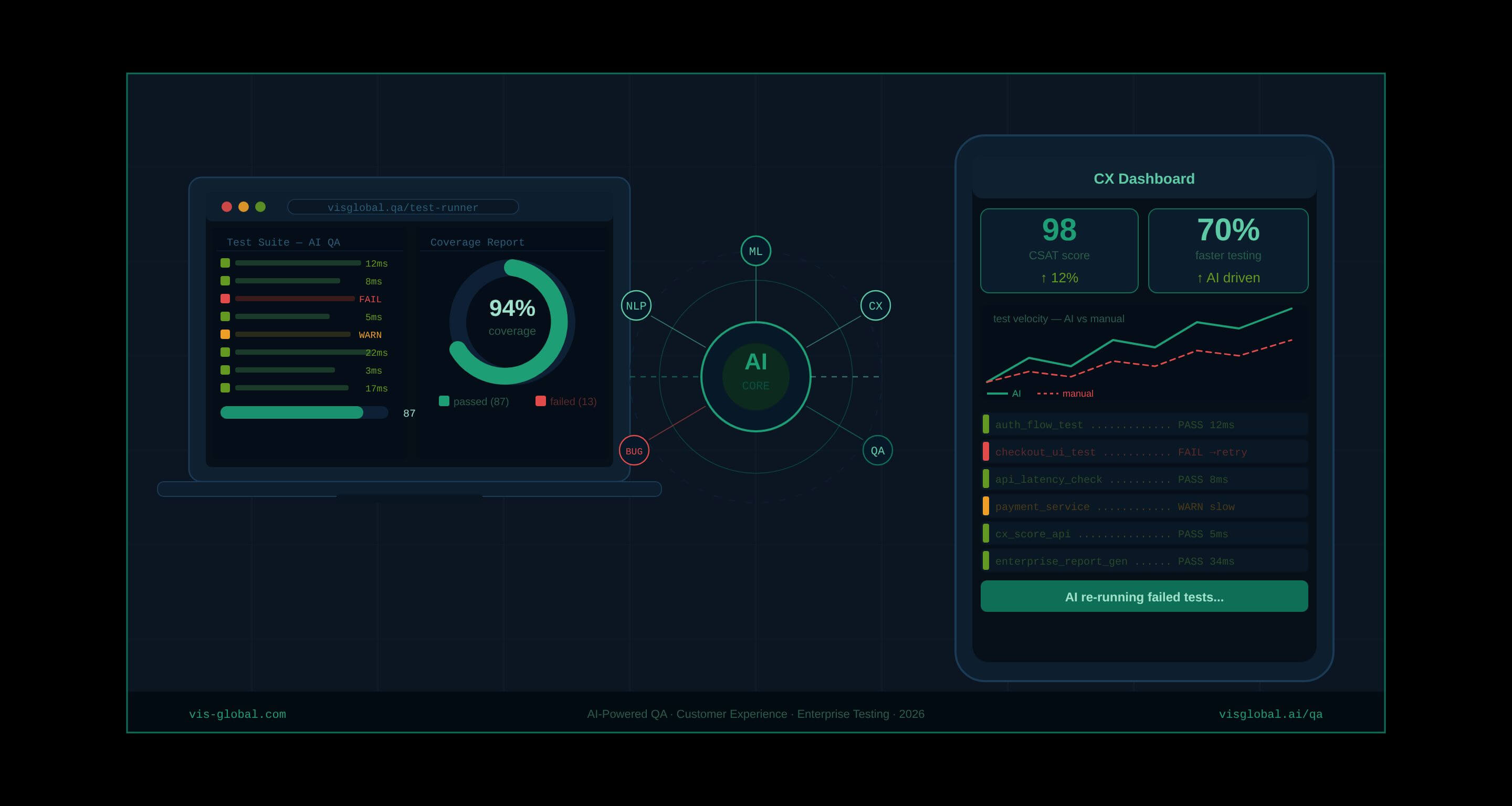 AI & Customer Experience
Introduction: The Shift from Software Testing to Experience Assurance
Quality Assurance is no longer just about testing whether software works - it’s about ensuring every customer interaction works flawlessly.
In today’s enterprise landscape, organizations operate across:
Cloud contact centres
Omnichannel communication platforms
AI-powered chatbots and voice assistants
Real-time customer engagement systems
Traditional QA approaches - manual testing, static scripts, and reactive validation - cannot keep up with this complexity.
They struggle to:
Keep pace with rapid deployments
Validate dynamic customer journeys
Detect failures in real-time
Scale across multiple channels
This is where AI-driven Quality Assurance (QA) is transforming how enterprises deliver seamless customer experiences. At VIS Global, QA is deeply integrated with automation, CX platforms, and cloud infrastructure, ensuring end-to-end experience validation.
What is AI in CX Quality Assurance?
AI in Quality Assurance uses machine learning, automation, and real-time analytics to test, monitor, and optimize customer interactions and enterprise workflows.
Unlike traditional QA, which focuses on isolated systems, AI-driven QA focuses on:
End-to-end customer journeys
Key Capabilities:
Intelligent test automation
Real-time monitoring of interactions
Predictive failure detection
Automated validation of CX workflows
Continuous testing in cloud environments
In VIS Global’s ecosystem, this includes:
Contact centre testing (IVR, voice, chat)
Omnichannel journey validation
AI bot performance testing
Workflow and automation testing
This ensures that every touchpoint - from first interaction to resolution - delivers a seamless experience.
Traditional QA vs AI-Driven CX QA
Traditional QA
Focuses on application functionality
Manual or script-based execution
Periodic testing cycles
Reactive issue detection
Limited test coverage
AI-Driven CX Quality Assurance
Focuses on end-to-end customer experience
Intelligent, automated testing
Continuous validation in real-time
Predictive insights and failure detection
Full customer journey coverage
5 Ways AI is Transforming Quality Assurance in CX & Enterprise Systems
1. AI-Powered Interaction Testing: Validating Real Customer Journeys
Modern customer interactions are complex - involving multiple touchpoints across voice, chat, and digital channels.
AI enables businesses to:
Simulate real customer interactions
Test IVR flows and call routing
Validate chatbot responses and intent accuracy
Identify friction points in journeys
These capabilities are especially critical in cloud contact centre solutions where seamless interaction across channels is essential.
Business Impact:
Reduced customer frustration
Improved first-call resolution
Consistent CX across channels
Instead of testing isolated components, AI ensures complete journey validation.
2. Intelligent Automation: From Static Scripts to Self-Healing Systems
Traditional test automation is fragile - even minor UI or workflow changes can break scripts.
AI introduces:
Self-healing automation
Dynamic test case generation
Adaptive workflows
Benefits:
Reduced maintenance effort
Faster testing cycles
Scalable QA operations
This is where enterprises leverage AI-driven automation services to build resilient and scalable testing ecosystems.
3. AI-Driven Test Strategy: Focusing on What Matters Most
Not all test scenarios are equally important.
AI analyzes:
Customer behavior patterns
Historical failure data
High-risk interaction points
What this enables:
Risk-based testing
Prioritization of critical journeys
Optimization of test coverage
These strategies are often implemented as part of broader digital workplace solutions that integrate communication, collaboration, and performance optimization.
4. Continuous Testing in Cloud Contact Centres
In modern enterprises, systems are always evolving - updates happen daily or even hourly.
AI enables:
Continuous testing across environments
Real-time monitoring of live systems
Instant detection of regressions
This is critical for organizations using cloud contact centre solutions where downtime or failure directly impacts customer satisfaction. AI ensures quality is embedded into the system - not checked after deployment.
5. Predictive CX Assurance: Preventing Failures Before They Occur
One of the most powerful capabilities of AI is prediction.
AI analyzes:
System performance trends
Interaction data
User behavior
It predicts:
Potential system failures
High-risk customer journeys
Performance bottlenecks
This predictive capability plays a key role in CX transformation initiatives where businesses aim to deliver seamless and intelligent customer experiences.
Outcome:
Proactive issue resolution
Improved customer experience
Reduced downtime
QA evolves into a predictive intelligence function.
Human + AI: A Hybrid Approach to Quality Assurance
AI enhances human capabilities -it does not replace them.
AI handles:
Data-heavy analysis
Repetitive testing
Pattern recognition
Humans focus on:
Exploratory testing
Customer empathy
Strategic decision-making
This hybrid model delivers:
Speed
Accuracy
Innovation
Industry Use Cases
Banking & Financial Services
Fraud detection validation
Secure transaction testing
Compliance monitoring
Healthcare
Patient interaction testing
Data integrity validation
System reliability
Retail & E-commerce
Omnichannel journey testing
Peak traffic performance
Personalization validation
Public Sector & Education
Accessibility compliance
Platform scalability
Citizen service validation
AI-driven QA ensures industry-specific reliability and performance.
Measurable Business Impact
Organizations adopting AI-driven QA report:
⬇️ 30–50% reduction in testing time
⬇️ 20–40% reduction in QA costs
⬆️ Improved customer satisfaction
⬆️ Faster time-to-market
These results demonstrate that AI-driven QA is not just a technical upgrade - it’s a business transformation enabler.
How to Implement AI in CX Quality Assurance
Successful implementation requires a structured approach:
1. Identify Critical Customer Journeys
Focus on high-impact interactions that affect user experience.
2. Automate High-Value Processes
Prioritize automation for repetitive and critical workflows.
3. Integrate AI with Existing Systems
Ensure compatibility with current infrastructure.
4. Continuously Monitor and Optimize
Adopt a continuous improvement mindset.Organizations often accelerate this journey through QA consulting and implementation services to ensure seamless adoption and measurable ROI.
Common Challenges in AI QA Adoption
Integration with legacy systems
Skill gaps in AI technologies
Managing complex CX ecosystems
Solution:
Partnering with an experienced provider like VIS Global ensures:
Faster implementation
Reduced risk
Better outcomes
Conclusion: Why VIS Global is the Right Partner for AI-Driven QA
Quality assurance today is about more than testing systems - it’s about delivering exceptional customer experiences.
AI has redefined QA by enabling:
Intelligent automation
Continuous validation
Predictive insights
Real-time monitoring
However, implementing AI-driven QA requires the right combination of:
Technology
Expertise
Strategic execution
This is where VIS Global excels.
With deep expertise in:
AI-driven automation
Cloud contact centre solutions
Customer experience transformation
Enterprise system integration
Transform Your Customer Experience with AI-Driven QA
Delivering seamless customer experiences requires more than traditional testing - it demands intelligent, continuous, and predictive quality assurance.
At VIS Global, we help enterprises implement AI-powered QA strategies that:
Improve customer experience across all channels
Reduce operational costs
Accelerate time-to-market
Ensure reliability at scale
Ready to elevate your QA strategy?
connect with our experts today:
🔗 https://visglobal.com.au/contact/