AI-Powered Intelligent Routing in Contact Centers
 AI & Customer Experience
AI-Powered Intelligent Routing in Contact Centers
Intelligent routing customer support has become one of the highest impact upgrades an Australian enterprise can make to its contact centre. Instead of sending customers through generic queues or basic IVR menus, AI powered routing analyses intent, urgency, and customer history in real time to connect each contact with the agent best equipped to help. For enterprises building on AI contact center solutions in Australia, intelligent routing is the layer that turns a well designed platform into consistently fast, accurate service.
Key Takeaways
AI powered intelligent routing matches customers to the best available agent using intent, skills, history, and real time context, not just queue order.
Enterprises using intelligent routing report shorter wait times, higher first contact resolution, and better use of specialist agent skills.
Combining intelligent routing with signals such as voice biometrics and sentiment analysis further improves accuracy and security.
What Is Intelligent Routing and Why It Matters for Customer Support
Intelligent routing is the use of artificial intelligence to decide, in real time, which agent or channel should handle a given customer contact. Rather than routing purely by arrival order or a static menu tree, intelligent routing systems weigh factors such as detected intent, customer value, language, sentiment, and agent skill or availability before making a decision.
The difference this makes is significant for both customers and the business. Customers reach a capable agent faster, without repeating themselves through multiple transfers. Agents spend more time on work that matches their skills, rather than fielding enquiries outside their expertise. Enterprises reduce average handle time and transfer rates, which directly lowers cost per contact.
Intelligent routing matters most in enterprises with varied enquiry types, multiple product lines, or regulatory complexity, where sending a customer to the wrong specialist wastes time on both sides. Banking, insurance, telecommunications, and government services all see outsized gains from intelligent routing because a single wrong route often means a second call and a frustrated customer.
Intelligent routing also extends beyond voice. The same logic applies to chat, email, and social channels, ensuring that a customer who starts an enquiry in one channel and continues in another still reaches an agent with full context and appropriate skills, rather than starting over.
The business case extends to workforce planning as well. Contact centre leaders gain much clearer visibility into demand by skill and channel when routing decisions are logged systematically, which improves forecasting accuracy and rostering. Instead of estimating headcount from total call volume alone, teams can plan around the specific skill mixes that intelligent routing shows are actually in demand at different times of day.
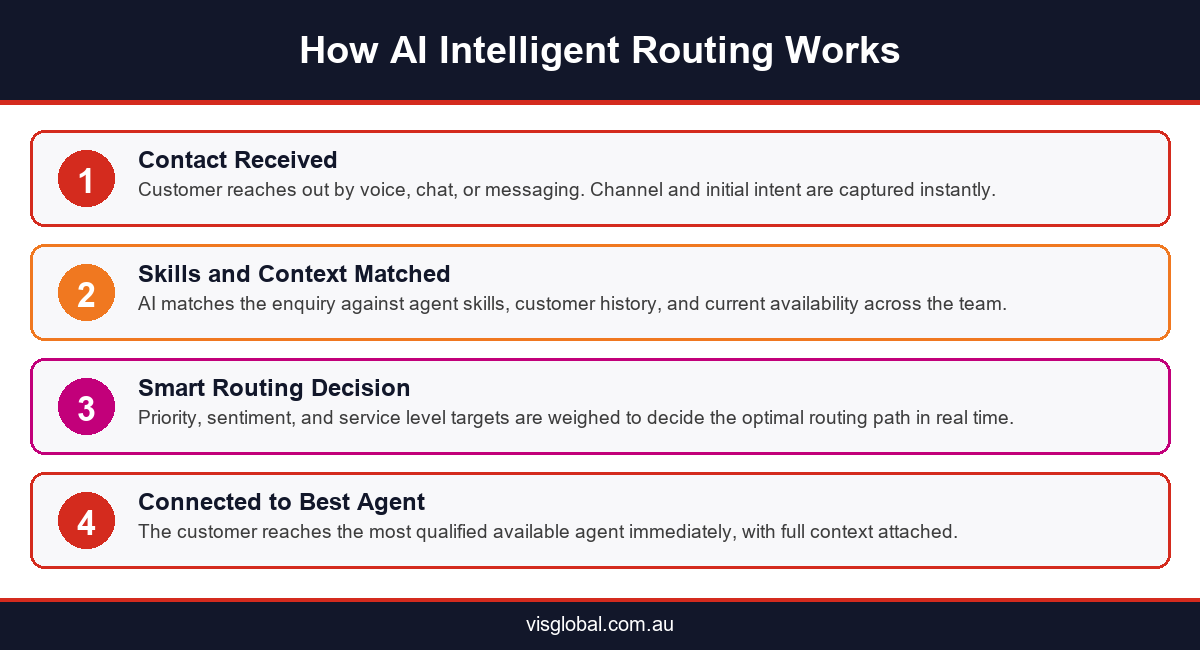
How AI Powered Intelligent Routing Works
Most enterprise routing platforms build on the principles of skill-based routing, where agents are tagged with the skills, languages, and product knowledge they hold, and contacts are matched against those tags. AI adds a further layer by predicting intent from the customer's opening words or IVR selections, rather than relying only on a static menu choice.
Real time signals are layered on top of the skill match. Sentiment detected from voice tone or message wording can bump a frustrated customer to a senior agent. Customer value or account status can prioritise certain contacts within the queue. Current agent workload and average handle time trends inform which available agent will likely resolve the enquiry fastest, not simply which agent has been idle longest.
The routing engine also learns over time. By analysing which routing decisions led to first contact resolution versus repeat contact or escalation, the system refines its matching logic, improving accuracy as more interaction data accumulates across the enterprise.
Overflow handling is another area where AI routing outperforms static rules. When a required skill group is fully occupied, the system can identify the next best qualified agent, offer a callback at a predicted wait time, or redirect to a self service option, rather than leaving the customer in a queue with no visibility into what happens next.
Integration depth determines how much of this is possible in practice. Routing engines need real time access to CRM records, case history, and agent presence data to make accurate decisions, which means the underlying platform architecture matters as much as the routing algorithm itself. Enterprises evaluating vendors should ask specifically how routing decisions are made when integration data is incomplete or delayed, since this is where many otherwise strong deployments quietly underperform.
Skill Based Routing vs Traditional IVR: What Changes
Traditional IVR routing asks customers to navigate a fixed menu tree, guessing which option best matches their need. This works reasonably well for simple, high volume enquiries but breaks down quickly for anything nuanced, often resulting in the wrong department, a manual transfer, and a customer who has to explain their issue twice.
Smart IVR, by contrast, lets customers describe their issue in natural language or select from AI generated options informed by recent account activity. Combined with skill based routing on the backend, this removes much of the guesswork from both the customer and the routing system, and shortens the path to resolution considerably.
The gap becomes even clearer when routing incorporates identity signals. Enterprises that pair intelligent routing with voice biometrics technology can authenticate a returning customer automatically during the greeting, skip manual identity checks, and route directly to the agent or self service flow appropriate for that verified customer, all before the conversation formally begins.
Migrating from traditional IVR to smart, AI driven routing rarely needs to happen in one step. Many enterprises start by layering natural language intent detection over their existing menu structure, then progressively retire menu branches as confidence in the AI routing grows, which keeps risk low while the organisation builds experience with the new system.
Getting Intelligent Routing Right: Best Practices for Australian Enterprises
Intelligent routing delivers the strongest results when it is treated as an ongoing tuning exercise rather than a one time configuration. Enterprises should review routing outcomes monthly, checking transfer rates, first contact resolution, and customer satisfaction by route, and adjusting skill tags and priority rules as products, teams, and customer needs evolve.
Data quality is the foundation. Routing decisions are only as good as the agent skill data, customer history, and intent detection feeding them. Enterprises should audit agent skill profiles regularly and ensure routing systems have access to the same customer data agents see once connected, which ties closely to broader contact center automation efforts across the organisation.
Service standards also matter. Enterprises operating regulated communication services should align routing design with guidance from the Australian Communications and Media Authority, particularly around complaint handling and accessibility for customers with disability, to ensure automated routing decisions never compromise service obligations.
Finally, intelligent routing should be planned as part of a broader customer experience management strategy rather than a standalone project, so that routing logic stays aligned with the channels, products, and service standards the enterprise is building toward.
It is also worth setting realistic expectations internally before rollout. Agents should understand why routing decisions are made the way they are, and team leaders should have visibility into routing logic so they can explain outcomes to staff and customers alike. Transparency around how intelligent routing works builds trust in the system and speeds adoption across the contact centre team.
Budget planning should account for the tuning period as well as the initial implementation. The first few months after go live typically involve the heaviest adjustment as skill tags, priority weightings, and escalation thresholds are refined against real interaction data, and enterprises that allocate dedicated time and ownership for this phase see faster stabilisation than those that treat go live as the finish line.
Intelligent routing customer support turns contact centre operations from a queue based waiting game into a precise, real time matching system that benefits customers, agents, and the business at once. Enterprises that pair skill based routing with real time signals like sentiment and identity verification see the fastest, most consistent gains. Contact VIS Global to design an intelligent routing strategy suited to your contact centre.