AI Tools for Hybrid and Remote Teams in Australia
 Digital Transformation
AI Tools for Hybrid and Remote Teams in Australia
The shift to hybrid work has permanently changed how Australian enterprises operate. More than 40 percent of Australian employees now work in hybrid arrangements, according to the Australian Bureau of Statistics, and organisations that fail to equip their distributed workforces with the right technology are seeing measurable declines in collaboration quality, team cohesion, and customer experience outcomes.
This guide covers the essential AI tools for hybrid and remote teams in Australia, from communication platforms to intelligent automation, and explains how to build a technology stack that keeps distributed teams productive, connected, and compliant with Australian workplace regulations.
Key Takeaways
AI collaboration tools purpose-built for hybrid teams reduce meeting overhead and improve cross-location communication quality.
Australian enterprises must balance productivity-enhancing AI tools with Privacy Act compliance when monitoring remote workers.
The right hybrid workforce technology stack combines communication, automation, and analytics tools in a unified platform.
Why AI Tools Are Essential for Hybrid and Remote Teams
Hybrid work creates a communication gap that traditional tools cannot bridge. When half a team is in the office and the other half is remote, standard video conferencing and email fail to replicate the organic collaboration of shared physical space. AI collaboration tools close this gap by adding intelligent context to every interaction: surfacing relevant documents during meetings, transcribing and summarising discussions automatically, and routing follow-up actions to the right team member without manual assignment.
For Australian contact centres and enterprise communication teams, the stakes are particularly high. Hybrid agents handling customer interactions need seamless access to knowledge bases, CRM data, and escalation paths regardless of their location. AI tools that integrate with communication platforms ensure that a remote agent delivers the same quality of service as a co-located colleague, maintaining consistent CX standards across the distributed workforce.
Core AI Tools Every Hybrid Team Needs
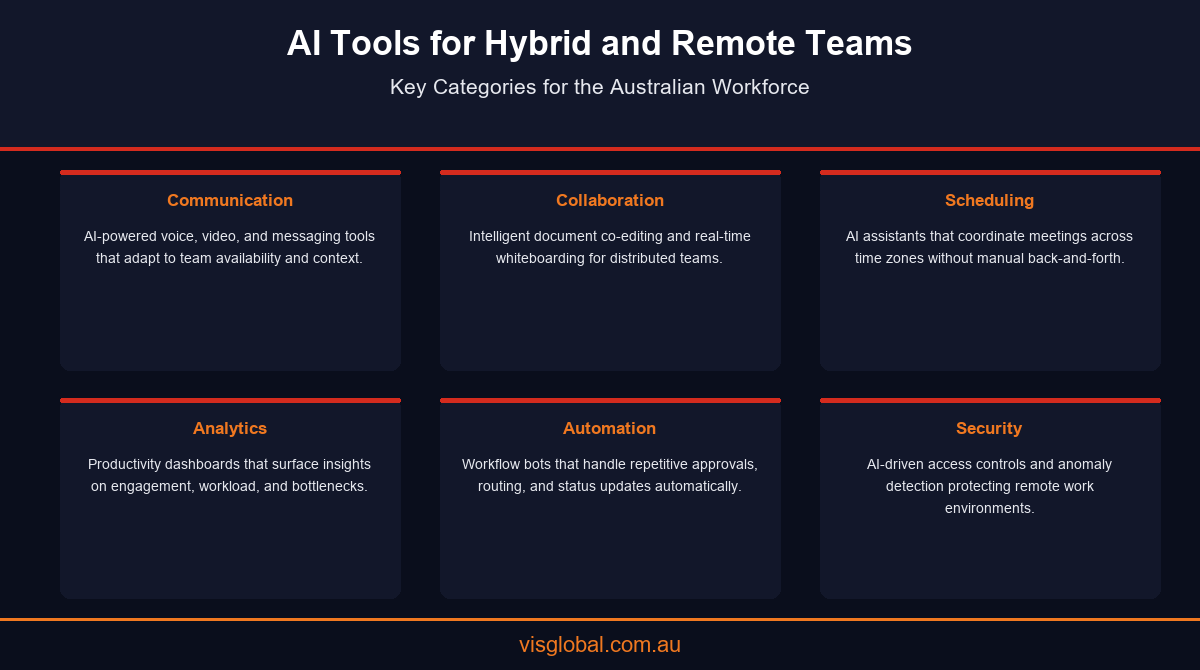
The foundation of any hybrid workforce technology stack is an AI-powered communication platform that handles voice, video, and messaging in a single interface. These platforms use AI to optimise audio quality, reduce background noise, generate live transcripts, and flag action items during meetings. For Australian enterprises with teams across multiple time zones, AI scheduling assistants that resolve meeting conflicts automatically are equally important.
Intelligent document collaboration tools are the second pillar. These platforms allow multiple team members to co-edit documents in real time, with AI assistants that suggest edits, summarise long documents, and surface relevant files based on the current conversation context. When integrated with your communication platform, these tools ensure that the right information reaches the right person at the right moment.
Analytics tools complete the core stack. AI productivity dashboards analyse communication patterns, workload distribution, and engagement levels across the hybrid team, giving managers the data they need to identify burnout risk, collaboration gaps, and skill development opportunities. For organisations managing both remote workers and in-office staff, these insights are critical for maintaining fair and equitable digital workplace practices.
Compliance Considerations for AI Tools in Australian Workplaces
Deploying AI tools in a hybrid workforce environment requires careful attention to Australian workplace law and the Privacy Act 1988. Employee monitoring tools, including AI productivity analytics, keystroke logging, and screen capture, must comply with the Act's requirements for informed consent and proportionate data collection. Employers must clearly disclose what data is collected, how it is used, and how long it is retained. For detailed guidance, refer to acsc.gov.au/cloud.
AI tools that process customer interaction data, such as call recording analysis platforms and CRM-integrated AI assistants, carry additional compliance obligations. Under the Notifiable Data Breaches scheme, any breach of customer data processed by a third-party AI tool must be reported to the Office of the Australian Information Commissioner within 30 days. Ensure that every AI vendor in your hybrid work stack has Australian data residency options and a documented breach response process.
Conclusion
AI tools for hybrid and remote teams are no longer a competitive advantage; they are a baseline requirement for Australian enterprises that want to maintain collaboration quality and CX standards across distributed workforces. Building the right stack requires balancing productivity technology with compliance obligations under Australian privacy law. If your organisation is ready to evaluate remote work AI tools for your hybrid team, speak with VIS Global to design a solution tailored to your workforce model and industry requirements.