AI Workflow Automation: Boosting Digital Workplace Productivity
 Digital Transformation
AI Workflow Automation: Boosting Digital Workplace Productivity
Australian enterprises are sitting on significant untapped productivity potential in their back-office and contact centre operations. Manual approval processes, repetitive data entry, rule-based routing decisions, and exception handling that relies on human judgment for tasks that follow predictable patterns are costing organisations hours every day per employee. AI workflow automation replaces these manual steps with intelligent, self-executing processes that reduce processing time, cut error rates, and free employees to focus on tasks that genuinely require human expertise.
This guide covers the fundamentals of AI workflow automation for the digital workplace, the key use cases for contact centres and back-office teams, and a practical five-step implementation framework for Australian enterprises ready to begin.
Key Takeaways
AI workflow automation delivers the greatest ROI in high-volume, rule-based processes with predictable exception patterns.
Contact centre and back-office automation can be combined in a unified approach that improves both CX and operational efficiency.
A five-step implementation framework reduces deployment risk and accelerates time-to-value for enterprise automation programs.
What AI Workflow Automation Means for the Digital Workplace
AI workflow automation combines robotic process automation (RPA) with machine learning and natural language processing to execute complex, multi-step processes that vary based on data inputs, context, or prior outcomes. Unlike traditional rule-based automation, AI workflow tools can handle exceptions, learn from patterns, and improve their decision accuracy over time without manual rule updates. For the digital workplace, this means that automation can extend beyond simple form-filling into tasks such as intelligent routing, document classification, compliance checking, and predictive task assignment.
McKinsey research estimates that up to 45 percent of tasks performed by knowledge workers can be automated with current AI technology. For Australian enterprises, this represents a substantial opportunity to reduce operational cost while simultaneously improving output quality, since AI-executed processes do not suffer from the attention lapses and fatigue-driven errors that affect human-executed repetitive work.
Key Use Cases in Contact Centres and Back-Office Operations
The highest-value AI workflow automation use cases in Australian contact centres include intelligent call routing, where AI analyses caller intent, history, and sentiment to assign the interaction to the best-matched agent without supervisor intervention. Automated after-call work is a second high-impact use case: AI tools summarise the call, update the CRM record, and trigger any required follow-up workflows, cutting average handle time by 30 to 50 percent in enterprises that have deployed this capability.
In back-office operations, the highest-impact use cases are invoice processing, policy renewals, and compliance exception handling. AI workflow tools extract data from unstructured documents, validate it against business rules, and route exceptions to the appropriate approver with full context attached. This reduces processing time from days to hours and creates a complete audit trail that satisfies compliance requirements in banking and insurance. These back-office gains compound the value of contact centre automation when both are implemented in a unified digital workplace transformation program.
How to Implement AI Workflow Automation: A Practical Framework
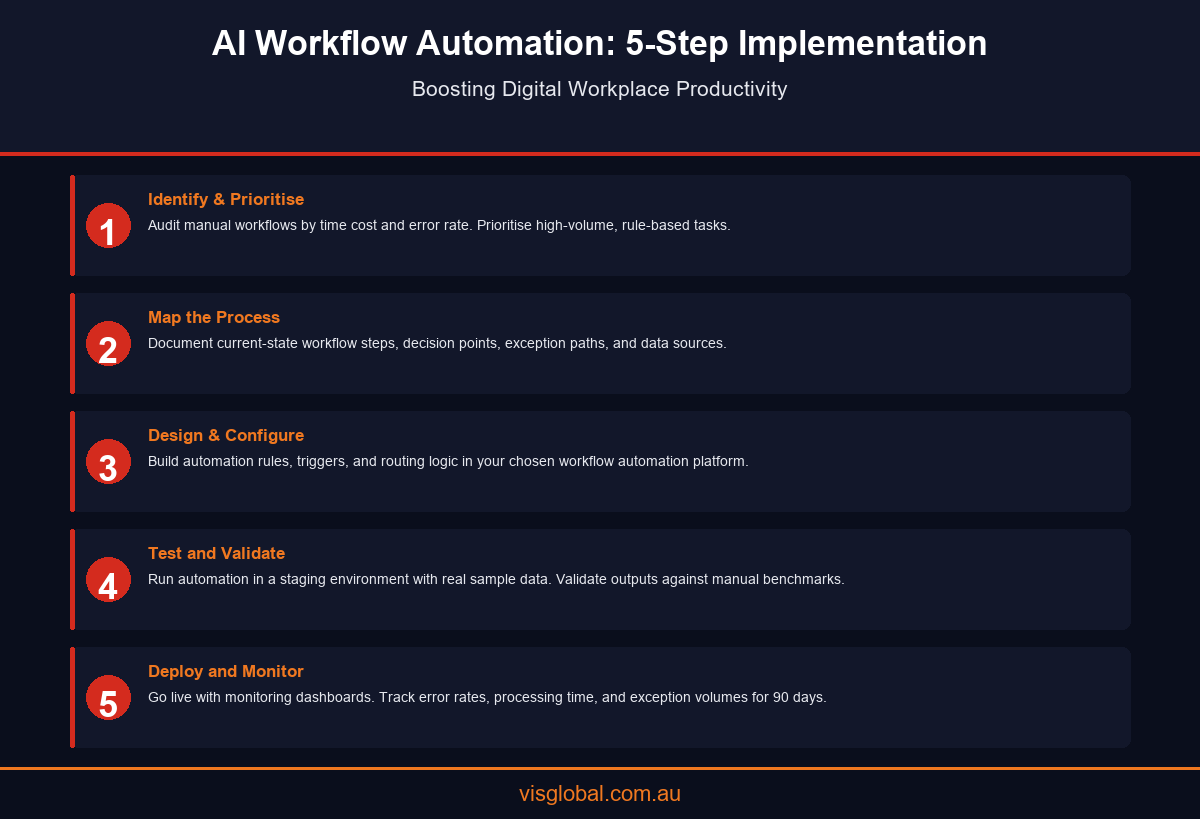
Successful workflow automation programs follow a structured five-step approach that prevents the common failure modes of over-scoping, under-testing, and deploying to production without adequate monitoring.
Start with a workflow audit that maps every manual process by volume, time cost per instance, and error rate. Prioritise processes that are high-volume and rule-based first, because these deliver the fastest payback and the lowest implementation risk. Avoid starting with processes that have high exception rates or require significant human judgment, as these are harder to automate and slower to yield returns.
Once priority workflows are identified, document the current-state process in detail before designing the automation. Many automation programs fail because they automate a flawed process rather than the optimal version of that process. The design phase is the right time to simplify and standardise, not after deployment. Engage your workplace transformation partner during the design phase to ensure that automation architecture aligns with your existing enterprise systems and scales with your growth plans.
Conclusion
AI workflow automation is the engine of the productive digital workplace. Australian enterprises that move from ad-hoc automation pilots to structured, enterprise-wide programs are seeing measurable gains in processing speed, error reduction, and employee satisfaction as repetitive work is removed from human queues. If your organisation is ready to scale AI productivity tools across your contact centre and back-office operations, speak with VIS Global to build a roadmap tailored to your processes and platforms.