Cloud Communication Security and Compliance in Australia
 Digital Transformation
Cloud Communication Security and Compliance in Australia
Security and compliance are the most frequently cited concerns among Australian IT leaders evaluating cloud communications platforms. These concerns are legitimate: moving voice, video, and messaging infrastructure to the cloud introduces new attack surfaces, data residency obligations, and regulatory requirements that must be addressed systematically. However, well-architected cloud communications platforms deliver stronger security than most on-premise environments — provided the right controls are implemented from the outset. This guide covers the key security requirements, Australian compliance frameworks, and implementation controls that govern cloud communications deployments. VIS Global's managed services team implements and maintains these controls for Australian enterprise clients.
Key Takeaways
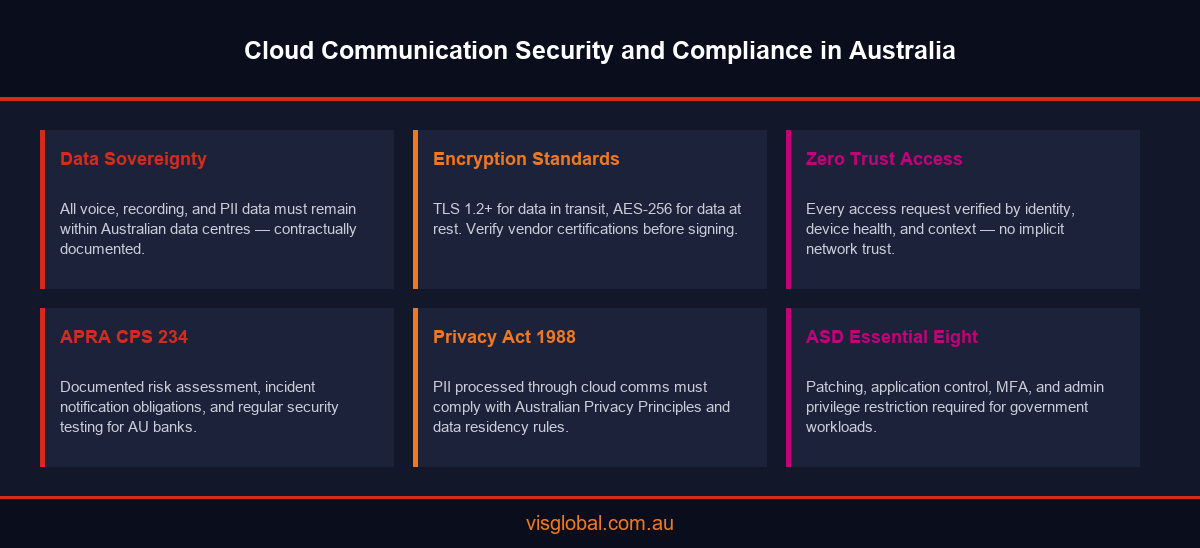
Australian cloud communications must satisfy APRA CPS 234, the Privacy Act 1988, and ASD Essential Eight — requirements that shape platform selection and architecture from day one.
Data sovereignty requires all voice recordings, PII, and communications metadata to remain within Australian data centres under contractually documented arrangements.
Zero trust architecture, end-to-end encryption, and multi-factor authentication are baseline security requirements for enterprise cloud communications in Australia.
Australian Regulatory Frameworks for Cloud Communications
Australian cloud communications deployments sit at the intersection of multiple regulatory frameworks. For financial services organisations, APRA Prudential Standard CPS 234 requires that information security capabilities extend to all third-party providers, including cloud communications platforms. This includes documented risk assessments, incident notification obligations within 72 hours of a material breach, and regular security testing of cloud infrastructure. APRA CPS 231 additionally governs the outsourcing arrangements that underpin cloud communications contracts.
The Privacy Act 1988 and Australian Privacy Principles apply to all organisations handling personal information of Australian residents, regardless of sector. Cloud communications platforms processing call recordings, chat transcripts, or contact details are handling personal information. This requires organisations to implement privacy by design, ensure data is collected only for specified purposes, and guarantee that personal information is not disclosed to offshore jurisdictions without appropriate safeguards.
Data Sovereignty: The Non-Negotiable Requirement
Data sovereignty is the requirement that data generated in Australia remains subject to Australian law. For cloud communications, this means call recordings, voicemail messages, chat transcripts, contact data, and metadata must be stored and processed within Australian data centres, not routed through or stored in jurisdictions subject to conflicting legal obligations. Organisations should verify Australian data residency through contractual commitments, not just marketing claims. The Australian Government Hosting Certification Framework provides a reference standard for evaluating cloud provider data sovereignty claims.
A practical verification checklist: confirm that the cloud provider operates at least two Australian data centres for redundancy, that data replication does not cross international borders, that support personnel accessing customer data are located in Australia, and that the contract explicitly prohibits offshore processing of protected data. These requirements should be embedded in the master services agreement before deployment begins.
Encryption, Access Control, and Zero Trust Architecture
Enterprise cloud communications require encryption at every layer. Data in transit must be protected by TLS 1.2 or higher for all voice, video, and messaging protocols. Data at rest — including call recordings and stored messages — requires AES-256 encryption with customer-managed key options for the most sensitive workloads. Vendors should provide third-party certification of their encryption implementation, not just self-attestation. These controls are foundational to the digital workplace solutions architecture that VIS Global designs for regulated Australian enterprises.
Zero trust architecture eliminates the assumption that any user, device, or network connection is inherently trustworthy. Every access request to cloud communications infrastructure is evaluated based on verified identity, device health assessment, and contextual signals. Multi-factor authentication is mandatory for all administrative access and strongly recommended for all user access. Privileged access management controls limit which personnel can access sensitive configuration settings and data.
ASD Essential Eight for Cloud Communications
The ASD Essential Eight mitigation strategies apply to government agencies and are increasingly adopted as a baseline by regulated private sector organisations. For cloud communications, the most relevant strategies are: application control (only approved communication applications can run on managed devices), patching (cloud platform updates applied within defined timeframes), multi-factor authentication (required for all cloud platform access), and restricting administrative privileges (limiting who can modify communications configuration). VIS Global's managed services team maintains Essential Eight compliance continuously through automated monitoring and documented evidence collection for agency reporting requirements.
Conclusion
Cloud communication security in Australia is defined by a specific set of regulatory requirements, technical controls, and data sovereignty obligations that must be addressed systematically before deployment begins. Organisations that treat security as a design principle rather than a deployment checklist consistently achieve better outcomes and face fewer compliance challenges. Contact VIS Global to discuss how our team can design and maintain a cloud communications security architecture that satisfies your sector's specific regulatory requirements.