Cloud Migration Checklist for Australian Contact Centers
 Digital Transformation
Cloud Migration Checklist for Australian Contact Centers
Moving a contact centre to the cloud is one of the most operationally complex technology transitions an Australian enterprise will undertake. When it goes well, it delivers significant cost reductions, improved agent flexibility, and access to AI-powered capabilities that legacy infrastructure cannot support. When it goes poorly, it causes call quality degradation, compliance gaps, and integration failures that take months to resolve. The difference is almost always preparation. This checklist covers every critical step Australian IT and operations teams must complete before, during, and after contact centre cloud migration. VIS Global's managed services team has guided Australian enterprises through this process across banking, healthcare, and BPO sectors.
Key Takeaways
Network readiness assessment is the most commonly skipped step — and the leading cause of post-migration call quality failures in Australian contact centres.
APRA, Privacy Act, and ASD compliance requirements must be verified before platform selection, not after — retrofitting compliance is costly and time-consuming.
A structured pilot group deployment before full rollout reduces migration risk and improves agent adoption rates significantly.
Pre-Migration: Assessment and Planning
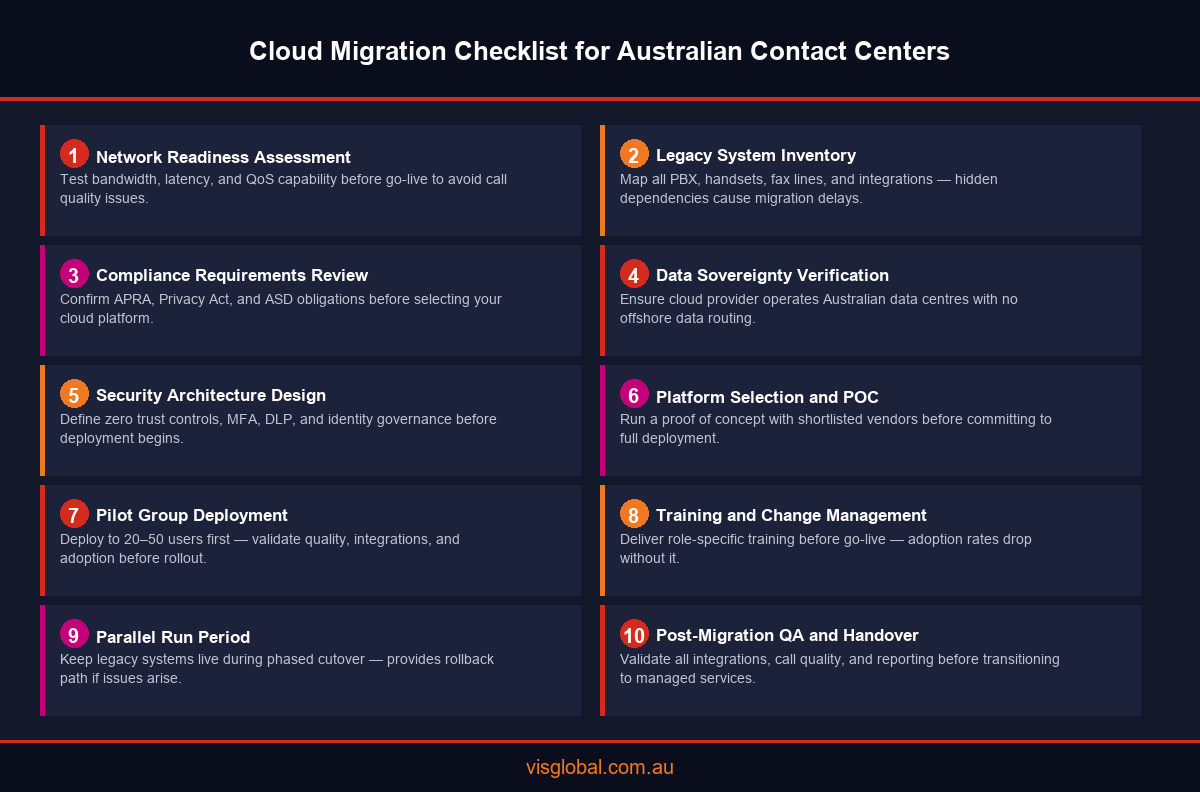
Network readiness is the foundation of a successful contact centre cloud migration. Cloud voice and video require consistent low-latency internet connectivity with Quality of Service (QoS) configuration that prioritises voice traffic over other data. Organisations that skip network assessment and proceed directly to platform deployment frequently encounter degraded call quality that damages customer and agent experience. According to Gartner, network-related issues account for over 60 percent of post-migration contact centre complaints.
Alongside network assessment, the pre-migration phase requires a complete inventory of all communications assets: physical handsets, conference systems, fax lines, contact centre seats, IVR configurations, and integration points with CRM, workforce management, and ticketing systems. This inventory surfaces hidden dependencies that cause delays if discovered mid-migration. Compliance requirements — APRA for financial services, Privacy Act for all sectors, ASD Essential Eight for government — must be mapped to platform capabilities before vendor selection begins.
Platform Selection and Proof of Concept
Platform selection for Australian contact centre cloud migration involves evaluating UCaaS and CCaaS vendors against a defined set of requirements: Australian data residency, compliance certifications, integration capabilities, AI features, and total cost of ownership. Shortlisted vendors should complete a structured proof of concept before contract signing. The POC validates call quality, integration performance, and user experience in conditions representative of the production environment. This process directly informs the customer experience management platform decisions that will shape the contact centre's CX capability for years.
Data sovereignty verification is a mandatory step in platform selection for Australian enterprises. The cloud provider must confirm that all voice, recording, and customer data is processed and stored within Australian data centres, with no routing through offshore jurisdictions. For regulated sectors, this confirmation must be contractually documented, not just verbally assured.
Deployment: Pilot, Rollout, and Cutover
A pilot group deployment of 20 to 50 agents before full rollout is the single most effective risk reduction measure in contact centre cloud migration. The pilot validates call quality under real load, surfaces integration issues, identifies training gaps, and generates adoption insights that inform the full rollout plan. Organisations that skip the pilot phase and proceed directly to full cutover consistently experience higher incident rates and slower adoption. Our case studies document how Australian contact centres have used structured pilot programmes to de-risk large-scale cloud migrations.
During phased rollout, legacy systems should remain live as a parallel run rather than being decommissioned at cutover. The parallel run period provides a rollback path if unexpected issues emerge and gives agents confidence that support is available while they adapt to the new platform. Role-specific training delivered before each cohort's cutover date dramatically improves first-week adoption and reduces the volume of support calls to the IT helpdesk.
Post-Migration: QA, Optimisation, and Managed Services
Post-migration QA validates that all integrations are performing as designed, call quality metrics meet SLA targets, reporting and analytics are delivering accurate data, and compliance controls are functioning correctly. This validation should occur within the first two weeks after each cohort's cutover, while the migration team is still engaged and issues can be resolved quickly. Transition to long-term managed services support follows successful QA sign-off, ensuring that platform performance is maintained, security patches are applied, and new capabilities are deployed as the platform evolves.
Conclusion
A structured approach to contact centre cloud migration, grounded in thorough assessment, rigorous compliance verification, and phased deployment, transforms a high-risk transition into a predictable programme with clear milestones and measurable outcomes. The organisations that achieve the best results are those that invest in preparation rather than rushing to go-live. For a comprehensive step-by-step walkthrough of the full transition process, read our guide on migrating from on-premise to cloud contact center. Contact VIS Global to begin your contact centre migration assessment with our Australian specialist team.