Customer Experience Platforms in Australia: The Complete Enterprise Guide (2026)
 Digital Transformation
Customer Experience Platforms in Australia: The Complete Enterprise Guide (2026)
Customer experience platforms in Australia are no longer optional infrastructure. They are the operating systems of modern enterprise relationships, combining AI, data intelligence, journey orchestration, and omnichannel engagement into a single capability layer. Yet most Australian organisations are still running on fragmented CRM systems and isolated point solutions that cannot meet what customers now demand. This guide covers everything enterprise leaders need to know about customer experience platforms in Australia — from the five forces driving transformation to practical roadmaps for implementation across banking, healthcare, government, and telecommunications.
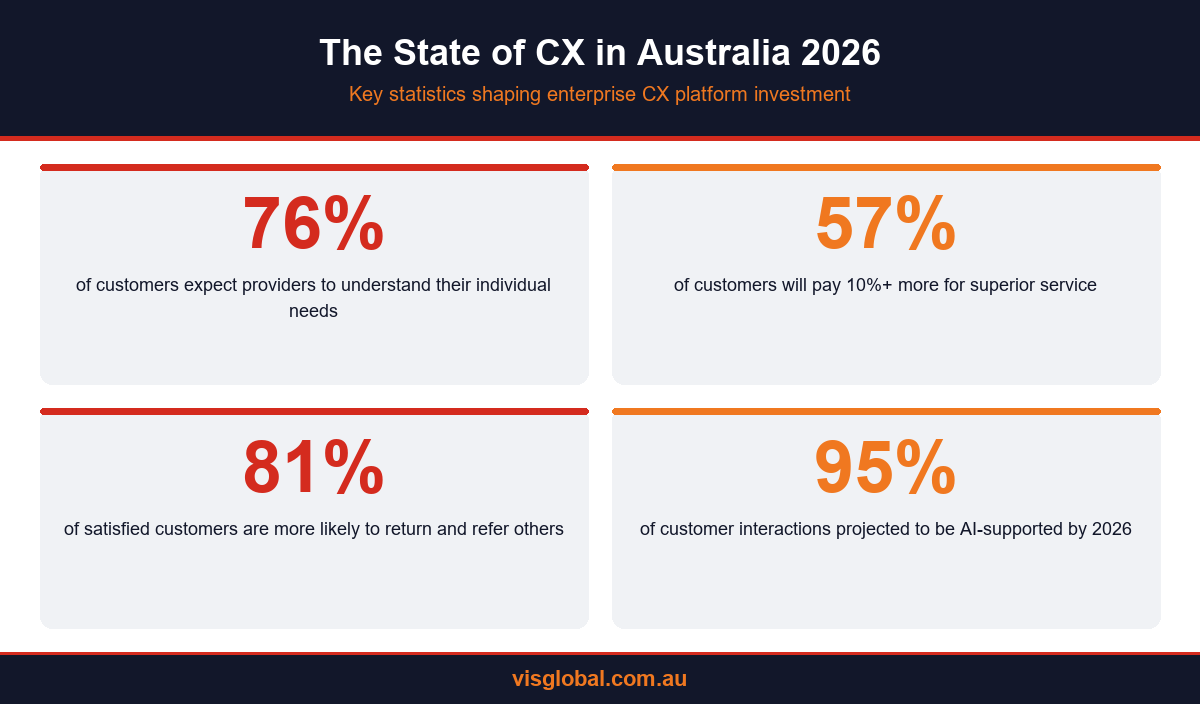
The competitive stakes are real and growing. Research from Salesforce shows that 76% of customers now expect providers to understand their individual needs, and 95% of all customer interactions are projected to be AI-supported by 2026. For Australian enterprise leaders, the question is no longer whether to invest in CX platform transformation. It is how to do so strategically, with the right architecture, governance, and organisational capability to make that investment deliver measurable and durable returns.
VIS Global's AI-powered customer experience management platform is built for exactly this shift — helping Australian enterprises unify CRM, journey orchestration, and omnichannel engagement into a single AI-driven layer, rather than bolting AI onto fragmented legacy systems. Our platform is deployed across banking, healthcare, government, and telecommunications organisations throughout Australia.
Key Takeaways
76% of Australian customers expect providers to understand their individual needs, making AI-powered personalisation a business imperative rather than a differentiator.
Modern CX platforms integrate AI, real-time data, journey orchestration, and omnichannel engagement into a single architecture that legacy CRM systems cannot replicate.
Australian enterprises face a clear strategic window to build the data foundations, governance frameworks, and human-AI collaboration models required to lead in customer experience.
Privacy Act compliance, first-party data strategy, and ethical AI governance are not afterthoughts — they are foundational architectural requirements for CX platform success in Australia.
What Is a Customer Experience Platform and Why ANZ Enterprises Are Rethinking Them
Customer experience platforms have evolved dramatically from their origins as contact management systems and CRM databases. Today's leading platforms are intelligent ecosystems that integrate data, artificial intelligence, automation, and human engagement into a coherent architecture capable of orchestrating the entire customer lifecycle. This evolution did not happen overnight. It is the result of a decade of accelerating digital adoption, shifting consumer expectations, and the rapid maturation of AI technologies that are now capable of powering real-time, highly personalised engagement at enterprise scale.
The shift is fundamental. A modern CX platform is not a system of record for customer information. It is a system of engagement that combines real-time data intelligence, AI-powered interaction, journey orchestration, and multi-channel delivery into a unified capability layer. It tracks not just what customers have done, but anticipates what they need next. For a deeper understanding of how AI drives this evolution, see VIS Global's guide to AI contact center solutions in Australia.
For Australian enterprises, this redefinition has urgent commercial implications. Research shows that 76% of customers now expect providers to understand their individual needs. A further 81% of satisfied customers are more likely to return and refer others, and 57% are willing to pay a premium of 10% or more for genuinely superior service. These are not aspirational statistics. They are the baseline expectation of the Australian market in 2026. Organisations that fail to meet this standard are not simply underperforming — they are actively ceding market share to competitors who can.
Key Platform Categories
The modern CX technology landscape comprises four interconnected platform types. Customer Experience Platforms (CXPs) are comprehensive suites integrating CRM, marketing automation, service management, and analytics, exemplified by Salesforce Customer 360, Adobe Experience Cloud, and Microsoft Dynamics 365. Customer Data Platforms (CDPs) provide unified data layers that ingest and activate customer information from all sources in real time, enabling consistent identity and personalisation at scale. AI-Driven Engagement Platforms apply machine learning, natural language processing, and generative AI to personalise and optimise interactions across every channel. Journey Orchestration Systems model and manage complete customer journeys, detecting intent signals, predicting next-best actions, and coordinating responses across channels in real time.
These platform categories are not mutually exclusive. The most effective CX architectures in the Australian market combine capabilities across all four, often through a composable, API-first approach that enables organisations to select best-in-class components rather than accepting the limitations of any single monolithic suite. This architectural flexibility is increasingly important as AI capabilities evolve rapidly and organisations need the ability to adopt new technologies without rebuilding their entire CX infrastructure.
Why Legacy Systems Are No Longer Sufficient
Legacy CRM systems were built for a different era. They are repositories of records, not engines of engagement. They cannot ingest streaming data, cannot orchestrate real-time journeys, and cannot power the AI-driven personalisation that Australian customers now expect as a baseline. The core problem is architectural: legacy platforms store what happened, while modern CX platforms act on what is happening right now. This gap creates measurable business consequences — slower resolution times, repeated context loss across channels, inability to detect and respond to churn signals, and the failure to deliver the personalised experiences that drive loyalty and lifetime value.
Many Australian organisations — particularly in financial services, government, and telecommunications — also carry substantial technical debt in the form of fragmented CRM, billing, and service management systems that are difficult and expensive to integrate with modern CX platforms. Addressing this legacy is not merely a technology project. It requires sustained executive commitment, careful change management, and a clear prioritisation framework that sequences modernisation in a way that delivers early commercial value while building toward the target architecture.
The 5 Forces Reshaping CX Platforms in Australia
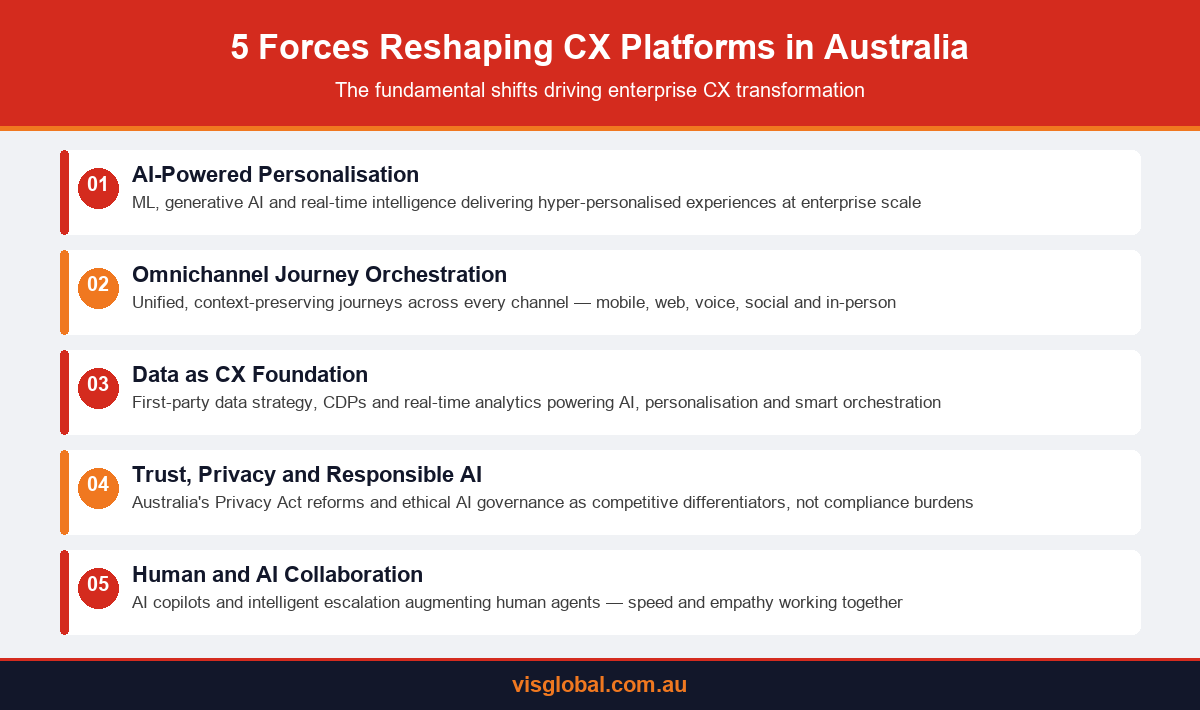
The transformation of customer experience platforms is being driven by five forces that are reshaping the entire architecture of customer engagement in Australia. These are not incremental improvements. They represent a fundamental shift in what a CX platform must be capable of delivering. For a full overview of how omnichannel capabilities fit within this framework, see VIS Global's guide to omnichannel customer experience management.
The first force is artificial intelligence. AI has moved from a back-office efficiency tool to the primary engine of customer engagement, enabling personalisation at a scale and precision that was previously unachievable. Generative AI, predictive analytics, and real-time recommendation engines are enabling enterprises to deliver hyper-personalised experiences with a consistency and speed no human workforce could maintain alone. The second force is the rise of omnichannel orchestration, which has evolved beyond simple channel presence into a discipline of unified journey management across every touchpoint — ensuring customers experience seamless continuity whether they engage via mobile, web, voice, or in-person.
The third force is the strategic importance of data, particularly first-party data, as the deprecation of third-party cookies and tightening privacy regulations accelerate the need for organisations to own and govern their customer intelligence directly. The fourth force is trust and privacy regulation, with Australia's Privacy Act reforms and New Zealand's Privacy Act 2020 creating significant new obligations for CX platform operators around consent management, data minimisation, and AI transparency. These regulatory changes are not headwinds to be managed — they are an opportunity for organisations that embrace privacy-first practices to build genuine competitive differentiation.
The fifth force is human and AI collaboration. The most valuable CX outcomes do not come from replacing human agents with automation. They come from intelligent augmentation — AI copilot systems that surface the right knowledge at the right moment, intelligent escalation that preserves full context when moving from automated to human service, and workflow tools that free agents to apply empathy, creativity, and judgment to the interactions where human connection matters most. Together, these five forces are creating a market in which organisations with modern, AI-native CX architectures will systematically outperform those running on legacy systems.
AI-Powered Personalisation: From Experimentation to Core CX Infrastructure
Artificial intelligence is no longer an experimental investment in Australian enterprise CX. It is the primary engine of customer engagement, enabling personalisation at a scale and precision that legacy platforms cannot match. For Australian organisations in banking, healthcare, government, and telecommunications, AI is rapidly becoming the core infrastructure through which every customer interaction is delivered, personalised, and continuously optimised. The transition from AI as an add-on to AI as a platform-native capability is the defining architectural shift of this era.
Recommendation Engines and Real-Time Intelligence
Modern CX platforms use machine learning to analyse behavioural signals, purchase history, and contextual data in real time, delivering product recommendations, content personalisation, and next-best-action guidance at the precise moment of customer intent. The shift from batch analytics to real-time intelligence is critical. Event-driven architectures and streaming data pipelines allow platforms to detect a behavioural signal — an abandoned transaction, a service complaint, or a sudden increase in usage — and trigger a personalised response within milliseconds. VIS Global's intelligent automation solutions are designed to integrate with these real-time data architectures, ensuring AI-powered CX capabilities are grounded in accurate, governed data. For Australian retailers, banks, and telcos, this capability translates directly into measurable improvements in conversion rates, customer retention, and lifetime value.
Generative AI and Conversational Engagement
Generative AI is creating an entirely new paradigm for customer interaction. Large language models integrated into customer service platforms enable sophisticated, contextually aware conversations that can resolve complex queries without human intervention. These systems are now capable of tone-matching, empathy modelling, and multi-turn reasoning, bringing AI-driven service quality closer to expert human engagement. Organisations deploying generative AI in customer service are reporting resolution rate improvements of 25 to 40 percent and average handling time reductions of up to 30 percent, while simultaneously improving customer satisfaction scores. Importantly, generative AI is not limited to text-based interactions. Voice-enabled AI agents are increasingly handling complex, multi-step service conversations across phone channels — a critical capability for Australian enterprises whose customers still prefer voice for high-stakes service interactions.
The most effective deployments combine generative AI with robust knowledge management systems, ensuring that AI-generated responses are grounded in accurate, up-to-date information rather than hallucinated outputs. Australian organisations investing in conversational AI must establish clear quality assurance frameworks, including human review of AI response quality, escalation threshold monitoring, and regular model retraining to maintain accuracy as product and service information evolves.
Trust as the Condition for AI Adoption
ANZ consumers exhibit conditional acceptance of AI in service contexts. They engage willingly with AI-powered interactions when these deliver genuine speed and convenience, and when the organisation is transparent about its AI practices. Trust is fragile. Negative AI experiences, particularly those involving perceived unfairness or loss of privacy, trigger rapid disengagement and brand switching. Research consistently shows that AI transparency — clearly communicating when a customer is interacting with an AI system and providing a straightforward path to human assistance — is a non-negotiable requirement for sustained AI adoption in the Australian market. Organisations must invest in explainable AI, bias detection, and clear communication about how AI is used in customer interactions as foundational platform capabilities, not afterthoughts.
Omnichannel Orchestration: Delivering Seamless Journeys Across Every Channel
Omnichannel has matured from an aspiration of channel consistency into a sophisticated discipline of journey orchestration. Modern customers expect journey continuity — the ability to begin an interaction in one channel and resume it seamlessly in another, without repetition or loss of context. Organisations that cannot deliver this are increasingly displaced by digital-native competitors that have built it as a foundational capability. The challenge for Australian enterprises is not merely to be present across multiple channels, but to deliver a unified, contextually intelligent experience across all of them simultaneously.
Unified Journey Management
Leading CX platforms now provide journey orchestration engines that model the ideal customer path, detect deviations in real time, and dynamically intervene to guide customers toward resolution or conversion. These systems maintain a persistent, unified view of each customer's history, preferences, and current state. A banking customer can begin a mortgage application on mobile, continue on desktop, and complete the conversation with a branch adviser — each transition seamless and fully contextualised. In healthcare, a patient can schedule an appointment via app, receive preparation reminders via SMS, and consult via video within a single integrated care journey. Australian organisations investing in unified channel architectures consistently demonstrate superior customer loyalty metrics and measurably lower rates of channel-switching frustration.
Journey orchestration also enables proactive intervention. Rather than waiting for customers to signal dissatisfaction, modern CX platforms can identify at-risk journeys in real time — detecting patterns that historically precede churn, abandonment, or complaint escalation — and trigger personalised interventions that resolve issues before they damage the relationship. This shift from reactive to proactive CX management is one of the most commercially significant capabilities available to Australian enterprises investing in modern platform architectures.
Conversational Commerce and Channel Integration
The emergence of conversational commerce — transactional capability embedded within messaging, social, and voice channels — is creating significant new engagement opportunities for Australian organisations. Platforms integrating transactional functionality into WhatsApp, Apple Messages for Business, and AI voice assistants are enabling customers to complete purchases, manage accounts, and resolve service issues entirely within their preferred communication environment. This is not a niche capability. Australia has one of the highest rates of social media and messaging app engagement globally, and conversational commerce adoption is accelerating across banking and financial services, telecommunications, and healthcare sectors. Organisations that integrate transactional capability into these channels create a significant competitive advantage by meeting customers where they already spend their time.
Physical and digital channel integration is also accelerating. The boundaries between digital and in-person customer experiences are dissolving across retail banking, healthcare, and government services. Customers who begin a complex service journey digitally increasingly expect to transition seamlessly to an in-person or phone interaction with an adviser who is fully briefed on their history and context — with no repetition required. Achieving this requires not just technology investment but a fundamental rethinking of how customer data flows between digital systems and human-facing service channels.
Data, Privacy, and Trust: The Foundations of Ethical CX in Australia
Every dimension of CX platform sophistication is fundamentally dependent on data. The organisations that will lead in customer experience are those that invest in the data foundations required to power AI, personalisation, and intelligent orchestration — and that build trust through ethical, privacy-first data practices. Australia's ongoing Privacy Act reform, including proposed changes to strengthen individual rights, clarify consent requirements, and expand the definition of personal information, is creating significant obligations for CX platform operators. These are not compliance burdens to be managed after deployment. They must be architectural principles embedded in data models, consent frameworks, and AI governance from day one.
The stakes are measurable. Research shows that 96% of ANZ consumers consider data protection a fundamental right, and 73% would stop using a brand after a data breach. Trust is both the most valuable asset in the customer relationship and the most fragile. Poorly designed AI interactions, opaque automated decisions, and failure to deliver on personalisation promises all erode the trust capital that organisations have built over years. Organisations that proactively communicate their AI practices, offer meaningful consent choices, and provide clear mechanisms for customers to query or restrict their data use will build the trust capital essential for sustainable CX leadership in Australia.
First-Party Data Strategy and CDPs
The deprecation of third-party cookies and increasing regulatory restrictions on data sharing have accelerated the strategic importance of first-party data — information collected directly from customers through owned interactions and channels. Organisations with robust first-party data strategies enjoy significant competitive advantages in personalisation accuracy, AI model performance, and regulatory compliance posture. Customer Data Platforms have become the critical infrastructure layer for responsible CX. By ingesting data from CRM, behavioural analytics, transactional systems, and offline channels into a unified, identity-resolved customer profile, CDPs enable the real-time, cross-channel personalisation that modern CX demands. Adoption of CDP technology among ANZ enterprise organisations has increased substantially in recent years, driven by the need to unify fragmented data estates and meet the real-time processing demands of AI-powered engagement.
AI Governance and Ethical Deployment
The deployment of AI in customer-facing systems introduces meaningful risks. Algorithmic bias can lead to discriminatory outcomes in credit, insurance, and service prioritisation. Generative AI can produce incorrect information with damaging consequences. Opaque AI decision-making can undermine customer trust and expose organisations to regulatory scrutiny. Australian organisations must establish AI governance frameworks that include model validation, bias testing, explainability requirements, and human oversight protocols. These frameworks should be treated as living documents — regularly updated as AI capabilities evolve, as new use cases are deployed, and as the regulatory environment continues to develop. Privacy compliance and AI governance are not separate workstreams. They are two dimensions of the same foundational commitment to earning and protecting customer trust.
Industry-Specific CX Platform Priorities for Australian Enterprises
CX platform transformation is playing out differently across Australian industry verticals, with distinct drivers, maturity levels, and priority investment areas in each sector. Understanding these industry-specific dynamics is essential for building a platform strategy that delivers measurable outcomes in your market context. A platform architecture that is optimal for a major bank will look significantly different from one designed for a healthcare provider or a government agency — even though the underlying technology capabilities draw from the same category of platforms.
In banking and financial services, Australian organisations face the dual challenge of meeting rising digital expectations while navigating stringent regulatory requirements around data use and AI decision-making. The most progressive institutions are deploying CDP architectures that unify retail and business banking data, AI-powered financial wellness tools that provide proactive and personalised financial guidance, and intelligent complaint management systems that detect and resolve customer dissatisfaction before it escalates to formal disputes. AI-powered fraud detection integrated into the CX layer is also emerging as a critical capability, enabling organisations to protect customers in real time without introducing friction into legitimate transactions.
In telecommunications, Australian organisations operate in highly competitive, churn-sensitive environments where CX quality is a primary differentiator. Network outages, billing disputes, and device upgrade journeys are high-stakes CX moments that directly influence retention. AI-powered churn prediction models that identify at-risk customers weeks in advance, proactive outage communications that set accurate expectations before complaints arise, and intelligent self-service platforms that resolve common issues without agent involvement are delivering measurable retention improvements for telcos that have invested in modern CX platform architectures.
In healthcare, digital transformation has accelerated substantially across Australia, with patient experience platforms emerging as a critical strategic investment. Telehealth integration, AI-assisted triage, patient journey orchestration, and care coordination platforms are fundamentally reshaping the patient experience. The patient journey has become increasingly complex, spanning multiple providers, care settings, and communication channels. CX platforms that can orchestrate this journey — maintaining continuity of information and context across GP referrals, specialist consultations, diagnostic appointments, and follow-up care — deliver measurable improvements in both patient outcomes and provider efficiency.
Government services in Australia are investing in CX transformation at pace, driven by citizen expectations shaped by private sector digital experiences and policy commitments to digital service delivery. Intelligent virtual agents, unified citizen identity platforms, and cross-agency journey orchestration represent the leading edge of public sector CX investment. For organisations serving BPO markets, the ability to deploy AI-powered CX capabilities that can be rapidly configured for multiple client verticals — with consistent quality, governance, and compliance standards across all — is a meaningful source of competitive advantage in an increasingly commoditised market.
The Future of CX Platforms: What Australian Leaders Need to Plan for Now
The next generation of CX platform capabilities is already moving from theoretical to practical application. Australian enterprise leaders who begin planning for these developments now will be better positioned to adopt them rapidly as they mature, building competitive advantages that compound over time. The organisations that will lead in customer experience over the next decade are not those with the largest technology budgets — they are those that build the data foundations, governance disciplines, and human-AI collaboration models required to deploy these capabilities responsibly and at scale.
Autonomous AI Agents
Autonomous AI agents represent the most significant near-term capability shift. These are systems capable of pursuing multi-step customer service goals independently, across multiple systems and channels, without continuous human supervision. Early deployments in financial services and e-commerce demonstrate that agentic AI systems can handle complex, multi-turn service interactions — including account management, complaint resolution, and personalised advisory — with minimal human oversight. For Australian enterprises, this represents a meaningful evolution in the scale and scope of service automation. Unlike earlier chatbot deployments, which handled only narrow, scripted interactions, agentic AI can reason across systems, retrieve real-time information, take actions on behalf of customers, and adapt its approach based on the evolving context of the interaction.
Emotion-Aware and Predictive Experiences
Emotion-aware CX platforms are emerging as a meaningful capability for organisations where the quality of human connection is a competitive differentiator. Advances in sentiment analysis, voice pattern recognition, and multimodal AI are enabling platforms to detect customer emotional states in real time and adapt engagement approaches accordingly — escalating to a human agent when frustration is detected, softening conversational tone in sensitive service contexts, or providing additional reassurance during high-anxiety interactions such as insurance claims or medical consultations. Predictive journey management will move CX platforms from reactive to anticipatory. By combining historical journey data, real-time behavioural signals, and external context, predictive journey systems will enable organisations to deliver hyper-relevant interventions at precisely the right moment — before the customer need is expressed rather than in response to it.
Customer Digital Twins and Composable Architecture
The concept of customer digital twins — AI-maintained models of individual customer preferences, behaviours, and predicted future states — is moving toward practical deployment. CX platforms built around digital twin architectures can simulate the likely response of specific customers to proposed interventions, enabling unprecedented precision in journey design, communication timing, and offer personalisation. Simultaneously, the monolithic CX suite is giving way to composable architectures in which organisations assemble best-in-class capabilities from modular, API-connected components. This architectural shift enables organisations to adopt new AI capabilities as they emerge without rebuilding their entire platform. For a deeper view of how cloud infrastructure supports these composable architectures, see VIS Global's guide to cloud migration for enterprise communications. The digital workplace capabilities that underpin these architectures are explored further in VIS Global's guide to digital workplace transformation in Australia.
Building Your CX Platform Strategy: A Practical Roadmap for ANZ Organisations
Translating CX platform ambition into actionable strategy requires a structured approach that aligns technology investment with business outcomes, organisational capability, and the pace of change an organisation can sustain. ROI from CX platform transformation accrues progressively over an 18 to 24 month investment horizon as data quality improves, AI models mature, and organisational capability develops. Organisations should plan accordingly — committing to a multi-year roadmap rather than expecting immediate returns, and measuring progress against both leading indicators such as customer satisfaction and digital adoption rates and lagging business outcomes such as revenue retention, cost to serve, and NPS improvement.
Short-Term Actions: Months 0 to 12
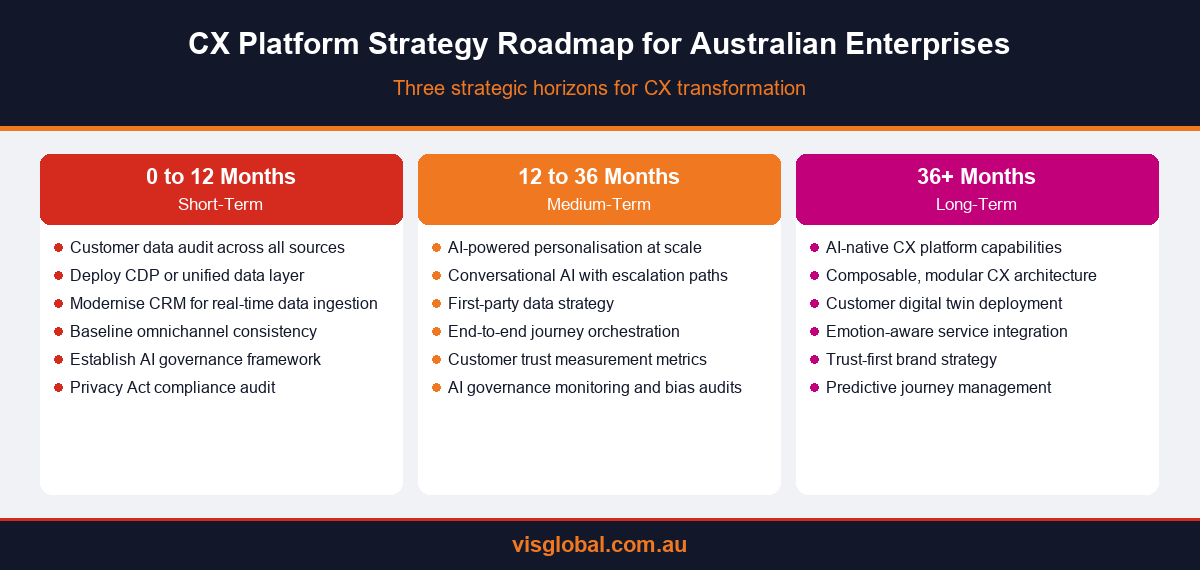
The priority in the first 12 months is to build the data and governance foundations on which all subsequent CX capabilities will depend. Conduct a comprehensive customer data audit identifying all sources, assess data quality, and map integration gaps across CRM, e-commerce, service ticketing, marketing automation, and offline channels. Unify customer identity across channels through a CDP or unified data layer initiative — this is the single highest-leverage investment available in this phase. Modernise CRM infrastructure to support real-time data ingestion and AI-ready data models. Implement baseline omnichannel consistency to ensure context is preserved across your top three customer-facing channels. Establish an AI governance framework that includes ethics principles, bias testing protocols, and model oversight procedures. Complete a privacy compliance audit against Australia's Privacy Act reform requirements and ensure consent management infrastructure is in place.
Medium-Term Investments: Months 12 to 36
With data foundations in place, the medium-term focus shifts to deploying AI-powered personalisation capabilities across digital channels, starting with recommendation engines and next-best-action systems. Implement conversational AI in customer service with deliberate escalation paths and human copilot assistance for agents — ensuring that AI augments rather than replaces human service capability. Build a first-party data strategy that creates genuine value exchange with customers in return for voluntary data sharing. Extend journey orchestration to cover the complete customer lifecycle from acquisition through to retention and win-back. Establish customer trust measurement metrics including privacy confidence, AI transparency scores, and ethical brand perception indicators. Strengthen AI governance with model monitoring, incident response procedures, and regular bias audits as AI deployment scales.
Long-Term Platform Vision: 36 Months and Beyond
The long-term investment horizon focuses on AI-native platform capabilities that deliver autonomous optimisation of journey design and communication, transitioning toward composable architectures assembled from best-in-class modular components, and deploying customer digital twin capabilities for predictive journey management at the individual level. Organisations should invest in emotion-aware service capabilities, integrating sentiment detection into both automated and human-assisted interactions. Building AI literacy and CX design capability within the organisation is equally important — the technology is only as powerful as the human capability that surrounds it. VIS Global's team supports Australian enterprises at every stage of this transformation journey, from initial strategy and architecture design through to implementation and long-term managed services. Explore our customer experience case studies to see how enterprise organisations in Australia have achieved measurable outcomes through strategic CX platform investment.
Conclusion
Customer experience platforms in Australia are at an inflection point. The organisations that invest in unified data foundations, AI-powered engagement, ethical governance frameworks, and human-centred design now will emerge with durable competitive advantages that compound over the decade ahead. The technology is available. The market imperative is clear. The competitive landscape will shift decisively in the next 36 months, and organisations that begin this transformation journey with clarity of purpose, strategic data investment, and a genuine commitment to customer trust will separate themselves from those that continue to operate on fragmented, legacy infrastructure. VIS Global partners with Australian enterprises across banking, healthcare, government, and telecommunications to build and implement CX platform strategies that deliver measurable, sustainable outcomes. With AI embedded at the core of every solution and more than 1,000 clients served globally, VIS Global brings the expertise, technology partnerships, and implementation capability required to accelerate your CX transformation. Contact our team today to begin.