CX Transformation for Government in Australia: A Complete 2026 Guide
 Digital Transformation
Australian citizens now expect government digital services to match the speed, simplicity, and responsiveness they experience from the best private sector organisations. The gap between what citizens expect and what many agencies deliver has never been more visible, and the consequences are significant. Research shows that 68 percent of Australians say a poor government service experience directly damages their trust in that agency. For government leaders, CX transformation is no longer a technology aspiration. It is a service delivery imperative. This guide examines the landscape, the challenges, the proven benefits, and the practical steps Australian agencies need to take to transform citizen experience in 2026.
Key Takeaways
· 72 percent of Australians expect government digital services to be available at any time, on any device, and 80 percent of routine enquiries could be resolved through self-service automation alone.
· CX transformation in government delivers measurable gains across three dimensions: operational cost reduction of up to 70 percent, always-on citizen satisfaction, and a more empowered public sector workforce.
· A phased, four-step evaluation framework helps agencies sequence automation investments from quick wins to enterprise-wide transformation, managing risk while delivering early return on investment.
The Citizen Experience Imperative: Why Government Must Act Now
Australia's public sector is facing a structural inflection point. The traditional model of service delivery, fragmented across agencies and dependent on paper-based workflows, is no longer adequate for a population that navigates digital services every day. Federal, state, and local government agencies are now expected to deliver services that are proactive, accessible across all channels, and genuinely citizen-centric. The Australian Government's Digital Government Strategy has set 2030 as the target for all government services to be digitally available end-to-end, but the pace of citizen expectation is outrunning the pace of agency transformation.
The data underscores the urgency. Seventy-two percent of Australians expect government services to be available digitally at any time, on any device. Sixty-one percent would switch to a digital channel if it offered faster resolution. When an agency delivers a poor service experience, 68 percent of Australians say it negatively affects their trust in that agency. In a democratic system where public trust is foundational, eroding it through slow, inconsistent, or inaccessible service carries significant reputational and political risk.
The private sector has raised the bar significantly. Banking customers receive instant loan decisions. Retail shoppers track parcels in real time. Healthcare patients book appointments through smartphone apps without speaking to anyone. When citizens interact with government after these experiences, the contrast in service quality is often stark. Agencies that fail to close this gap risk not just poor satisfaction scores but a deeper erosion of the social contract between government and the communities they serve. CX transformation is the mechanism through which agencies can close that gap systematically, at scale, and sustainably.
Shifting Citizen Expectations in the Post-Pandemic Era
The pandemic accelerated digital adoption across every demographic. Citizens who previously relied on in-person services or phone calls discovered the convenience of digital alternatives, and their expectations reset accordingly. Younger citizens, those in regional and remote areas, and individuals from culturally and linguistically diverse backgrounds now rely on digital and automated channels as their primary means of engaging with government. Any agency that cannot serve these cohorts efficiently and digitally is delivering an inferior service to some of its most vulnerable citizen groups.
Australia's Digital Government Landscape: From Pilots to Enterprise Transformation
Australia has made meaningful progress on digital government. The Digital Transformation Agency has established a national vision for government services that are simple, clear, and fast. Yet for many agencies, legacy systems, siloed data repositories, and complex regulatory environments continue to inhibit the pace of change. The gap between ambition and delivery is real, and closing it requires a structured approach to automation deployed across three complementary layers.
Robotic Process Automation: The Efficiency Foundation
Robotic Process Automation handles high-volume, rule-based back-office tasks across government systems. Benefit payments, licence renewals, data transfers between agency platforms, and compliance document generation are all strong candidates for RPA. In the government contact centre, RPA automates post-call CRM updates, complaint logging, and report generation, reducing average handle time and freeing agents for more complex citizen interactions. Organisations deploying RPA for back-office processes achieve 40 to 70 percent reductions in manual processing time within the first six months of deployment.
Intelligent Automation: Handling Complexity at Scale
Where RPA excels at predictable, structured tasks, intelligent automation extends those capabilities with AI, natural language processing, and machine learning. This combination enables agencies to automate complex, judgement-based workflows involving unstructured data such as citizen correspondence, scanned documents, and multi-channel interaction histories. As automation matures across Australian government, agencies are moving from isolated pilots to enterprise-wide transformation programs, with citizen experience at the core of the value proposition.
Government-Specific Challenges Limiting CX Progress
Government agencies face structural challenges that are distinct from those encountered by private sector organisations. Understanding these constraints is essential for designing automation strategies that are realistic, compliant, and sustainable over the long term.
Legacy infrastructure: Many Australian agencies operate on systems designed before cloud computing was viable. Integrating modern automation platforms with legacy infrastructure requires careful architecture planning and phased migration strategies that manage service continuity risk throughout the transition.
Compliance and data sovereignty: Australian privacy law and data sovereignty obligations impose strict constraints on where citizen data can be stored and processed. Any automation solution must comply with the Privacy Act 1988 and relevant state-based legislation, requiring legal review as part of the procurement process.
Multi-agency service complexity: Many citizen service journeys cross agency boundaries. Automating these end-to-end journeys requires inter-agency data sharing agreements and coordinated process design across organisational boundaries that can be time-consuming to negotiate and implement.
Contact centre performance gaps: Long wait times, poor first-contact resolution rates, and inconsistent service quality are persistent challenges across government contact centres. These are precisely the areas where automation delivers the most visible and measurable improvement in citizen satisfaction.
Budget and workforce constraints: Government agencies typically operate under tighter budget cycles and procurement frameworks than private sector organisations. Automation investment cases must demonstrate clear, quantified returns within defined timeframes to secure executive and ministerial approval.
Digital literacy and change management: Workforce skill gaps in automation, data analytics, and digital service design create resistance to change that can slow or derail transformation programs. Effective CX transformation requires investment in staff training and change management alongside the technology deployment itself.
Despite these challenges, agencies that have progressed furthest in CX transformation treat each constraint not as a reason to delay, but as a design requirement that shapes how automation is deployed. This reframing is a defining characteristic of transformation programs that achieve lasting outcomes.
Three Measurable Benefits of CX Transformation for Government
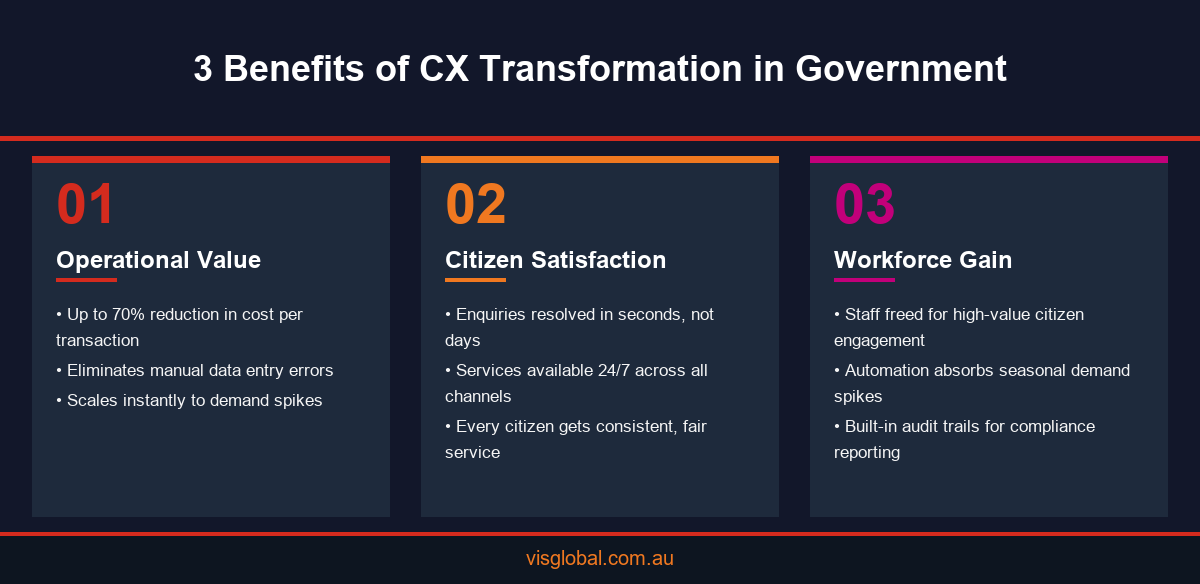
When government agencies implement CX transformation effectively, the benefits are demonstrable across three distinct dimensions. These reflect outcomes achieved by agencies that have committed to automation as a strategic capability rather than a tactical experiment.
1. Operational Value
Automating high-volume transactional processes including benefit payment processing, licence renewals, and permit applications can reduce the cost per transaction by up to 70 percent compared to manual processing. Beyond cost reduction, automation eliminates manual data entry errors, ensuring accurate records across agency systems and reducing downstream compliance risk. When demand spikes during tax lodgement periods, disaster recovery responses, or public health events, intelligent automation scales instantly without requiring additional headcount or temporary staffing arrangements.
2. Citizen Satisfaction
AI-powered contact centre solutions allow citizens to access services 24 hours a day, seven days a week, across voice, web, and mobile channels, without being placed on hold or constrained by business hours. Automated workflows resolve routine enquiries in seconds rather than days, producing immediate improvements in citizen satisfaction scores and complaint volumes. Automation also introduces consistency and fairness: every citizen receives the same standard of service, eliminating variability caused by differences in agent experience levels, workload pressure, or personal interpretation of policy.
3. Public Sector Workforce Gain
By removing repetitive, low-value tasks from frontline staff workflows, CX transformation increases job satisfaction and allows employees to engage in complex casework, policy advisory work, and high-value citizen engagement that requires human judgement. Automated audit trails provide agencies with real-time visibility into service delivery, supporting regulatory reporting and accountability frameworks under the Australian Public Service Act.
Six Multimodal Capabilities Reshaping Citizen Engagement
Effective CX transformation in government requires more than automating back-office processes. It requires rethinking how agencies engage citizens across every channel and lifecycle stage. The most advanced agencies are deploying a suite of integrated multimodal capabilities that work together to deliver seamless, responsive, and accessible service experiences.
Virtual Agents with Intelligent Live Handoff
AI-powered virtual agents now serve as the front door of government contact centres. Citizens receive instant, accurate responses to common enquiries across digital and voice channels, with seamless handoff to a live officer when complexity demands human judgement. When a handover occurs, the live agent receives a full context summary from the virtual agent interaction. Citizens do not need to repeat themselves, average handle time is reduced, and officer effort is directed toward enquiries that genuinely require human expertise and empathy.
Visual Self-Service, Intelligent Routing, and Digital Messaging
Traditional IVR menus frustrate citizens with long lists of options. Visual IVR surfaces these choices on any smartphone or web browser, allowing citizens to navigate services and select their pathway without being placed on hold. Intelligent Call Routing integrates with CRM platforms and citizen identity systems to route contacts to the most appropriate officer based on prior interactions, case history, and language preference. Together these capabilities enable omnichannel citizen engagement across voice, web, mobile, and messaging channels, delivering consistent service quality regardless of how a citizen chooses to interact.
Digital messaging automation via SMS allows agencies to deliver outbound notifications for appointment reminders, application status updates, and payment confirmations at scale. Two-way SMS enables citizens to confirm, reschedule, or query without speaking to an officer, freeing contact centre capacity for interactions that require human resolution.
Voice Biometrics and Cloud Scalability
Voice biometrics enables government contact centres to verify citizen identity passively during the natural flow of conversation, without requiring PIN entry or security question responses. This reduces verification time, improves accessibility for citizens who struggle with traditional authentication, and strengthens fraud prevention. For agencies handling sensitive services such as welfare, health, or taxation, identity assurance is paramount, and voice biometrics delivers it without adding friction to the citizen experience.
Cloud and virtualisation infrastructure underpins the scalability all these capabilities require. Legacy on-premise infrastructure limits agencies to fixed capacity and slow update cycles. Cloud-based managed services allow agencies to scale capacity rapidly, deploy updates without service disruption, and integrate new channels as citizen needs evolve. Virtualisation also supports hybrid workforce models, enabling officers to work remotely while maintaining full access to automation tools and citizen data.
A Four-Step Framework for Evaluating CX Automation Opportunities
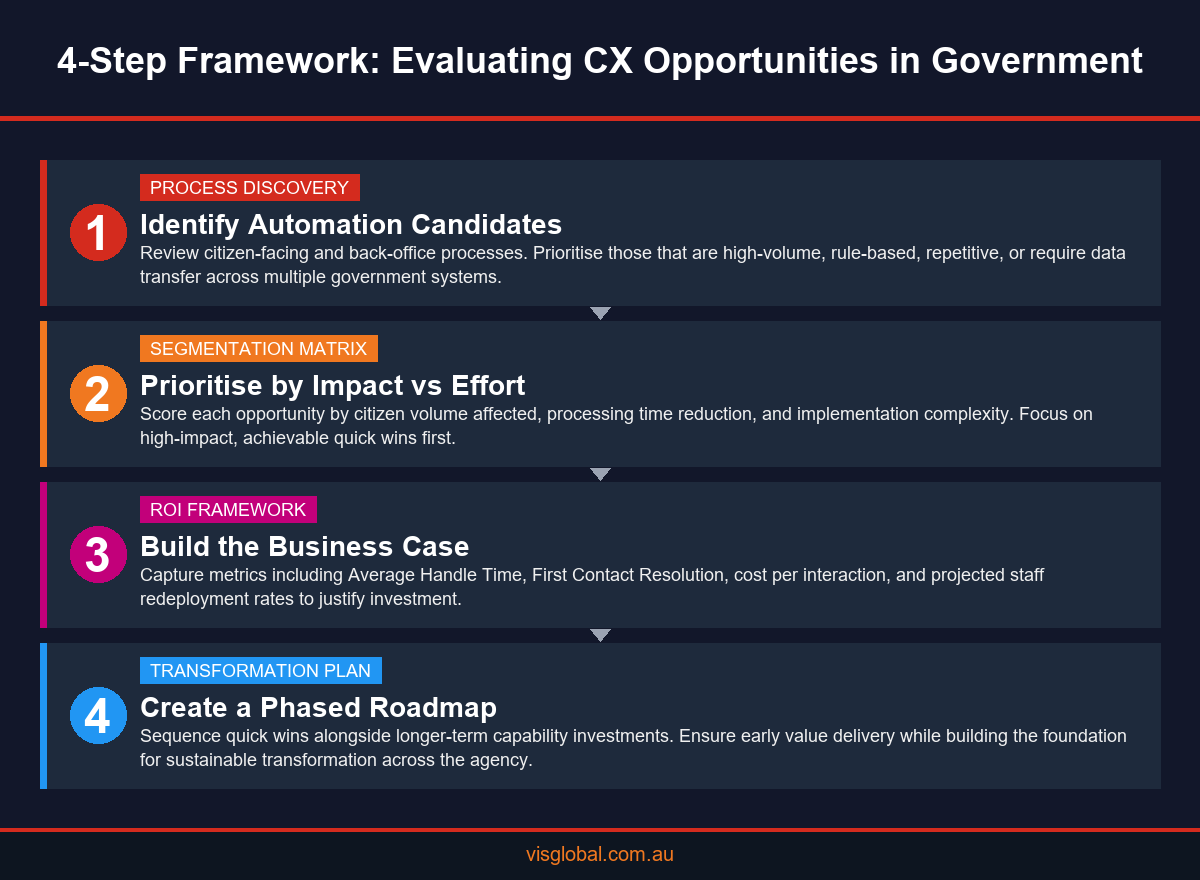
The most successful government CX transformation programs share a common characteristic: they begin with structured evaluation rather than technology selection. Before committing to any platform or solution, agencies that achieve sustained results take a deliberate, four-step approach to identifying, prioritising, and sequencing their automation investments.
Step 1: Identify Automation Candidates. Review all citizen-facing and back-office processes. Strong candidates are highly manual and repetitive, involve high transaction volumes, can be broken into clear rule-based steps, require data transfer between multiple government systems, and apply stable policy rules with limited exception pathways.
Step 2: Prioritise by Impact and Effort. Score each opportunity using a segmentation framework that balances potential impact against implementation effort. Impact factors include citizen volume affected, reduction in processing time or cost per transaction, and improvement to citizen satisfaction. High-impact, lower-effort opportunities should be prioritised as quick wins to build confidence and internal capability.
Step 3: Build a Structured Business Case. Capture both economic and performance impact. Operational metrics include Average Handle Time, First Contact Resolution rate, Customer Effort Score, and the percentage of contacts resolved through self-service. Business metrics cover cost per citizen interaction by channel, Net Promoter Score improvement, staff redeployment rate, and reduction in error and rework rates.
Step 4: Build a Phased Transformation Roadmap. Organise prioritised opportunities into a phased roadmap that sequences quick wins alongside longer-term capability investments. The roadmap should ensure early value realisation while building the foundations for sustainable transformation. A well-structured roadmap typically spans 12 to 36 months, with clearly defined milestones, governance checkpoints, and success metrics at each phase.
Measuring What Matters: Key Metrics for Government CX Programs
Measurement is the discipline that separates CX transformation programs that sustain investment from those that stall after the initial deployment. Agencies need a consistent set of operational and business metrics that can be tracked over time and reported to stakeholders. Intelligent automation platforms with built-in analytics and process mining capabilities allow agencies to monitor performance in real time, identify emerging bottlenecks, and deploy targeted improvements continuously.
On the operational side, Average Handle Time measures the efficiency of individual citizen interactions. First Contact Resolution tracks the percentage of enquiries resolved without a callback, a direct proxy for both citizen satisfaction and operational efficiency. Customer Effort Score measures how easy citizens find it to complete a transaction through a given channel. On the business side, cost per citizen interaction by channel provides a direct comparison between automated and manual service modes. Net Promoter Score, when tracked consistently over time, offers a longitudinal view of citizen sentiment. Staff redeployment rate measures the proportion of officers whose roles have shifted to higher-value activities following automation deployment.
Benchmarking and Continuous Improvement
Agencies should establish a pre-transformation baseline for each metric before deploying automation, and commit to reporting against those baselines at defined intervals. Without this discipline, the value delivered by CX transformation programs remains invisible to the stakeholders whose continued support is essential for long-term success. Continuous improvement is the principle that distinguishes mature programs from one-time deployments. Agencies that invest in platforms with strong analytics foundations are better positioned to adapt quickly, maintain service quality, and demonstrate ongoing return on investment.
Conclusion
CX transformation for government in Australia is not a future-state aspiration. It is a present obligation for agencies that understand the relationship between service quality, public trust, and operational sustainability. The capabilities are available. The frameworks are proven. The data on citizen expectations is unambiguous.
Agencies that invest in intelligent automation today are not simply cutting costs. They are redesigning the relationship between government and the people it serves. Contact VIS Global to discuss how your agency can build a citizen experience transformation roadmap that delivers measurable outcomes for citizens, for officers, and for the communities you serve.