Data Migration Best Practices for Enterprise Communication Systems
 Digital Transformation
Data Migration Best Practices for Enterprise Communication Systems
When organisations migrate to cloud-based contact centre platforms they face one of the most operationally critical challenges in enterprise IT: moving years of customer interaction data, configuration settings, and compliance records without disrupting live services. Data migration in communication systems is not simply a file transfer. It is a structured, risk-managed process that determines whether your cloud transformation succeeds or stalls.
This guide outlines proven data migration best practices for enterprise communication systems, covering everything from pre-migration auditing to post-migration validation. Whether you are moving from a legacy on-premise PBX, a siloed CRM, or a standalone ACD platform, the principles here will help your team execute with confidence.
Key Takeaways
Thorough data auditing before migration reduces failure risk by identifying data quality issues and format mismatches early.
A phased migration with staging environment testing ensures data integrity is validated before production cutover.
Compliance with Australian privacy laws including the Privacy Act must be maintained at every stage of the migration lifecycle.
Why Data Migration Is Critical for Communication System Upgrades
Enterprise communication systems hold decades of accumulated data: call recordings, interaction transcripts, customer profiles, routing rules, agent performance metrics, and compliance audit logs. When organisations move to cloud communications platforms, this data must travel with them, or the value of the migration is lost.
Failed or incomplete data migrations create serious business consequences. Agents lose access to customer history, making every interaction feel like a first contact. Compliance teams cannot produce audit records when regulators ask for them. Reporting dashboards display gaps or inaccuracies that undermine operational decisions. In regulated industries such as banking, healthcare, and government, these gaps can trigger formal investigations and financial penalties.
The Australian Privacy Act 1988 and the Notifiable Data Breaches scheme impose specific obligations on how customer data is handled during system transitions. Any migration that exposes personal information to unauthorised access, even temporarily, constitutes a notifiable breach. This regulatory context makes data migration not just a technical project but a governance responsibility that must be planned accordingly.
Step 1: Conduct a Thorough Data Audit Before Migration
The single most valuable activity in any data migration project is a comprehensive pre-migration audit. Many organisations underestimate the volume and complexity of data held within their communication systems because it is spread across multiple platforms that were never designed to interoperate.
Begin by cataloguing every data source that feeds into or out of your communication platform. This includes the ACD or IVR platform, the CRM, the workforce management tool, the quality monitoring system, call recording storage, and any analytics or reporting databases. For each source, document data format, volume, age, and ownership.
Assess data quality at this stage. Duplicate contact records, inconsistent formatting, and orphaned records that reference deleted agents or closed queues will cause failures downstream if not resolved before migration. Engage your managed services partner to conduct automated data profiling and generate a quality score for each data set before migration planning begins.
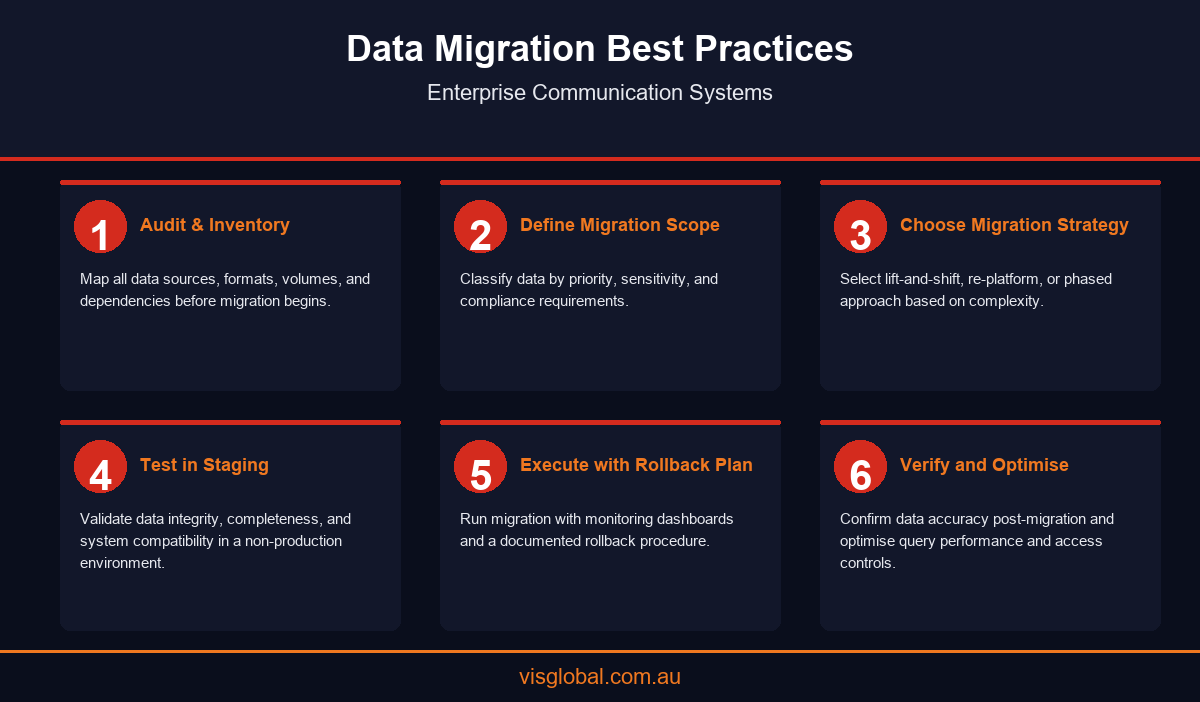
Step 2: Define Your Migration Strategy and Scope
Not all data needs to migrate on day one. Defining migration scope clearly prevents scope creep, reduces risk, and allows the project team to prioritise the data that matters most to operational continuity.
Classify data into three tiers based on business criticality. Tier 1 includes active customer records, current routing configurations, agent profiles, and compliance records from the past 7 years. Tier 2 includes historical interaction records from 1 to 7 years that are needed for reporting but not live operations. Tier 3 includes archived data older than 7 years that must be retained for regulatory reasons but rarely accessed.
Choose a migration strategy that matches your complexity and risk tolerance. Lift-and-shift moves data as-is and is fastest but transfers existing quality problems into the new environment. Re-platforming transforms data to fit the target system's schema and is more thorough but requires longer timelines. A phased approach migrates in waves by data tier or business unit and is the most commonly recommended model for enterprise communication systems because it limits the blast radius of any single failure.
Step 3: Test Rigorously in a Staging Environment
No data migration should proceed directly to production without staging validation. A staging environment that mirrors your target cloud intelligent automation platform allows your team to test data completeness, format compatibility, and system behaviour before any customer-facing impact occurs.
Execute a full migration rehearsal in staging using a representative sample of your production data. Sample selection matters: include edge cases such as records with special characters in customer names, calls with unusually long durations, and agent records with multiple role changes over time. These boundary cases reveal the mapping errors that standard records miss.
Validate three things after each staging run. First, record count integrity: the number of records in the target system must match the number extracted from the source after accounting for any intentional deduplication. Second, field-level accuracy: spot-check a random sample of records to confirm that data mapped to the correct fields in the target schema. Third, functional testing: confirm that routing rules fire correctly, IVR flows execute as expected, and agent interfaces display the migrated data accurately.
Step 4: Manage Compliance and Security Throughout Migration
Data in transit is data at risk. Every stage of the migration pipeline, from extraction to transformation to loading, must apply the same security controls as your production environment.
Encrypt all data in transit using TLS 1.2 or higher. Encrypt data at rest in staging and backup systems using AES-256. Restrict access to migration tooling and staging environments to named individuals with documented business need. Log every access event and retain those logs for a minimum of 90 days. These controls align with the Australian Cyber Security Centre guidelines for cloud data security, available at acsc.gov.au/cloud.
Review your obligations under the Privacy Act 1988 before extracting any data set containing personal information. If your migration involves transferring data to an offshore cloud region, you must assess whether the destination country provides equivalent privacy protections under Australian Privacy Principle 8. Document this assessment and retain it as evidence of due diligence.
For detailed guidance on privacy obligations during system transitions, refer to the Office of the Australian Information Commissioner. Engage your legal team to review the privacy impact assessment before the migration cutover date.
Ensuring Long-Term Success After Migration
Data migration does not end at cutover. The post-migration period is when many hidden issues surface, and having a structured validation and optimisation phase is what separates successful migrations from those that limp along with data quality problems for months.
Assign a dedicated data steward role for the 90 days following migration. This individual is responsible for tracking data quality tickets, coordinating with the platform vendor on schema anomalies, and ensuring that any records identified as incorrectly migrated are corrected promptly. Establish a clear escalation path so that data issues do not get buried in the general IT helpdesk queue.
Optimise query performance and access control configurations once the migrated data is in production. Many organisations find that their historical data sets, once in the cloud, unlock new reporting capabilities that were not possible in the legacy system. Work with your digital workplace solutions partner to build dashboards that leverage the full depth of your migrated data. Monitor for anomalies in the first 30 days and run a formal data quality review at the 90-day mark to close out the migration project.
Conclusion
Effective data migration for enterprise communication systems requires rigorous planning, staged testing, and continuous compliance oversight. Organisations that invest in pre-migration auditing, phased execution, and post-migration validation are the ones that achieve seamless cloud transitions without service disruption or regulatory exposure. If your team is preparing for a contact centre data migration, speak with VIS Global to design a migration roadmap tailored to your industry, data volume, and compliance requirements.