Digital Workplace Transformation for the Australian Banking Sector
 Digital Transformation
Digital Workplace Transformation for the Australian Banking Sector
Australia's banking sector is under simultaneous pressure from three directions: customers who expect seamless digital service across every channel, regulators who require demonstrable compliance with APRA and AUSTRAC obligations, and a competitive landscape that includes neobanks and fintech challengers deploying technology that legacy institutions cannot match without significant infrastructure change. Digital workplace transformation for Australian banking addresses all three pressures in a single, coordinated program: modernising the technology environment that employees use to serve customers while building in the compliance controls that regulators require.
This guide covers the five priority areas of digital workplace transformation for Australian banks and financial services organisations, from unified agent desktops to AI-assisted compliance monitoring, and explains how each initiative contributes to both CX improvement and regulatory risk reduction.
Key Takeaways
Digital workplace transformation in banking must simultaneously improve customer experience and satisfy APRA and AUSTRAC compliance requirements.
AI-assisted customer service tools and unified agent desktops deliver the fastest CX improvement for Australian bank contact centres.
Secure remote work technology with zero-trust controls enables banks to operate hybrid workforces without compromising regulatory compliance.
Why Australian Banks Need Digital Workplace Transformation
The Australian banking sector spends billions annually on technology, yet the internal tools that branch and contact centre employees use to serve customers are often decades behind the digital experience that customers receive through mobile apps and online banking portals. A customer who can open a savings account on a smartphone in under three minutes expects the same speed and simplicity when they call the contact centre or visit a branch. Delivering that experience requires digital workplace tools that give frontline employees instant access to complete customer context, automated compliance checks, and AI assistance, without switching between multiple legacy systems.
APRA Prudential Standard CPS 234 and the AUSTRAC Anti-Money Laundering and Counter-Terrorism Financing regime add specific compliance requirements that shape the technology choices available to banks. Any digital workplace tool that processes or stores customer financial data must meet CPS 234 information security standards. Communications monitoring tools must support AUSTRAC transaction monitoring and suspicious matter reporting obligations. This regulatory overlay means that banks cannot simply deploy commercial off-the-shelf productivity tools without assessment and configuration for compliance.
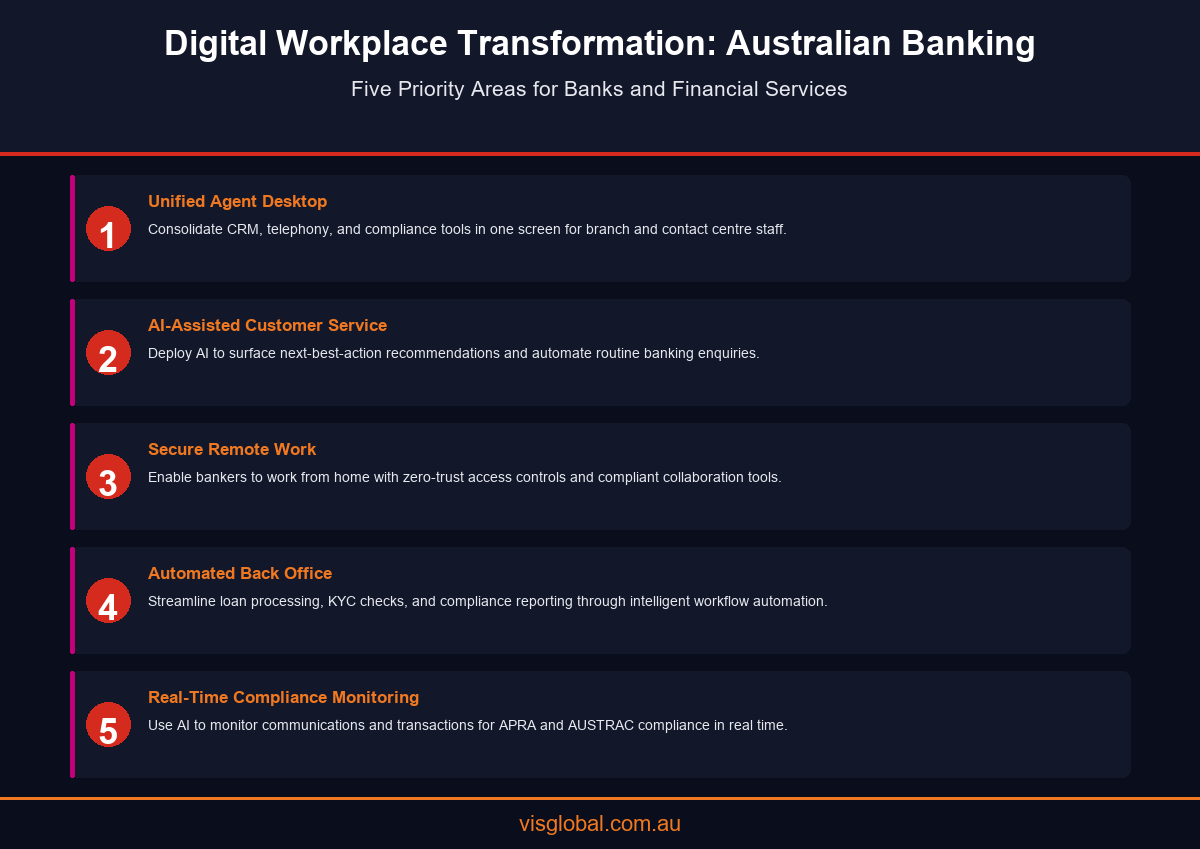
Priority 1: Unified Agent Desktop for Branch and Contact Centre Staff
The unified agent desktop is the highest-impact digital workplace initiative for Australian bank contact centres. A unified desktop consolidates the CRM, telephony platform, knowledge base, compliance checklist, and transaction history into a single interface, eliminating the screen-switching that currently costs Australian banking agents an average of 20 to 40 seconds per interaction. At scale, this translates to thousands of productive hours recovered each month. VIS Global's customer experience management solutions include unified desktop implementations designed specifically for the data integration and compliance requirements of Australian financial services.
The unified desktop must integrate with the bank's core banking system to surface account balances, transaction history, and product holdings in real time during the customer interaction. For Australian banks operating across multiple brands or product lines, the integration layer must handle complex customer identity resolution, linking all accounts and products associated with a single customer view.
Priority 2: AI-Assisted Compliance and Back-Office Automation
Back-office automation delivers the fastest cost reduction in banking digital workplace programs. Loan origination, KYC document verification, account opening workflows, and compliance exception handling are all high-volume, rule-based processes that intelligent automation can execute faster and more accurately than manual processing teams. Banks that have deployed AI in these workflows report processing time reductions of 40 to 70 percent and error rate reductions of over 80 percent compared to manual processing.
AI-assisted compliance monitoring is a complementary initiative. Real-time communication monitoring tools that use natural language processing to flag potential compliance breaches in agent interactions reduce the cost of post-call quality review while providing AUSTRAC-compliant records of suspicious matter indicators. For Australian banks subject to AUSTRAC reporting obligations, automated compliance monitoring also generates the audit trail required for regulatory examination. Full guidance on AUSTRAC obligations is available at austrac.gov.au.
Conclusion
Digital workplace transformation for Australian banking is not a single project; it is a structured program of interconnected initiatives that collectively modernise the employee experience, improve customer service quality, and build a compliance architecture that satisfies APRA and AUSTRAC requirements. Banks that approach this transformation with a clear priority order, starting with the unified agent desktop and AI-assisted automation, deliver measurable outcomes faster than those that attempt to transform everything simultaneously. If your bank is ready to plan its digital workplace banking transformation, speak with VIS Global to build a roadmap that balances CX ambition with regulatory reality.