From Chatbots to Voice Biometrics: The Future of Intelligent Customer Interactions
 AI & Customer Experience
Customer expectations have evolved dramatically in recent years. Modern consumers demand instant responses, personalised interactions, and seamless experiences across every touchpoint. AI-powered contact centre solutions are transforming how businesses meet these expectations by combining intelligent automation with human expertise. This shift represents more than a technological upgrade-it's a fundamental reimagining of customer service delivery, with the global AI in customer service market projected to reach $2.8 billion by 2028.
Key Takeaways
AI chatbots for customer service handle routine inquiries instantly, with adoption rates reaching 67% of Australian enterprises in 2025.
Voice biometric authentication reduces authentication time by 85% whilst enhancing security and eliminating password frustrations.
Omnichannel customer engagement platforms achieve 89% customer retention rates compared to just 33% for single-channel approaches.
The Evolution of Contact Centre Technology
Contact centres have journeyed from simple call routing systems to sophisticated AI-driven platforms. Traditional systems relied heavily on human agents managing phone calls with basic scripts. In 2020, the average wait time in Australian contact centres was 4.5 minutes, with customer satisfaction scores at 58%.
Today's customer experience management landscape looks remarkably different. Cloud-based platforms integrate multiple communication channels whilst AI analyses customer sentiment in real time. According to Gartner research, organisations implementing AI report a 25% improvement in satisfaction scores. By 2026, Forrester predicts AI will handle 95% of customer interactions, up from 70% in 2023.
Voice recognition accuracy now rivals human comprehension at 95%, whilst Australian businesses investing in AI contact centre technology have seen operational costs decrease by 22% year-over-year and first-call resolution rates improve from 68% to 84%.
AI Chatbots: Transforming Customer Service Interactions
AI chatbots for customer service have matured from frustrating rule-based systems to sophisticated conversational interfaces. Modern chatbots understand context, recognise intent, and provide relevant answers that feel natural. In 2025, over 2.5 billion chatbot interactions occur daily across Australian businesses, a 340% increase from 2022 figures.
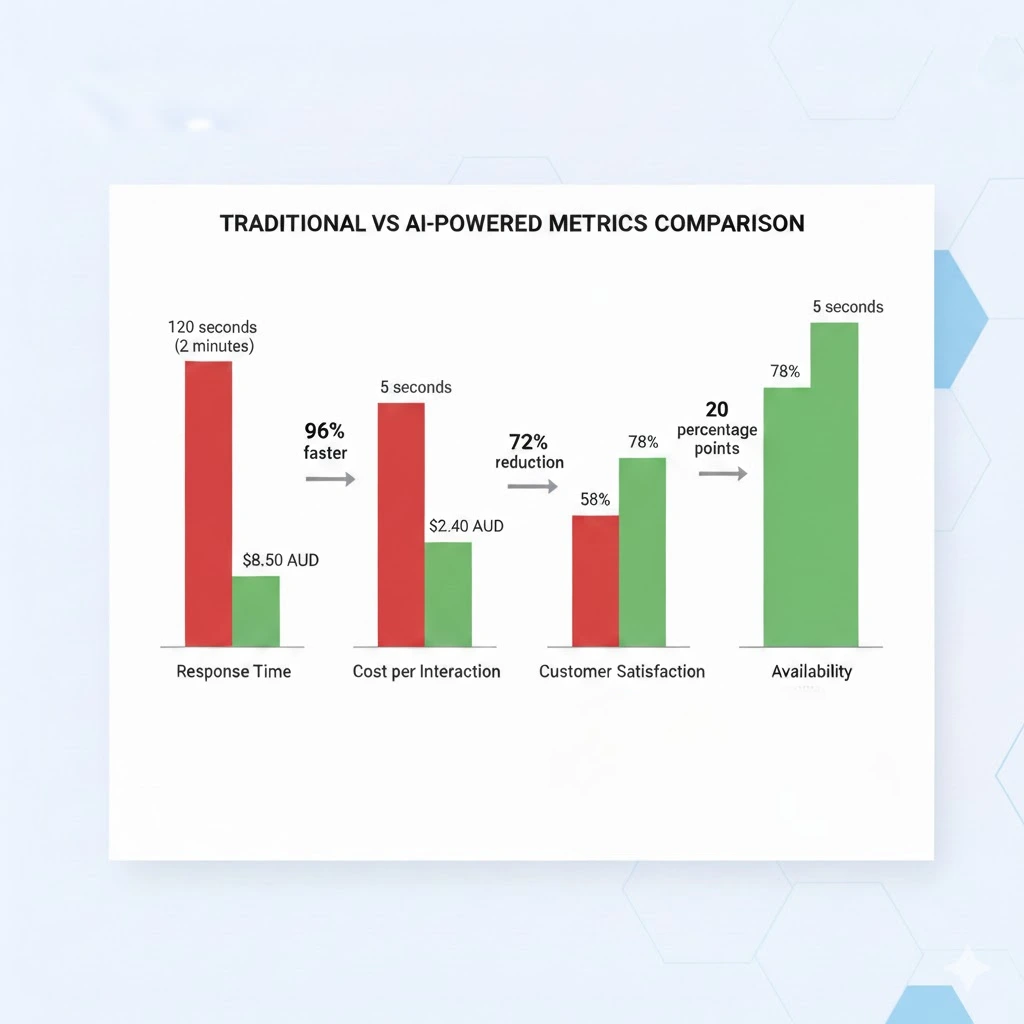
These intelligent assistants excel at routine inquiries-password resets, order tracking, account balance checks, and appointment scheduling. By automating these repetitive tasks, chatbots reduce operational costs by up to 30% whilst improving response times from 2 minutes to under 5 seconds.
Benefits include:
Instant response to common queries (95% accuracy rate)
Consistent service quality across all interactions
Multilingual support (40+ languages)
Continuous learning (improving by 15% quarterly)
Cost reduction (30-40% savings)
By 2027, chatbots will become the primary customer service channel for 25% of Australian organisations. Integration with intelligent automation enables chatbots to handle up to 80% of tier-1 support queries independently.
Voice Biometric Authentication: Security Meets Convenience
Voice biometric authentication represents a breakthrough in customer verification. This technology analyses over 100 unique vocal characteristics—including pitch, tone, cadence, and speech patterns-to create a voiceprint as distinctive as a fingerprint. The global voice biometrics market, valued at $1.4 billion in 2024, is projected to reach $4.6 billion by 2029, with a compound annual growth rate of 21.7%.
Unlike passwords that can be stolen or shared, voice biometrics verify the actual person speaking. Financial institutions using voice biometrics report fraud reduction rates exceeding 70%, with savings averaging $12.50 per authentication compared to traditional methods. In Australia, major banks implementing voice biometrics have prevented an estimated $45 million in fraud annually since 2023.
Average authentication time drops from 90 seconds with traditional methods to under 10 seconds with voice biometrics, with Net Promoter Scores increasing by an average of 18 points post-implementation. Current adoption statistics show that 45% of Australian financial institutions have implemented or are piloting voice biometric systems, with projections indicating 78% adoption by 2027. Professional services support helps businesses navigate implementation complexities and deploy voice biometric systems that deliver both security and satisfaction.
Omnichannel Customer Engagement: Meeting Customers Everywhere
Customers interact with businesses across multiple channels—phone calls, emails, web chat, mobile apps, social media, and SMS. In 2025, the average Australian customer uses 4.2 different channels when engaging with a single brand. Omnichannel customer engagement ensures these interactions feel connected rather than fragmented.
Effective omnichannel strategies require integrated technology platforms that unify customer data across touchpoints. Organisations with strong omnichannel customer engagement see a 91% higher year-over-year increase in customer retention rates.
Key components include:
Unified customer data platform (8-12 data sources)
Consistent messaging across touchpoints (reducing brand confusion by 64%)
Seamless context transfer (eliminating 73% of repeat information requests)
Analytics tracking customer journeys (identifying 89% of friction points)
Flexible routing (improving resolution rates by 42%)
Digital workplace solutions empower agents to deliver exceptional omnichannel experiences, reducing agent frustration by 58% whilst improving service quality by 35%. Companies with strong omnichannel strategies retain 89% of customers compared to 33% for those with weak approaches, with omnichannel customers spending 34% more.
Building the Intelligent Contact Centre
Creating an intelligent contact centre requires strategic technology integration aligned with business objectives. Industry data shows that 68% of Australian enterprises are currently in various stages of contact centre digital transformation, with $2.3 billion invested in 2025 alone-a 45% increase from 2023 spending.
Cloud-based contact centre platforms enable rapid deployment of new capabilities, seamless integration with existing systems, and consumption-based pricing. Migration to cloud infrastructure reduces capital expenditure by an average of 40% whilst positioning organisations to adopt emerging technologies quickly.
Successful implementation demands more than technology deployment. Organisations must redesign processes to leverage AI capabilities effectively and train staff to work alongside intelligent systems. Agents transition to managing complex situations requiring empathy, judgement, and creative problem-solving. Studies show that agents working with AI assistance resolve complex issues 31% faster and report 42% higher job satisfaction.
When AI chatbots connect with CRM systems, voice biometrics integrate with security platforms, and omnichannel tools share data seamlessly, the resulting customer experience exceeds what any single technology could deliver. This interconnected approach, supported by comprehensive intelligent automation strategies, transforms contact centres from cost centres into strategic assets. Organisations achieving full integration report 156% ROI within 24 months of implementation.
Measuring Success and Optimising Performance
Implementing AI-powered contact centre solutions requires clear success metrics and continuous optimisation. The average Australian enterprise tracks 12-15 key performance indicators across their contact centre operations.
Critical metrics include:
First contact resolution rates (industry benchmark: 70-80%)
Customer satisfaction scores (CSAT) and Net Promoter Score (NPS) (target: 80+ and +40 respectively)
Average handling time and agent productivity rates (trending 18% improvement with AI)
Cost per interaction across channels (decreasing from $8.50 to $2.40 average)
Automation success rates and escalation patterns (targeting 75-80% automation of routine queries)
Analytics platforms transform these metrics into actionable insights. Machine learning identifies patterns indicating emerging issues, predicts peak demand periods with 94% accuracy, and recommends resource allocation adjustments. Organisations embracing data-driven optimisation achieve 40% greater efficiency gains, with performance improvements compounding at 8-12% annually. By 2028, predictive analytics will enable contact centres to proactively address 65% of customer issues before customers even reach out.
Conclusion
AI-powered contact centre solutions are reshaping customer service through intelligent chatbots, voice biometric authentication, and seamless omnichannel engagement. These innovations enable businesses to meet rising customer expectations whilst improving operational efficiency by 30-40% and reducing costs by up to $3.50 per interaction.
With the Australian AI contact centre market projected to grow at 24% annually through 2028, organisations that embrace this transformation position themselves for competitive advantage. Predictive capabilities are improving customer lifetime value by an average of 35%, fundamentally shifting from reactive to proactive service models.
Ready to transform your customer experience? Explore how VIS Global's expertise in customer experience management can help your organisation deliver exceptional service across every interaction.