How to Evaluate AI Contact Center Platforms in Australia
 AI & Customer Experience
How to Evaluate AI Contact Center Platforms in Australia
Choosing an ai contact centre platform australia decision makers can commit to for the long term requires more than a feature comparison spreadsheet. With dozens of vendors now claiming AI capability, enterprises need a structured way to separate genuine enterprise grade platforms from basic tools with an AI label attached. This guide sets out a practical framework for evaluating AI contact center solutions in Australia, covering the criteria that matter most for enterprise deployments.
Key Takeaways
Evaluating AI contact centre platforms requires assessing AI and NLP depth, integration capability, compliance, and vendor support together, not in isolation.
Australian data residency and Privacy Act alignment should be non negotiable requirements, not optional extras, in any vendor shortlist.
A structured proof of concept against real enquiry data reveals far more than vendor demonstrations or feature checklists alone.
Why Evaluating AI Contact Center Platforms Properly Matters
An AI contact centre platform sits at the centre of customer facing operations for years once deployed, which makes the evaluation stage disproportionately important. A platform that looks capable in a vendor demonstration but struggles with real enquiry complexity, local compliance requirements, or the enterprise's existing systems creates costly rework long after the contract is signed.
Many enterprises underestimate how much AI quality varies between vendors marketing similar sounding capability. Two platforms can both claim natural language understanding, yet perform very differently once exposed to Australian accents, industry specific terminology, or the volume and variety of enquiries a real enterprise contact centre handles daily.
Market noise makes this harder still. Vendor marketing frequently uses AI, automation, and intelligent as interchangeable terms regardless of the underlying technology, which means procurement teams cannot rely on category labels alone and must dig into technical specifics during every stage of the evaluation process.
The cost of getting this wrong extends beyond the platform itself. Poor AI accuracy frustrates customers and agents alike, weak integration creates manual workarounds that erode the efficiency gains the platform was meant to deliver, and compliance gaps discovered after deployment can trigger expensive remediation projects.
A structured evaluation process protects against these outcomes by testing claims against evidence before commitment, rather than relying on vendor assurances and reference customers selected by the vendor itself.
The stakes are also organisational, not just technical. Contact centre staff, IT teams, and compliance functions all need to trust the platform selected, and a rushed or poorly evidenced decision tends to generate internal resistance that slows adoption even after the technology itself is proven capable. Involving these stakeholders in the evaluation process, not just the final decision, builds the confidence needed for a smooth rollout.
Core Evaluation Criteria: AI Capability, Integration, and Compliance
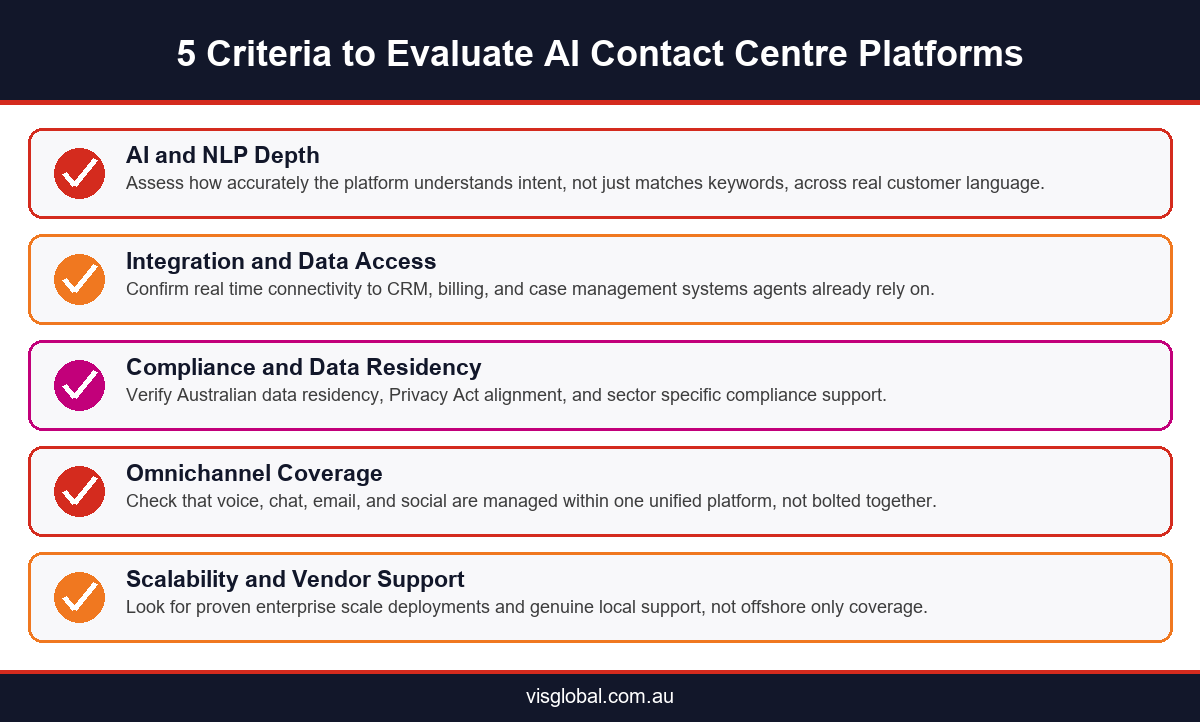
AI capability should be tested directly rather than taken on faith. Request a proof of concept using real, anonymised enquiry transcripts from your own contact centre, and measure intent recognition accuracy, not just whether the platform can hold a scripted demo conversation. This is the same rigour enterprises should apply when choosing the right conversational AI platform for chatbot or voice bot deployments specifically.
Integration depth determines whether the platform will actually reduce agent effort or simply add another screen to manage. Confirm real time, bidirectional integration with core CRM, billing, and case management systems, and ask vendors to demonstrate this with your specific systems rather than a generic integration example.
Compliance requirements are non negotiable for Australian enterprises. Data residency within Australia, alignment with the Privacy Act, and sector specific obligations for banking, healthcare, or government customers must be confirmed contractually, not assumed. Enterprises should also review vendor security practices against guidance from the Australian Cyber Security Centre before finalising any shortlist.
Finally, evaluate the platform's roadmap and update cadence. AI capability moves quickly, and a vendor that has not shipped meaningful AI improvements in the past twelve months may already be falling behind the market, regardless of how the platform performs today.
Language and accent coverage deserves specific attention in the Australian context. A platform trained primarily on North American speech patterns may underperform on Australian accents or the multicultural customer base many enterprises serve, so accuracy testing should always use representative local voice and text samples rather than vendor supplied benchmark data alone.
Comparing Deployment Models and Vendor Support
Most enterprise AI contact centre platforms are delivered as contact centre as a service, which shifts infrastructure management to the vendor and typically shortens deployment timelines compared with on premise alternatives. Enterprises should still confirm how the vendor handles scaling during peak periods, since not all CCaaS platforms scale AI processing as smoothly as core telephony capacity.
Vendor support quality is easy to overlook during evaluation and expensive to discover too late. Ask prospective vendors directly about local support hours, escalation paths for critical incidents, and whether an Australian based team is involved in implementation or if support is entirely offshore. Enterprises in regulated industries in particular should weigh this heavily, since incident response speed carries compliance implications.
Reference checks should go beyond the customers a vendor proposes. Ask for at least one reference in a similar industry and of comparable scale to your own enterprise, and ask specifically about the tuning period after go live, since this is where the gap between marketing claims and real world performance becomes most visible.
Pricing models also vary meaningfully between vendors, ranging from per agent seat licensing to consumption based AI usage charges. Enterprises should model total cost across a realistic twelve month usage scenario rather than comparing headline per seat prices alone, since AI usage costs can scale unpredictably with enquiry volume.
Contract flexibility is worth negotiating early rather than after signing. Enterprises should seek exit provisions, data portability guarantees, and clearly defined service level commitments for AI accuracy and uptime, not just telephony availability, since a platform that cannot demonstrate its AI performance contractually offers little recourse if results fall short after deployment.
A Practical Evaluation Framework for Australian Enterprises
A disciplined evaluation process typically runs across four stages: defining requirements, shortlisting vendors, running a structured proof of concept, and confirming commercial and compliance terms before signing. Skipping the proof of concept stage is the most common mistake enterprises make, often because sales cycles create pressure to decide quickly.
Requirements should be documented and weighted before any vendor conversations begin, covering AI accuracy expectations, required integrations, compliance obligations, channel coverage, and support expectations. This prevents vendor presentations from steering the evaluation criteria rather than the enterprise's own operational needs.
Engaging an experienced customer experience management partner during evaluation adds significant value, since an experienced partner has typically already tested multiple platforms against similar requirements and can flag gaps that vendor demonstrations rarely surface on their own.
Finally, build evaluation scoring around outcomes the business actually cares about, such as projected first contact resolution improvement and cost per interaction reduction, rather than a generic feature count. A platform with fewer features that are deeply integrated and highly accurate will usually outperform a feature rich platform with shallow AI capability.
Document the final decision rationale even after a vendor is selected. A clear record of why the chosen platform scored highest against defined criteria makes it far easier to justify the investment internally, track whether the platform delivers against the expectations set during evaluation, and inform the next platform decision when the market has moved on again.
Evaluating an ai contact centre platform australia enterprises can rely on takes real discipline, but the payoff is a platform that performs as promised long after the contract is signed. Enterprises that test AI accuracy directly, verify compliance contractually, and check vendor support honestly consistently avoid the costly surprises that come from rushed decisions. Contact VIS Global to get an independent perspective on evaluating AI contact centre platforms for your enterprise.