Intelligent Automation Solutions in Australia: The Complete Enterprise Guide (2026)
 AI & Customer Experience
Australian enterprises are automating faster than anywhere else in the Asia-Pacific region. Intelligent automation solutions in Australia now cover everything from robotic process automation in contact centres to AI-powered workflow orchestration across banking, healthcare, and government. Yet many organisations are still in early stages, running isolated bots rather than a connected automation strategy. This guide explains what intelligent automation really means in 2026, how it transforms customer experience and operations, and how to build a roadmap that delivers measurable ROI.
↵↵
Key Takeaways
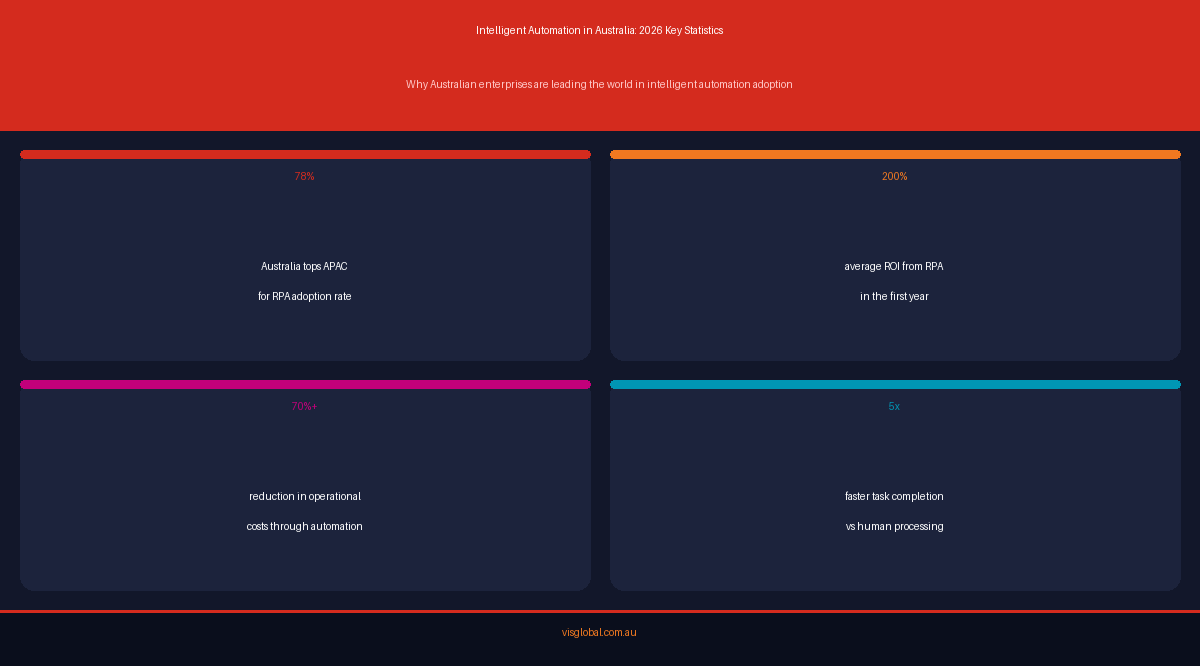
Australia leads the Asia-Pacific region in RPA adoption at 78%, ahead of India at 49%, making local expertise and case study evidence readily available.
Enterprises deploying RPA at scale achieve 200% ROI in the first year and up to 300% at full deployment, with most recovering their investment in under nine months.
Intelligent automation reduces operational costs by more than 70% while software bots complete tasks five times faster than human workers with 100% accuracy and consistency.
↵↵
Why Intelligent Automation Is Reshaping Australian Enterprise Operations
Australia has emerged as the leading adopter of robotic process automation in the Asia-Pacific region. According to Australia RPA adoption statistics, 78% of Australian organisations now use RPA, a rate that outpaces every other APAC market. This adoption reflects a clear-eyed business decision: the combination of rising labour costs, growing regulatory complexity, and escalating customer expectations has made manual process execution unsustainable at enterprise scale.
The global intelligent automation market is expanding rapidly to meet this demand. The global RPA market is valued at USD 35.27 billion in 2026 and is projected to reach USD 247.34 billion by 2035, a compound annual growth rate of 24.20%. This growth is not speculative. It reflects the measurable operational and financial improvements that enterprises across every sector are realising from automation deployment.
↵↵
For Australian enterprises, the business case is particularly compelling. Manual processes in contact centres, back offices, and compliance functions consume significant human resource capacity. These processes are high in volume, rule-based in nature, and prone to human error. They are precisely the conditions where intelligent automation delivers its fastest and highest returns. One robot effectively replaces the productivity of six human employees while working continuously without fatigue, error, or compliance deviation.
↵↵
The organisations gaining competitive advantage in Australia today are those that have moved beyond individual bot deployments to a connected, AI-driven automation strategy. They treat intelligent automation not as a cost-cutting tool but as a strategic capability that enables their people to focus on judgment, relationships, and innovation rather than repetitive processing tasks.
↵↵
↵
Understanding Intelligent Automation: Beyond Basic RPA
The term intelligent automation is often used loosely, but its meaning has a precise technical definition that matters for enterprise planning. Understanding the distinction between basic RPA and full intelligent automation helps organisations make better investment decisions and avoid deploying the wrong technology for a given process.
↵↵
What Is Robotic Process Automation?
Robotic process automation uses software bots to replicate the actions a human worker performs on a computer: opening applications, copying and pasting data, filling forms, triggering workflows, and generating reports. RPA bots follow explicit rules. They do not interpret ambiguous inputs or make judgement calls. They are exceptionally effective for high-volume, structured, repetitive processes where the inputs and outputs are consistent and predictable. For a full breakdown of the difference between RPA and intelligent automation, including which approach suits which use case, see our dedicated comparison guide.
↵↵
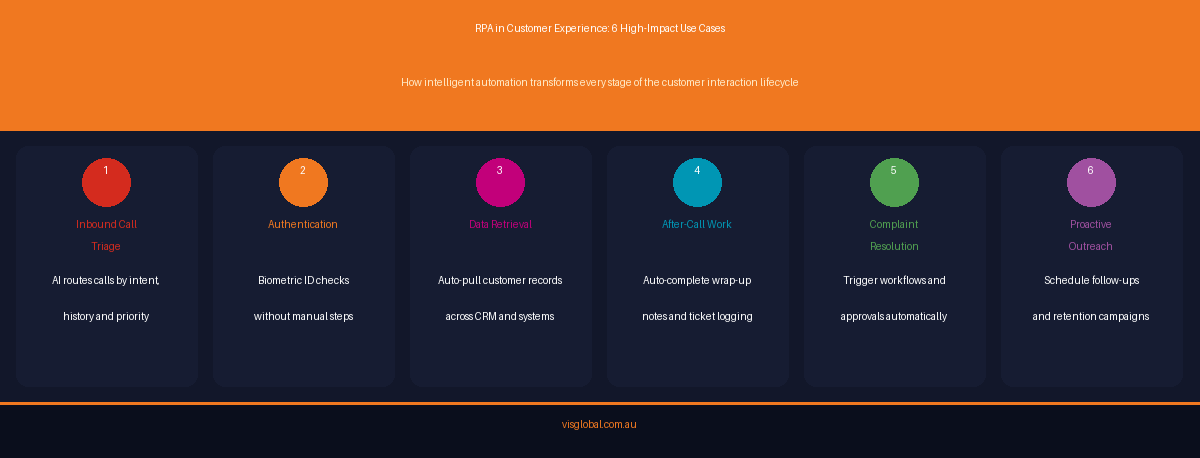
In a contact centre context, RPA bots handle tasks like automatically pulling up a customer record when a call is received, logging call notes after an interaction, generating service tickets from email requests, and routing completed transactions to downstream systems. Each of these tasks might take a human agent two to five minutes per interaction. An RPA bot completes them in seconds with 100% accuracy.
↵↵
From RPA to Intelligent Automation: The Evolution
Intelligent automation extends RPA by adding artificial intelligence capabilities: natural language processing, machine learning, computer vision, and process mining. Where RPA handles structured data in predictable workflows, intelligent automation can process unstructured data such as freeform customer emails, scanned documents, and voice transcripts. Read our guide to how RPA and AI streamline enterprise operations for a detailed breakdown of each capability.
VIS Global's intelligent automation solutions combine RPA with AI at every layer: bots that understand context, adapt to variation, and improve through learning. This approach means automation can be applied to a much broader range of enterprise processes than traditional RPA alone, including complex compliance workflows, multi-system data reconciliation, and real-time customer interaction support.
↵↵
Intelligent Automation in Customer Experience and Contact Centres
The contact centre is the highest-impact deployment environment for intelligent automation in Australian enterprises. It combines high interaction volumes, time-sensitive processing requirements, and direct revenue and satisfaction implications into a single operating environment. Intelligent automation transforms every stage of the contact centre workflow.
↵↵
Automating Routine CX Tasks
In a typical Australian enterprise contact centre, agents spend 30 to 40% of their time on tasks that do not require human judgment: looking up account information, logging call notes, completing post-call wrap-up, processing standard transactions, and updating records across multiple systems. These tasks are ideal candidates for RPA automation.
Deploying RPA bots for these routine tasks immediately reduces average handling time, frees agents to focus on complex customer issues, and eliminates transcription errors from manual data entry. The customer experience management improvements are measurable: shorter wait times, faster resolution, and higher first-contact resolution rates all follow from removing manual processing delays from the interaction workflow.
↵↵
AI-Powered Agent Assist and Back-Office Automation
Agent assist automation uses AI to support human agents in real time during live interactions. The system listens to the conversation, retrieves relevant knowledge base articles, suggests response scripts, surfaces customer history, and flags compliance requirements automatically. Agents receive contextual support without interrupting the conversation to search for information manually.
↵↵
Back-office intelligent automation connects the front-line contact centre to the downstream workflows that fulfil customer requests. When a customer calls to update their address, the automation chain handles the update across every relevant system simultaneously rather than requiring the agent to navigate multiple applications. When a complaint is lodged, the automation triggers the appropriate escalation workflow, assigns a case reference, sends acknowledgment communications, and schedules a follow-up, all without manual intervention.
↵
Natural Language Processing: Making Automation Conversational
Natural language processing is the AI capability that transforms intelligent automation from a back-office efficiency tool into a front-line customer experience technology. NLP enables automation systems to understand, interpret, and respond to human language in all its variability, including freeform text, spoken words, different accents, and ambiguous phrasing.
↵↵
NLP in Customer Service Interactions
NLP-powered chatbots and virtual agents use language understanding to interpret customer enquiries and generate appropriate responses. Unlike rule-based chatbots that follow fixed decision trees, NLP systems understand intent even when customers phrase their requests differently each time. They handle context shifts, follow-up questions, and multi-turn conversations in a way that feels natural rather than scripted.
↵↵
For Australian enterprises managing large volumes of digital enquiries, NLP automation scales customer service capacity without proportional increases in headcount. Routine enquiries resolved through NLP bots free human agents for high-value, complex, or emotionally sensitive interactions. VIS Global integrates NLP capabilities directly into contact centre platforms as part of its full-stack intelligent automation solutions deployment approach.
↵↵
Sentiment Analysis and Intent Recognition
Sentiment analysis uses NLP to monitor the emotional tone of customer communications in real time. When a customer's message shows frustration, urgency, or dissatisfaction, the system triggers an appropriate response: escalation to a human agent, a proactive service recovery offer, or a priority routing rule. This capability turns reactive customer service into proactive experience management.
↵↵
Intent recognition classifies the purpose behind a customer message before any human reads it. An email flagged as a complaint is routed differently from one flagged as a product enquiry. A chat message indicating purchase intent triggers a different response pathway than one indicating technical difficulty. Intelligent automation uses intent classification to orchestrate the right response across every channel simultaneously.
↵↵
Intelligent Automation Across Australian Industries
Intelligent automation delivers measurable value across every major Australian industry vertical, but the specific applications, compliance requirements, and implementation priorities vary significantly by sector.
↵↵
Banking and Financial Services
Australian banks and financial institutions process millions of routine transactions daily: account updates, payment processing, compliance checks, fraud flags, and loan application assessments. Each of these processes is a candidate for intelligent automation. RPA bots handle structured transaction processing at speed and scale. AI layers add pattern recognition for fraud detection and document intelligence for loan document processing. Our guide to intelligent automation for banking and financial services in Australia covers sector-specific applications in depth.
↵↵
For the banking sector, intelligent automation also addresses regulatory compliance obligations. Automated compliance checking ensures that every transaction is assessed against current rules without manual review. Audit trails are generated automatically. Suspicious activity is flagged and escalated without human intervention. The result is lower compliance risk and lower compliance cost simultaneously.
↵↵
Healthcare
Healthcare organisations in Australia use intelligent automation to manage appointment scheduling, patient record updates, billing processing, Medicare claim submissions, and clinical documentation. These administrative workflows consume significant staff capacity and are prone to error when managed manually.
VIS Global supports healthcare providers with automation deployments that comply with Australian Privacy Act requirements and healthcare data governance standards. Bots handle high-volume administrative tasks while clinical staff focus on patient care. Post-discharge follow-up calls and medication reminder communications are automated through NLP-powered outreach systems that personalise every message while maintaining clinical accuracy.
↵↵
Government Agencies
Government agencies and councils process large volumes of citizen enquiries, permit applications, benefit claims, and compliance submissions. Intelligent automation dramatically reduces processing times for routine applications while maintaining the accuracy and audit trail requirements of government administration.
VIS Global's digital workplace solutions connect front-line citizen service automation with back-office government workflows, ensuring that automation improvements extend across the full service delivery chain rather than being limited to individual departments or processes.
↵↵
Measuring ROI: What Australian Enterprises Can Expect
The financial case for intelligent automation in Australian enterprises is well established by deployment data from organisations across the region. Understanding realistic return expectations helps leaders build credible business cases and set appropriate performance benchmarks.
↵↵
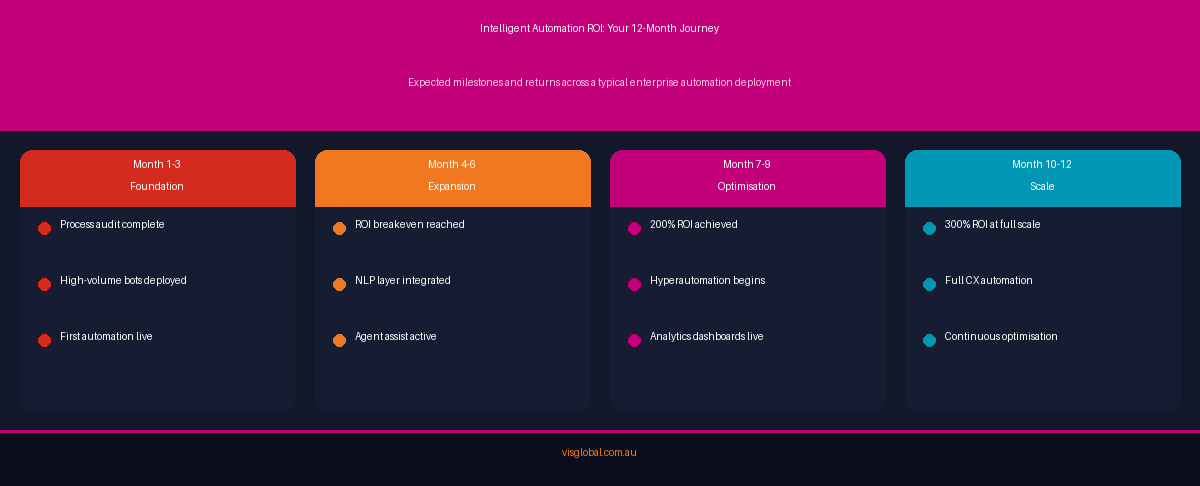
According to intelligent process automation enterprise value research, enterprises typically recover their automation investment within nine months of deployment. The ROI trajectory follows a predictable pattern: rapid returns in the first phase from high-volume routine task automation, expanding returns in the second phase as AI layers are added, and compounding returns in the third phase as automation scales across the organisation.
↵↵
First year ROI: 200% average return across enterprise RPA deployments, with finance-specific automation achieving payback in under six months.
Operational cost reduction: More than 70% reduction in processing costs for automated workflows versus human-managed equivalents.
Error elimination: 100% accuracy and compliance consistency across all automated processes, eliminating the cost of error correction and compliance remediation.
Productivity multiplier: One software robot delivers the equivalent output of six human employees working standard hours, operating continuously without fatigue.
Full-scale returns: Organisations that scale automation across the enterprise achieve up to 300% ROI, with returns compounding as automation coverage expands.
↵↵
VIS Global's managed services team tracks ROI metrics throughout every automation deployment, providing clients with transparent performance reporting from go-live through to full-scale operation.
Building Your Intelligent Automation Roadmap
A successful intelligent automation program requires a structured approach from initial process identification through to enterprise-wide scale. Organisations that rush to technology selection without completing the foundational steps consistently underperform those that invest in strategy before deployment.
Step 1: Process discovery and prioritisation. Use process mining tools to identify which workflows consume the most human time, generate the highest error rates, and offer the clearest automation pathway. Prioritise by impact and feasibility rather than by departmental preference.
Step 2: Start with RPA for structured processes. Deploy rule-based bots for your highest-volume, most structured workflows first. These deliver the fastest ROI and build organisational confidence in automation before adding AI complexity.
Step 3: Add NLP for customer-facing interactions. Once back-office automation is operating reliably, extend to customer-facing processes using NLP-powered chatbots, virtual agents, and sentiment analysis. This is where automation begins to transform the customer experience directly.
Step 4: Integrate AI for intelligent decision-making. Layer machine learning and AI capabilities onto your RPA foundation to handle unstructured data, variable inputs, and processes that require contextual judgment rather than simple rule execution. Explore how generative AI for enterprise transformation extends automation into higher-order decision-making.
Step 5: Scale through a Centre of Excellence. Establish an internal automation Centre of Excellence that owns the automation platform, sets standards, trains process owners, and manages the ongoing roadmap. This structure ensures automation scales systematically rather than in isolated pockets.
Step 6: Partner with a specialist. Intelligent automation transformation requires technology expertise, process knowledge, change management capability, and compliance awareness simultaneously. VIS Global has delivered automation programs across banking, healthcare, government, and BPO environments in Australia.
Conclusion
Intelligent automation solutions in Australia are no longer a competitive advantage for early adopters. They are becoming a baseline operational requirement for enterprises that intend to remain competitive in cost, accuracy, and customer experience quality. With 78% of Australian organisations already using RPA, the question is no longer whether to automate but how to automate intelligently, at scale, and with measurable returns.
↵↵
Whether you are beginning your automation journey or scaling an existing program, VIS Global brings the local expertise, proven methodology, and full-stack capability to help you achieve your goals. Speak with our team to start building your intelligent automation roadmap today.