Intelligent Workforce Australia: How AI, Automation and Skills Intelligence Are Transforming Work (2026)
 Digital Transformation
Intelligent Workforce Australia: How AI, Automation and Skills Intelligence Are Transforming Work (2026)
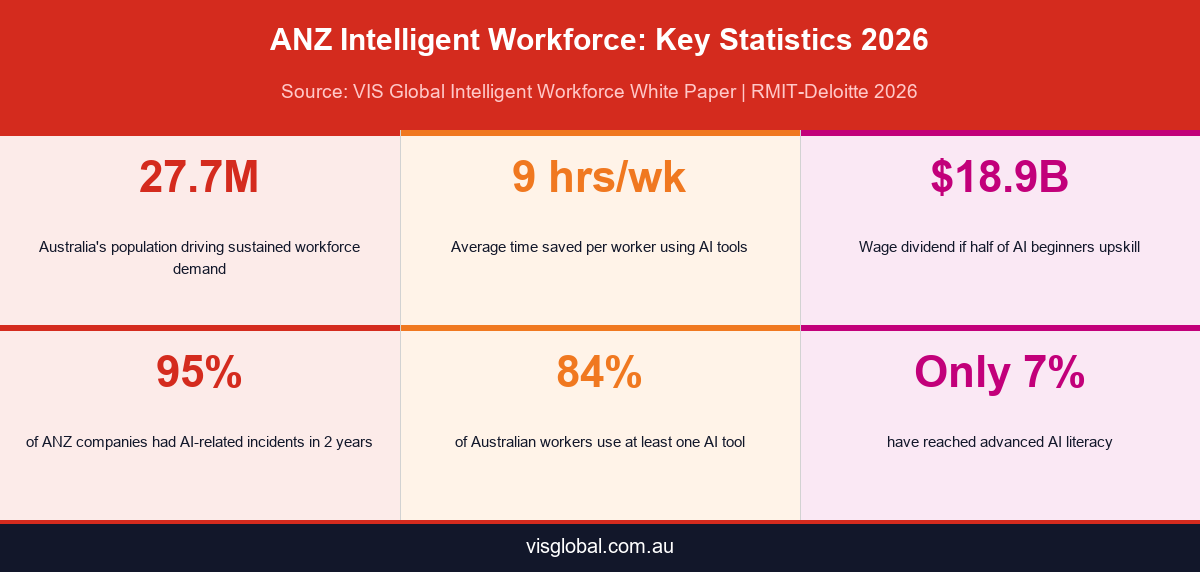
Australia's workforce is at an inflection point. With 84 per cent of Australian workers already using AI tools and only 7 per cent achieving advanced AI literacy, the gap between adoption and genuine capability is widening at pace. The concept of an intelligent workforce Australia represents a fundamental shift in how organisations find, develop, and deploy talent through the deliberate combination of human skills, AI systems, data infrastructure, and continuous learning. This guide draws on VIS Global’s Intelligent Workforce White Paper 2026 to outline what this transformation means for ANZ enterprises, what the data reveals, and how to lead the transition.
Key Takeaways
An intelligent workforce is not about replacing people with machines. It is about redesigning work so that human-AI collaboration consistently outperforms either alone.
Australia faces a structural AI literacy crisis, with 5.4 million workers classified as AI beginners and significant generational gaps in capability, confidence, and judgement skills.
Organisations that invest in workforce intelligence now will build compounding advantages in productivity, talent retention, and competitive positioning through to 2030.
The ANZ Workforce Challenge: Why Traditional Approaches Are Failing
Australia and New Zealand face a compounding set of workforce pressures that no single policy or technology can resolve in isolation. Skills shortages, demographic shifts, rising wage costs, productivity stagnation, and the rapid pace of AI adoption are converging to create a structural challenge that demands a fundamentally new approach to how organisations find, develop, and deploy talent. With a population of 27.7 million as of September 2026, Australia’s sustained demand for workforce services is intensifying across healthcare, engineering, digital, and data roles, and the tools that worked in the previous decade are no longer fit for purpose.
The economic stakes are significant and measurable. AI literacy now commands a direct wage premium: a one-point improvement in AI literacy score is associated with a 6.2 per cent increase in full-time wages, approximately $7,040 per year for the average Australian worker. Yet most organisations continue to invest in AI tools without investing equally in the human capability required to use them effectively. This asymmetry is at the core of Australia’s workforce problem and represents both the greatest risk and the most significant opportunity for ANZ enterprises through to 2030.
The Productivity Stagnation Crisis
Australia’s labour productivity in June 2026 remained at pre-pandemic levels, roughly equivalent to December 2019, according to the Australian Bureau of Statistics. Average annual productivity growth in 9 of 16 market sector industries has lagged its 20-year average. Hybrid work arrangements remain structurally elevated above pre-pandemic baselines across ANZ, and employee burnout risk is rising, particularly among younger workers using AI most intensively. Among Gen Z and millennial workers using AI heavily, 40 to 42 per cent report pressure to work faster, compared with 25 to 26 per cent of older cohorts. These pressures are compounding, and the window to address them through proactive workforce investment is narrowing.
Additionally, 95 per cent of ANZ companies have experienced AI-related incidents in the past two years. These incidents range from AI-generated errors in customer communications to compliance breaches arising from insufficient human oversight of automated decisions. The cost of misuse is real, and the governance frameworks required to manage it are underdeveloped in most organisations. This reality makes building genuine AI capability, not just AI access, the defining workforce priority of 2026.
What Is an Intelligent Workforce? The Five Core Pillars
An intelligent workforce is not simply a workforce that uses AI tools. It is an organisational capability built on the deliberate combination of human talent, AI systems, data infrastructure, and continuous learning, enabling an organisation to sense, adapt, and perform at levels beyond what either humans or machines can achieve alone.
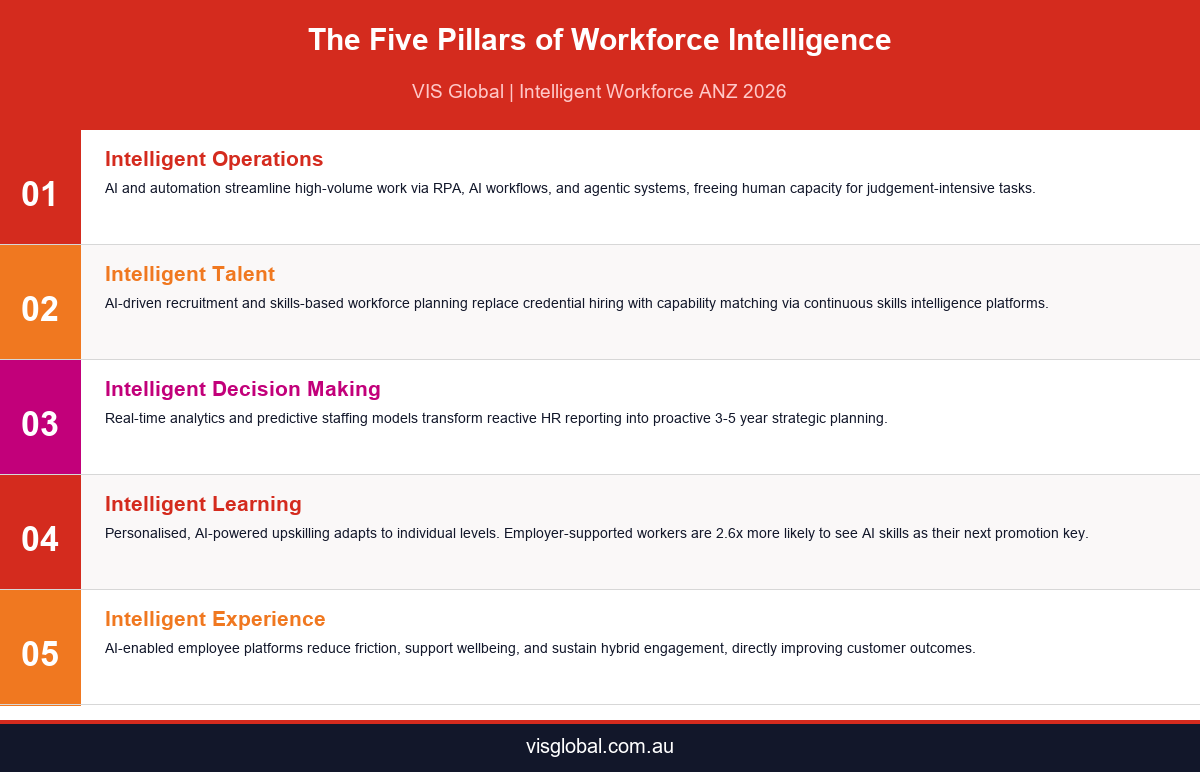
Achieving this state requires investment across five interconnected pillars that span operations, talent acquisition, decision-making, learning, and employee experience. Together they form the architecture of digital workplace transformation at enterprise scale in ANZ.
Intelligent Operations: AI and automation streamline repetitive, high-volume work using RPA, AI-assisted workflows, and intelligent scheduling. Agentic AI systems execute multi-step processes with minimal oversight, freeing human capacity for higher-value judgement-intensive tasks.
Intelligent Talent: AI-driven recruitment and skills-based workforce planning replace credential-based hiring with capability-based matching. Skills intelligence platforms continuously map workforce capabilities against evolving demand.
Intelligent Decision Making: Real-time workforce analytics and predictive staffing models transform reactive HR reporting into proactive planning. Only 12 per cent of organisations currently conduct strategic workforce planning with a three to five-year horizon.
Intelligent Learning: Continuous, personalised upskilling powered by AI adapts content, pacing, and delivery to individual capability levels. Workers with employer-supported training are 2.6 times more likely to see AI skills as central to their career advancement.
Intelligent Experience: AI-enabled employee experience platforms reduce friction, support wellbeing, and sustain engagement in hybrid environments, directly improving customer satisfaction outcomes.
Australia’s AI Literacy Crisis: The Capability Gap Suppressing Productivity
RMIT Online, in partnership with Deloitte Access Economics, conducted Australia’s first comprehensive measure of AI literacy across 2,025 workers in January 2026. While 84 per cent of Australian workers use at least one AI tool, just 7 per cent have reached advanced AI literacy, and 54 per cent, representing 5.4 million workers, are classified as AI beginners who lack the skills to use AI safely.
The RMIT-Deloitte framework measures AI literacy across six domains: Knowledge (3.80/5), Ethical and Legal Awareness (3.70), Practical Skills (3.46), Strategic Application (3.44), Transferability (3.28), and Critical Evaluation (3.10). Critical Evaluation is the most differentiating skill and the hardest to develop through generic training programs.
Technical Skills vs Judgement Skills: A Critical Imbalance
Workers are twice as likely to be advanced in AI technical skills (21 per cent) as in AI judgement skills (11 per cent). According to the University of Melbourne and KPMG’s Trust, Attitudes and Use of AI 2026 report, 56 per cent of workers have made work mistakes due to AI-generated content. Addressing the judgement gap is not optional for organisations serious about intelligent automation at scale.
The Generational Divide in AI Adoption: A Dual Challenge for ANZ Employers
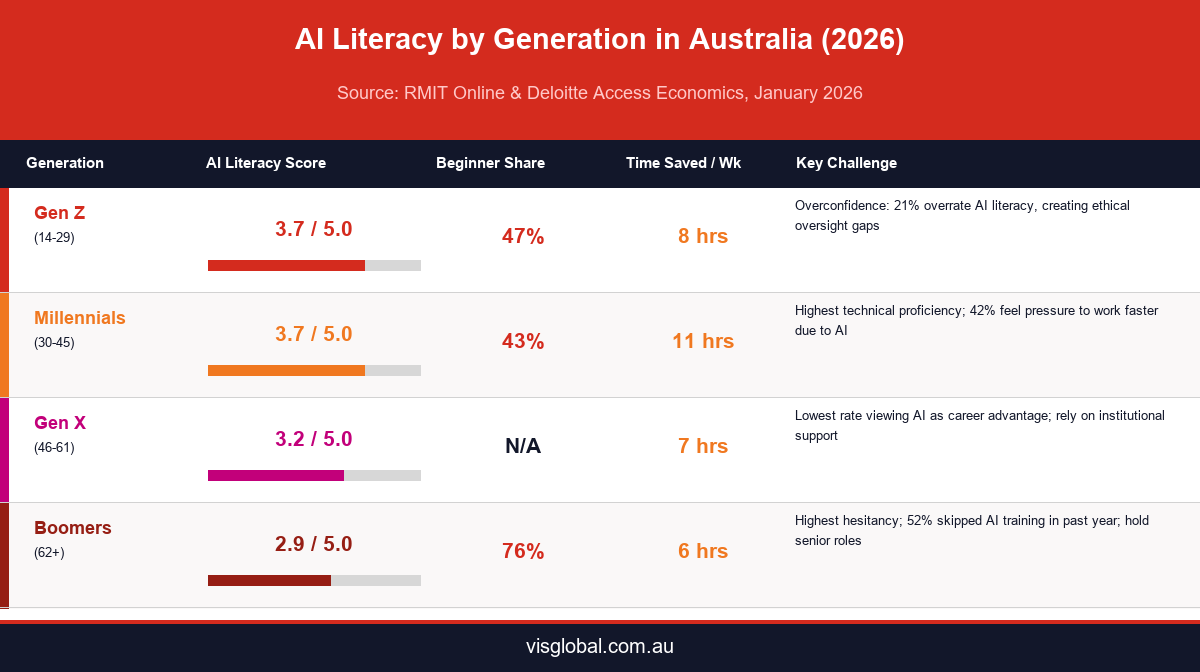
Australia’s workforce spans four generations with markedly different relationships with AI technology. Applying a one-size-fits-all AI training program without accounting for generational differences is one of the most common and costly mistakes ANZ organisations are making in 2026.
Gen Z (14-29): AI literacy score of 3.7/5, 47 per cent beginners, 8 hours saved per week. Key risk: overconfidence. 21 per cent overrate their AI literacy, creating misuse risk and insufficient ethical oversight.
Millennials (30-45): AI literacy score of 3.7/5, 43 per cent beginners, 11 hours saved per week. Highest technical proficiency but 42 per cent feel pressure to work faster due to AI.
Gen X (46-61): AI literacy score of 3.2/5, 7 hours saved per week. Moderate willingness but lowest rate of viewing AI as a career advantage.
Baby Boomers (62+): AI literacy score of 2.9/5, 76 per cent beginners, 6 hours saved per week. 52 per cent have not completed AI training in the past year, yet hold senior decision-making roles.
If just half of Australia’s 5.4 million beginner AI users improved to intermediate level, the aggregate wage dividend would exceed $18.9 billion. Closing the boomer AI literacy gap to millennial levels alone would deliver $3.1 billion in collective wage gains.
Technology Enablers: Building the Intelligent Workforce Stack
The intelligent workforce is built on an integrated technology stack. Leading ANZ organisations are combining generative AI, predictive analytics, robotic process automation, and agentic AI systems into connected workforce intelligence platforms.
Core Technology Layers for Workforce Intelligence
Generative AI (GenAI): The most widely adopted technology layer, with 64 per cent of retailers and growing shares in financial services, healthcare, and government deploying GenAI tools across existing workflows.
Robotic Process Automation (RPA): 51 per cent of leading ANZ organisations have adopted RPA. Automates invoice processing, onboarding workflows, compliance checks, and data entry.
Predictive Analytics and AI Forecasting: Enables organisations to forecast workforce demand, predict attrition risk, and model staffing scenarios before decisions must be made.
Workforce Analytics Platforms: Only 12 per cent of ANZ organisations conduct strategic workforce planning with a three to five-year horizon. Workforce analytics platforms are the primary technology closing this gap.
Agentic AI Systems: By 2030, many ANZ organisations will operate hybrid workforces where AI agents handle end-to-end processes alongside human teams. 54 per cent of retailers already use agentic technologies significantly.
Skills Intelligence Platforms
Platforms such as Workday, SAP SuccessFactors, and ServiceNow are evolving into dynamic skills-mapping and workforce planning systems. These platforms are a core component of VIS Global’s managed services framework for enterprise workforce transformation clients.
Industry Applications: How ANZ Sectors Are Transforming Their Workforces
Workforce intelligence is reshaping every major sector across Australia and New Zealand.
Financial Services
Commonwealth Bank and ANZ Bank are among the most advanced adopters of AI workforce tools in the region. VIS Global’s banking industry solutions address the unique workforce intelligence needs of Australian financial institutions operating under complex regulatory frameworks.
Healthcare
Healthcare’s non-market sector productivity has been negative for three years, and AI represents the clearest structural path to improvement. VIS Global’s healthcare industry solutions embed AI governance frameworks ensuring clinical AI outputs are validated by human professionals before influencing care decisions.
Retail and Logistics
55 per cent of retailers have seen moderate to very high ROI from AI investments, with 71 per cent expecting significant ROI within the next year. The customer experience management capabilities VIS Global provides are directly enabling this transformation.
Mining, Energy and Government
BHP and Rio Tinto are global leaders in autonomous mining operations. In the public sector, Service NSW achieved a 9.1 per cent year-on-year CX improvement in 2026 through digital platforms and data-driven personalisation.
Risks, Governance and ANZ Regulatory Considerations
The top barriers to AI workforce integration: security and data privacy concerns (38 per cent), lack of AI skills (27 per cent), poor data quality (27 per cent), data silos (26 per cent), lack of leadership understanding (25 per cent), employee resistance (23 per cent), and AI bias (21 per cent).
ANZ-Specific Regulatory Framework
Privacy Act 1988 and Upcoming Reforms: AI workforce tools must comply with Australian Privacy Principles. Privacy-by-design is no longer optional for ANZ organisations deploying AI at scale.
Fair Work Act Implications: AI-assisted scheduling and performance management tools must respect award entitlements. Automated decisions affecting pay or hours require careful human oversight.
Responsible AI Frameworks: Australia’s National AI Centre emphasises responsible AI leadership embedded inside organisations. By 2030, AI governance is expected to become a formal organisational function.
Union Considerations: Proactive consultation with union representatives on AI deployment reduces the risk of industrial action and builds trust for longer-term transformation.
Future Outlook 2026-2030 and Strategic Recommendations
Australia’s workforce gets reorganised around AI between 2026 and 2030, not replaced by it. Jobs get decomposed into tasks redistributed between humans and AI systems based on comparative advantage.
01. AI-Augmented Workforce Becomes the Default: AI shifts from a discrete tool to embedded operational infrastructure across banking, mining, healthcare, and public services.
02. Rise of Digital Employees and Agentic Systems: By 2030, AI agents will handle end-to-end processes as functional contributors alongside human teams.
03. Shift to Skills-Based Organisational Design: Hiring logic shifts from credentials to capability. Skills intelligence platforms become the operating system of the new talent model.
04. Human-Machine Teaming as the Core Work Unit: Employees increasingly act as decision owners and validators while AI handles analysis, simulation, and drafting.
05. Continuous Reskilling Becomes Structural: Employability increasingly depends on adaptability rather than static expertise.
Strategic Recommendations: A Maturity Framework for ANZ Enterprises
Foundations (Good): Audit AI literacy levels, deploy AI tools with role-specific training, establish a connected workforce data platform, implement Privacy Act-compliant governance policies.
Scale (Better): Deploy workforce analytics dashboards, implement AI-assisted recruitment with human oversight, build generational upskilling pathways, pilot predictive workforce planning.
Transform (Best): Deploy agentic AI in high-value workflows, shift to skills-based organisational design, build a formal AI governance function, establish continuous reskilling as a structural activity.
Building Australia’s Intelligent Workforce Starts Now
The intelligent workforce Australia needs is a strategic imperative for every enterprise operating in a skills-constrained, AI-accelerated economy. The gap between AI adoption and capability is quantified, the $18.9 billion productivity opportunity is real, and the technology to close both gaps exists today. Contact VIS Global to understand how our intelligent automation, digital workplace, and customer experience management solutions can accelerate your organisation’s workforce transformation journey.