Omnichannel Contact Center: Integrating Voice, Chat, and Social
 AI & Customer Experience
Omnichannel Contact Center: Integrating Voice, Chat, and Social
Omnichannel contact center solutions solve a problem most Australian enterprises still face: customers move fluidly between voice, chat, email, and social channels, but the systems behind those channels often do not. This guide focuses specifically on how voice, chat, and social integration actually works at a technical level, building on the broader case for AI contact center solutions in Australia with a practical look at unifying channels into one coherent customer experience.
Key Takeaways
True omnichannel integration unifies customer context across voice, chat, email, and social into a single continuous conversation, not separate siloed threads.
The technical foundation is a unified customer record and agent desktop that persists context regardless of which channel a customer uses next.
Enterprises that integrate channels properly see fewer repeated explanations from customers and faster resolution across every channel combined.
What Omnichannel Integration Really Means for Contact Centers
True omnichannel integration means a customer can start a conversation in one channel and continue it in another without losing context or repeating information. A customer who begins a query in web chat and later calls should reach an agent who can already see the chat transcript, not one who asks the customer to start over.
This is a fundamentally different architecture from simply offering multiple channels side by side. Many contact centres describe themselves as omnichannel when they actually operate several disconnected channels, each with its own queue, history, and reporting, which delivers none of the continuity that defines genuine omnichannel service.
The distinction matters most at the moments customers care about. A billing dispute that starts over email and escalates to a phone call, or a product question that begins on social media and finishes in chat, are the exact scenarios where disconnected channels create visible friction and where true integration earns customer trust.
Achieving this requires more than a shared inbox. It requires a common data model for customer identity and conversation history that every channel writes to and reads from in real time, so that whichever channel a customer picks next, the full picture travels with them automatically.
For enterprises evaluating platforms, this is the single most important question to ask vendors directly: does the system maintain one continuous conversation record across channels, or does it simply present multiple channel specific views within the same interface.
It is worth testing this claim rather than accepting it at face value during procurement. A simple but effective test is to raise an issue in one channel, switch to another mid conversation, and observe whether the receiving agent can see the full prior exchange without asking the customer anything at all. Platforms that pass this test convincingly are rarer than marketing materials suggest.
How Voice, Chat, and Social Connect on One Platform
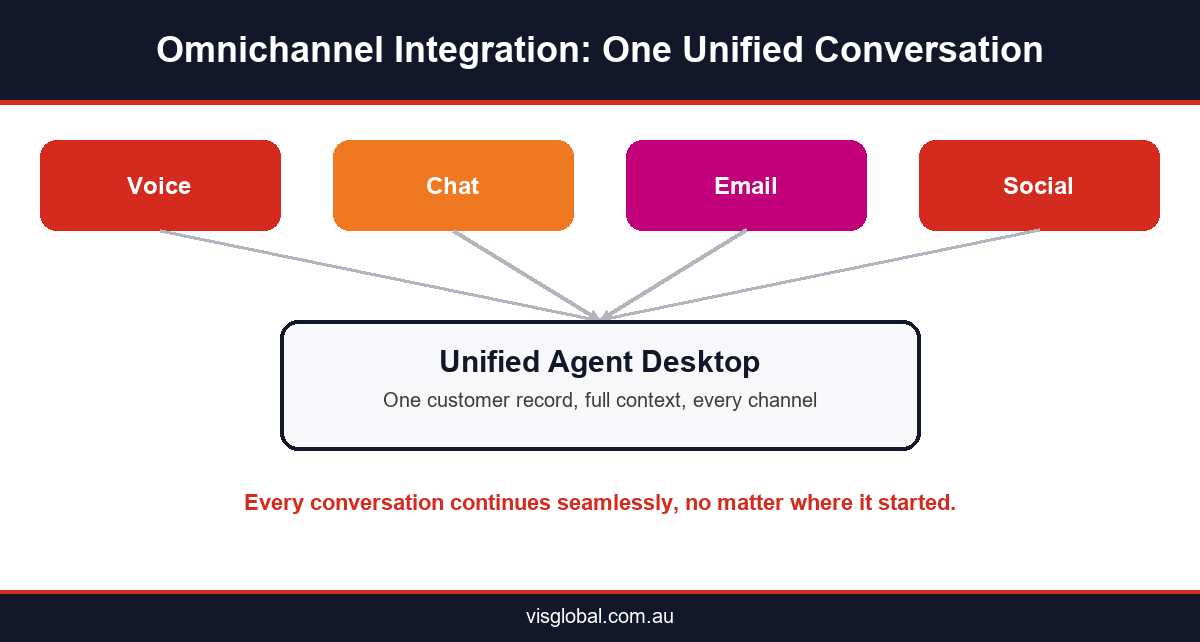
The technical foundation of omnichannel integration is a unified customer record that captures every interaction, regardless of channel, tagged to a single customer identity. Voice calls, chat transcripts, emails, and social messages all write to this same record, giving agents and AI systems a complete interaction history the moment a new contact arrives.
On top of this shared record sits a unified agent desktop, where agents handle contacts from any channel through one interface rather than switching between separate applications for phone, chat, and social. This alone removes a significant source of agent inefficiency and error in contact centres still running channel specific tools.
Routing logic must also work across channels rather than within them. An intelligent routing engine that only considers voice queue position misses the customer who has already spent ten minutes in chat with no resolution. Genuine omnichannel routing weighs effort and context across all channels together, which connects closely to the future of intelligent customer interactions as AI increasingly manages this cross channel complexity.
Social channel integration introduces its own complexity, since platforms like Facebook, Instagram, and WhatsApp each have different message formats, response time expectations, and public versus private conversation dynamics. A properly integrated platform normalises these differences into the same case management workflow used for voice and chat, rather than treating social as an entirely separate operation.
Session handoff between AI and human agents also depends on this shared architecture. When a chatbot or voice bot escalates a conversation, the receiving agent needs the full automated exchange, not just a bare transfer, so that customers never have to repeat what they already told the automated system moments earlier.
Why Omnichannel Beats Multichannel for Customer Experience
Multichannel service offers customers a choice of contact methods, but each channel typically operates in isolation with its own queue and history. Omnichannel service offers the same choice while ensuring every channel draws on the same shared context, which is the difference customers actually notice and value.
The practical impact shows up in reduced repeat contact and faster resolution. When agents no longer need to ask customers to re-explain their issue after a channel switch, average handle time drops and customer satisfaction rises, particularly for the more complex enquiries that tend to span multiple channels before resolution.
Multichannel operations also complicate reporting and quality management, since performance data lives in separate silos that must be manually reconciled. Omnichannel platforms provide a single reporting view across all channels, which is the operational foundation the broader Omnichannel Customer Experience Management in Australia strategy depends on to function effectively at scale.
Employee experience improves alongside customer experience. Agents working from a unified desktop with full context available spend less time hunting for information and more time actually helping the customer, which reduces the frustration that drives contact centre attrition in channel fragmented environments.
Customer expectations have also shifted permanently toward this standard. Enterprises that continue operating disconnected channels are increasingly compared, often unfavourably, against digital native brands and neobanks that have built omnichannel continuity into their service model from the outset, raising the baseline expectation for every enterprise regardless of industry.
Implementing Omnichannel Integration: Practical Considerations for Australian Enterprises
Enterprises moving from multichannel to true omnichannel operation should start by auditing their current channel landscape, identifying which systems hold customer interaction data today and where the gaps in shared visibility actually sit before selecting a platform to close them.
Sequencing matters. Rather than integrating every channel simultaneously, most successful enterprise rollouts start with the two or three highest volume channels, typically voice and chat, prove the unified record and routing model works reliably, then extend to email and social channels once the core architecture is validated.
Consistency across channels should extend to service standards as well as data. Enterprises can align channel response time commitments and escalation handling with guidance such as the Australian Government's Digital Service Standard, which sets useful benchmarks for consistent, accessible digital service delivery across channels.
Change management deserves as much attention as the technology itself. Agents accustomed to channel specific workflows need training and time to adapt to a unified desktop, and enterprises that plan for this transition alongside their technical rollout, ideally with support from an experienced customer experience management partner, see faster adoption and fewer operational disruptions during the switch.
Measurement should be built into the rollout from day one rather than added afterward. Enterprises should track cross channel handoff rate, repeat contact within a single customer issue, and unified resolution time as core success metrics, since these are the indicators that reveal whether the integration is delivering real continuity rather than just technical connectivity between systems.
Omnichannel contact center solutions deliver their real value when voice, chat, email, and social genuinely share one customer record and one continuous conversation, not when they simply sit side by side in the same interface. Enterprises that build this shared foundation see measurable gains in resolution speed, customer satisfaction, and agent efficiency across every channel combined. Contact VIS Global to plan an omnichannel integration strategy for your contact centre.
Frequently Asked Questions
What is the difference between omnichannel and multichannel contact centres?

Multichannel offers several separate contact methods with independent histories, while omnichannel unifies every channel into one continuous customer record, so context carries across channels automatically as customers switch between them.
What technology is needed for omnichannel integration?
Enterprises need a unified customer data record, a shared agent desktop spanning all channels, and cross channel routing logic, typically delivered through a modern CCaaS platform built for omnichannel rather than bolted together point solutions.
Can social media really be integrated with voice and chat?
Properly integrated platforms normalise social messages from Facebook, Instagram, and WhatsApp into the same case management workflow used for voice and chat, despite differing message formats and response expectations.
How long does it take to implement an omnichannel contact centre?
Most enterprises complete a phased omnichannel rollout in eight to twelve weeks, starting with core channels like voice and chat before layering in social messaging and additional integrations across CRM and workforce management systems.
Does omnichannel integration require replacing existing phone systems?
No. Modern omnichannel platforms integrate with existing PBX and telephony infrastructure through APIs and SIP trunking, allowing enterprises to preserve current phone investments while adding unified chat, social, and email channels.
How does omnichannel integration affect agent productivity?
Agents work faster because a single unified desktop eliminates switching between separate applications for each channel, and full conversation history follows the customer automatically, reducing repeated questions and average handling time.
What is the difference between an omnichannel platform and a CRM?
A CRM stores customer records and sales data, while an omnichannel platform manages live conversations across channels and feeds that interaction data back into the CRM, keeping both systems synchronised in real time.
Can small and mid sized businesses benefit from omnichannel integration?
Yes. Cloud based CCaaS platforms make omnichannel integration accessible without large infrastructure investment, letting smaller teams deliver the same connected customer experience as larger enterprises at a fraction of the cost.
How does AI support omnichannel customer service?
AI powers intelligent routing, sentiment analysis, and automated responses across every channel, ensuring queries reach the right agent with full context, regardless of whether the customer started on chat, voice, or social media.
What should businesses look for in an omnichannel contact centre vendor?
Look for proven CRM and telephony integrations, unified reporting across channels, scalable AI capabilities, and local Australian data compliance support, ensuring the platform meets both operational and regulatory requirements long term.