Omnichannel Customer Experience Management in Australia: The Complete Enterprise Guide
 Customer Experience Management
Customers today do not think in channels. They move between voice calls, live chat, email, social media, and in-person interactions without pausing to consider which system sits behind each touchpoint. Yet most Australian enterprises still manage these channels in isolation. Omnichannel customer experience management closes this gap by unifying every interaction under one intelligent platform, giving customers continuity and giving businesses a complete view of every relationship. This guide explains how to build, measure, and scale a winning omnichannel CX strategy in Australia.
Key Takeaways
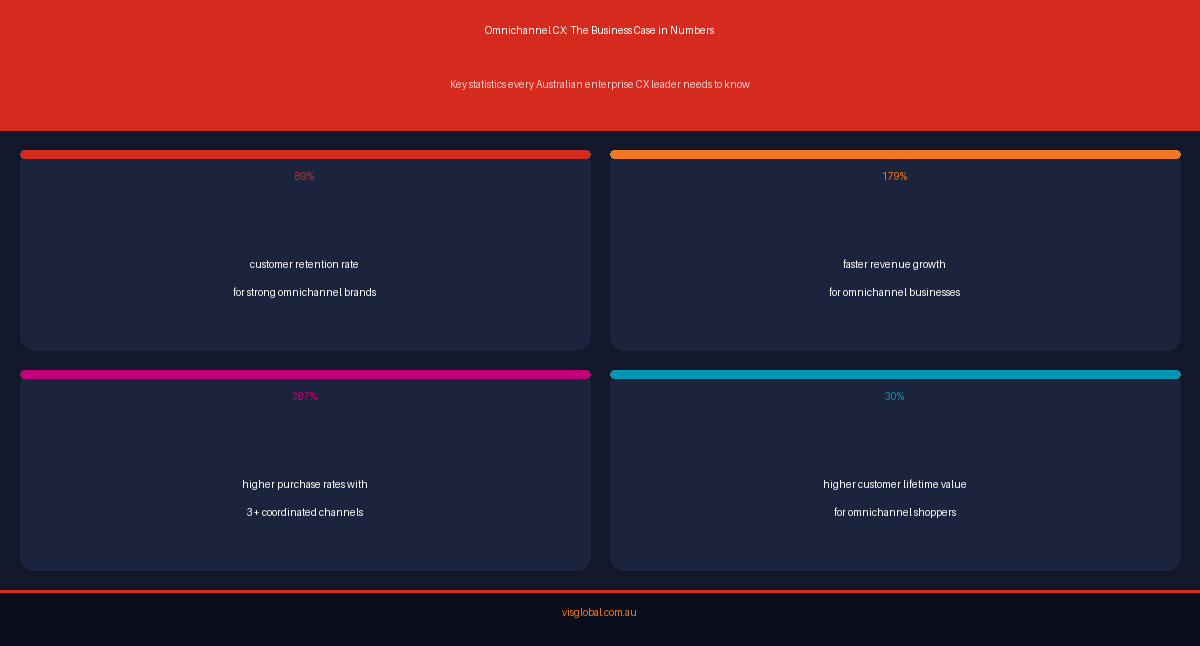
Enterprises with strong omnichannel strategies retain 89% of customers, compared to just 33% for those with weak engagement across channels.
Omnichannel businesses report 179% faster revenue growth and customers who engage across multiple channels carry 30% higher lifetime value.
95.4% of B2C marketers now use AI in their omnichannel strategy, making AI-driven CX a baseline expectation rather than a differentiator.
Why Omnichannel CX Is No Longer Optional for Australian Enterprises
Customer expectations in Australia have shifted permanently. According to KPMG's Customer Experience Excellence report, the top-performing Australian brands are distinguished not by price or product alone but by their ability to deliver empathetic, consistent, and seamlessly connected experiences across every channel. That standard has become the baseline expectation for all enterprises, regardless of sector.
The cost of falling short is significant. Poor customer service puts USD 3.8 trillion in global revenue at risk in 2026. In Australia, 72% of customers switch brands after a single negative experience. These are not abstract statistics. They represent real revenue loss and real competitive risk for organisations that have not yet invested in a unified CX architecture.
At the same time, the opportunity for enterprises that act is substantial. According to omnichannel customer retention research, brands with robust omnichannel engagement retain 89% of customers, compared to just 33% for brands with weak cross-channel performance. Marketers using three or more coordinated channels achieve 287% higher purchase rates than those relying on a single channel. And omnichannel customers spend 16% more per order with 30% higher lifetime value than single-channel buyers.
Australian enterprises across banking, healthcare, government, retail, and BPOs are operating in an environment where customers interact with an average of six touchpoints before making a purchase decision. B2B buyers regularly use ten or more channels during their purchase journey. The organisations winning in this environment are those that have connected these touchpoints into a coherent, AI-powered experience rather than managing them as separate operational silos.
Understanding the Omnichannel Customer Journey
Before building an omnichannel CX platform, it is essential to understand what the omnichannel customer journey actually looks like in practice. It is rarely linear. Customers enter at different points, switch channels mid-journey, and expect every interaction to build on the last. The enterprise that maps and manages this journey holistically gains a significant advantage over those that optimise each channel in isolation.
From Awareness to Loyalty: Mapping Every Touchpoint
A comprehensive omnichannel customer journey map covers every stage from initial awareness through consideration, purchase, post-purchase support, and long-term loyalty. At each stage, multiple channels are active simultaneously. A prospective customer might discover a brand through a social media ad, visit the website on mobile, call the contact centre with a question, complete the purchase online, and then use a chat function for post-sale support.
Each of these interactions generates data. An effective omnichannel customer experience management platform captures and connects that data in real time, creating a single customer record that follows the individual across every channel and every stage. This connected view enables agents and AI systems alike to deliver responses that are contextually relevant rather than generic.
Why Context Continuity Is the Critical Difference
Context continuity is the defining characteristic of genuine omnichannel CX. It means that when a customer who submitted a support request via email then calls the contact centre, the agent immediately sees the email history, understands the issue, and can pick up the conversation without asking the customer to start over.
This sounds simple. But delivering it requires deep integration across CRM systems, communication platforms, contact centre infrastructure, and AI analytics. Most Australian enterprises have the individual components. The gap is in the integration layer that connects them into a unified experience. This is precisely where specialist intelligent automation and omnichannel platform expertise creates measurable value.
AI as the Engine of Omnichannel Customer Experience
Artificial intelligence is not simply a feature within omnichannel CX platforms. It is the operating engine that makes true omnichannel possible at enterprise scale. Without AI, managing consistent, personalised interactions across six or more channels simultaneously would require an impractical volume of human resources. With AI, it becomes operationally achievable and commercially sustainable.
Real-Time Personalisation Across Every Channel
AI-driven personalisation analyses customer data in real time, using purchase history, interaction patterns, sentiment indicators, and behavioural signals to tailor every response to the individual. This capability extends across every channel simultaneously. The same customer receives a personalised email recommendation, a contextually relevant chatbot response, and an informed agent call experience, all driven by the same underlying intelligence layer.
The commercial impact is significant. Businesses excelling in personalisation see 40% higher revenue than competitors. 65% of consumers now expect tailored experiences, and 80% are more likely to purchase from brands that deliver personalised interactions. AI makes this level of personalisation scalable across the full customer base rather than limited to high-value segments.
AI-Driven Sentiment Analysis and Journey Orchestration
AI-powered sentiment analysis monitors customer emotions in real time across voice, chat, and digital channels. When a customer shows signs of frustration, the system triggers an appropriate response: escalation to a human agent, a proactive service recovery offer, or a supervisor alert. This capability transforms reactive customer service into proactive experience management.
Journey orchestration takes this further. AI maps the optimal path for each customer through the journey, dynamically routing interactions, timing outreach, and personalising content based on where the customer is in their decision-making process. According to industry research, proactive AI-driven interactions will outnumber reactive ones by 2026. Australian enterprises that implement journey orchestration today are positioning themselves ahead of this shift.
Building a Unified Omnichannel CX Platform
A unified omnichannel CX platform is the technical foundation that makes everything else possible. It connects every channel, every data source, and every AI capability into a single operating environment. Building this foundation requires both the right technology choices and the right implementation approach.
Integrating Voice, Chat, Email, Social, and Emerging Channels
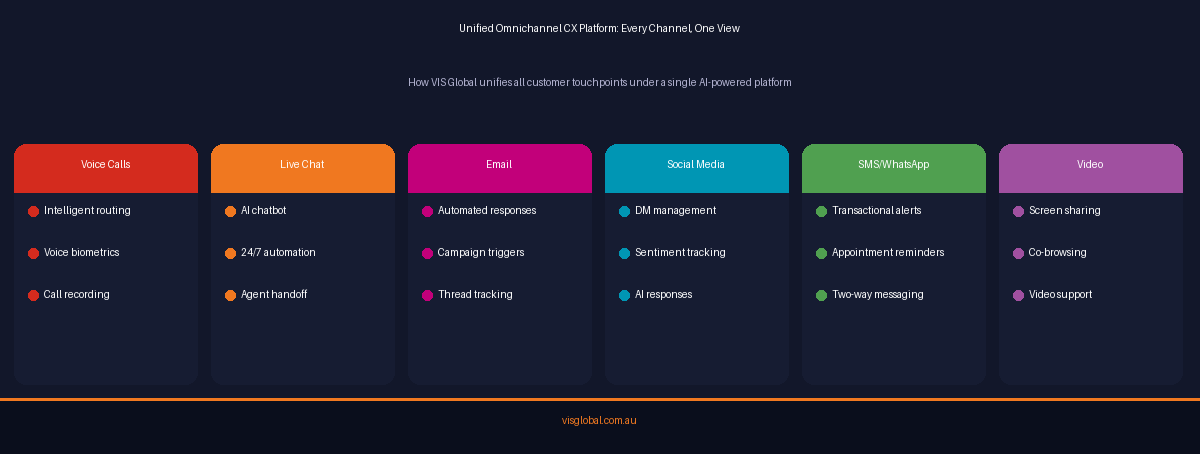
The starting point for any omnichannel platform is channel unification. Voice calls, live chat, email, SMS, social media messaging, video support, and emerging channels like WhatsApp Business must all feed into a single platform that maintains a unified customer record. Each channel integration must be bidirectional, meaning that updates in one channel are immediately reflected across all others.
VIS Global's approach to omnichannel integration goes beyond connecting channels technically. It aligns each channel with the AI capabilities most relevant to that interaction type: voice biometrics for phone authentication, sentiment analysis for chat and email, intelligent routing for voice, and AI-powered response generation for social and messaging channels. The infographic below shows how each channel contributes to the unified platform.
The Role of Customer Data Platforms
A Customer Data Platform (CDP) is the data infrastructure layer that makes omnichannel CX intelligent. It collects, unifies, and activates customer data from every channel and system, creating a persistent, real-time customer profile that is accessible across the entire platform. Without a CDP, personalisation is limited to individual channel histories rather than a complete view of the customer relationship.
For Australian enterprises, CDP implementation requires careful attention to data residency, the Australian Privacy Act, and sector-specific compliance requirements such as APRA CPS 234 for financial services. VIS Global's managed services team ensures that CDP architecture and omnichannel platform deployment meet Australian regulatory standards from day one, avoiding costly compliance remediation after deployment.
Omnichannel CX Across Australian Industries
Omnichannel CX delivers value across all industries, but the specific implementation priorities and compliance requirements vary by sector. Australian enterprises need solutions designed for their regulatory context, not generic international platforms adapted for local markets.
Banking and Financial Services
Australian banks and financial services organisations manage some of the most complex omnichannel environments. Customers interact across mobile banking apps, ATMs, branch visits, phone banking, live chat, and social media, often switching between channels multiple times during a single issue resolution journey.
An effective omnichannel CX platform for the banking sector connects all these touchpoints while maintaining APRA compliance for every interaction. AI-powered sentiment analysis identifies at-risk customers during hardship conversations. Voice biometrics streamline authentication across phone and digital channels. Personalised proactive outreach helps retain customers at renewal and life-event moments. The result is a measurably better customer experience with lower operating cost per interaction.
Healthcare
Healthcare providers across Australia face unique omnichannel challenges. Patients interact through phone bookings, patient portals, telehealth platforms, SMS reminders, and in-person reception. Each touchpoint must deliver empathetic, accurate, and privacy-compliant service.
AI-powered omnichannel CX platforms help healthcare providers automate high-volume routine interactions like appointment scheduling, prescription reminders, and post-discharge follow-up, while ensuring clinical conversations are routed to qualified staff. Strict Australian Privacy Act compliance governs every data interaction, and VIS Global's implementation approach builds compliance into the platform architecture rather than treating it as an afterthought.
Government and Public Sector
Government agencies and local councils serve the full spectrum of the Australian community across an increasingly wide range of channels. Citizens expect to access services via phone, web, app, social media, and in-person counters, with consistent service quality regardless of which channel they choose.
Omnichannel CX platforms help government organisations manage high enquiry volumes cost-effectively, extend service hours through AI automation, and route complex cases to specialist officers. VIS Global's digital workplace solutions connect frontline citizen service tools with back-office workflows, ensuring that omnichannel CX improvements extend across the full government service delivery chain.
Measuring Omnichannel CX Success: KPIs That Matter
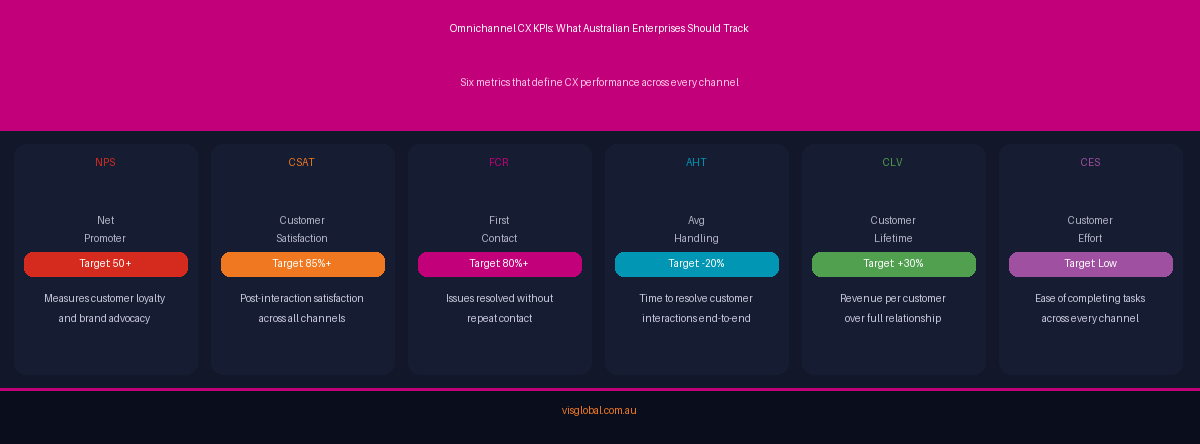
Effective omnichannel CX management requires a measurement framework that captures performance across every channel simultaneously, not just within individual channels in isolation. The following six KPIs provide a comprehensive view of omnichannel CX performance for Australian enterprises.
Net Promoter Score (NPS): Measures overall customer loyalty and advocacy. Target 50 or above for top-quartile performance in the Australian market.
Customer Satisfaction Score (CSAT): Post-interaction satisfaction rating across all channels. Target 85% or above to benchmark against leading Australian brands.
First Contact Resolution (FCR): The percentage of issues resolved without requiring a follow-up interaction. Target 80% or above. FCR is the single most powerful driver of customer satisfaction.
Average Handling Time (AHT): Time from first contact to issue resolution. AI automation should drive a 20% or greater reduction within 12 months of platform deployment.
Customer Lifetime Value (CLV): Revenue generated per customer over the full relationship. Omnichannel engagement should drive a 30% or greater CLV increase versus single-channel customers.
Customer Effort Score (CES): How much effort customers must expend to resolve an issue. Lower is better. High-effort experiences are the primary driver of channel switching and churn.
According to omnichannel revenue growth data, organisations with effective omnichannel strategies report 179% faster revenue growth than those without integrated channel strategies. Tracking these KPIs provides the evidence base to continuously optimise the platform and demonstrate ROI to leadership.
How to Build Your Omnichannel CX Strategy: A Practical Roadmap
Building an effective omnichannel CX strategy is a structured process. Organisations that rush to platform selection without first completing the foundational steps consistently underperform those that invest in strategy before technology.
Step 1: Audit current channel performance. Map every active customer channel and score each on: customer satisfaction, resolution rate, volume, and cost per interaction. This audit identifies your highest-impact improvement opportunities and informs investment prioritisation.
Step 2: Define the ideal customer journey. For your top three customer segments, map the full journey from awareness to loyalty. Identify the moments of highest friction and the touchpoints where context continuity currently breaks down. These are your primary design targets.
Step 3: Select a unified platform. Choose a platform that natively unifies all your active channels, supports your compliance requirements, integrates with your existing CRM and back-office systems, and includes AI capabilities across routing, personalisation, and analytics.
Step 4: Implement in phases. Start with your highest-volume, highest-friction channel combinations. Prove ROI at each phase before expanding. A phased approach reduces risk and builds internal confidence in the transformation.
Step 5: Measure continuously and optimise. Establish your KPI baseline before go-live, then track weekly. Use AI analytics to identify patterns and optimise routing, content, and channel strategies based on real performance data.
Step 6: Engage a specialist partner. Omnichannel CX transformation involves technology, process redesign, compliance, and change management simultaneously. Partnering with a specialist like VIS Global gives you access to local expertise, proven methodology, and ongoing managed support.
Conclusion
Omnichannel customer experience management is the defining competitive capability for Australian enterprises in 2026. The gap between organisations that have unified their channels under an AI-powered platform and those still managing channels in isolation is widening every quarter. The statistics are unambiguous: 89% retention, 179% faster revenue growth, 287% higher purchase rates. These outcomes are achievable. But they require a committed strategy, the right technology, and a partner who understands both the opportunity and the Australian market. To start building your omnichannel CX strategy, speak with our team today.