On-Premise to Cloud Contact Center: A Step-by-Step Migration Guide
 Digital Transformation
On-Premise to Cloud Contact Center: A Step-by-Step Migration Guide
Migrating an Australian contact centre from on-premise infrastructure to a cloud platform is one of the most consequential operational decisions an enterprise technology team will make. Done well, it unlocks significant cost efficiencies, AI-powered capabilities, and operational flexibility that legacy systems cannot provide. Done poorly, it disrupts customer service, creates compliance exposure, and generates remediation costs that dwarf the original project budget. This step-by-step guide covers every phase of the migration journey, from initial discovery through to long-term managed operations. VIS Global's managed services team has delivered contact centre cloud migrations for Australian enterprises across multiple sectors.
Key Takeaways
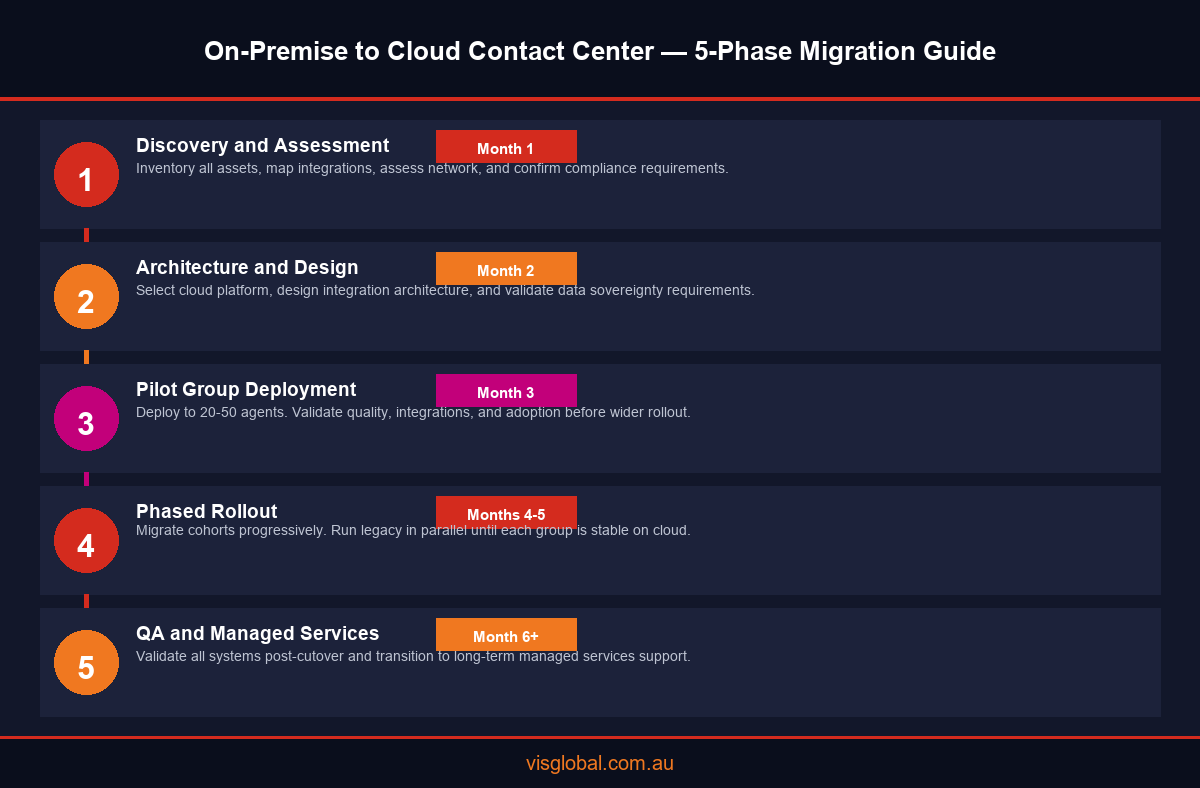
A five-phase migration approach — discovery, architecture, pilot, phased rollout, and managed services — reduces risk and delivers predictable outcomes.
The discovery phase must surface all legacy integrations, compliance obligations, and network requirements before any platform selection occurs.
Running legacy systems in parallel during phased cutover provides a rollback path and significantly reduces the risk of service disruption.
Phase 1: Discovery and Assessment
Discovery is the foundation on which every subsequent migration decision rests. An incomplete discovery phase is the single most common cause of contact centre migration failures. The discovery process maps every communications asset in the organisation: PBX systems, physical handsets, softphone licences, conference room technology, fax-to-email services, IVR configurations, call recording systems, and integration points with CRM, workforce management, and ticketing platforms. Compliance requirements are mapped in parallel: APRA obligations for financial services, Privacy Act requirements for data handling, and ASD standards for government.
Network readiness assessment runs alongside asset discovery. Cloud voice requires consistent low-latency connectivity with QoS configuration. Sites with insufficient bandwidth or misconfigured QoS will experience degraded call quality after cutover regardless of how well the platform is configured. Network assessment findings directly inform the migration sequence: sites with marginal connectivity need remediation before their cutover date, not after.
Phase 2: Platform Selection and Architecture Design
Platform selection follows discovery. At this stage, the organisation has a clear picture of its requirements: scale, channel mix, compliance obligations, integration dependencies, and budget. Vendors are evaluated against these requirements, not against generic feature lists. Australian data residency, APRA or Privacy Act compliance certifications, and integration with existing systems are non-negotiable requirements for most Australian enterprises. A proof of concept with shortlisted vendors validates performance before contract commitment. This process aligns with VIS Global's approach to customer experience management platform design, ensuring the chosen solution supports the full CX roadmap.
Architecture design specifies how the cloud platform connects to existing systems, how security controls are implemented, how call recordings are stored and retained, and how reporting data flows to analytics tools. A documented architecture design reviewed by the security team before deployment begins prevents the compliance gaps that emerge when security is considered only after go-live.
Phase 3: Pilot Deployment and Validation
The pilot phase deploys the cloud platform to a representative group of 20 to 50 agents before full rollout. The pilot group should include agents from different teams, locations, and device types to surface issues that would not appear in a homogeneous test group. During the pilot, the IT team monitors call quality metrics, integration performance, and agent adoption closely. Issues identified during the pilot are resolved before the full rollout begins, significantly reducing the incident rate during subsequent cohort migrations. Review our case studies for pilot deployment outcomes from Australian contact centre migrations.
Agent feedback during the pilot is as important as technical metrics. Agents who experience friction with the new platform during the pilot will communicate that frustration to colleagues before the rollout reaches them. Addressing usability issues and training gaps during the pilot phase — rather than after full deployment — dramatically improves adoption rates across the organisation.
Phase 4 and 5: Phased Rollout and Long-Term Operations
Phased rollout migrates the remaining agent population in planned cohorts, typically by team, site, or function. Legacy systems remain live in parallel throughout the rollout, providing a rollback path for any cohort that experiences significant issues. The parallel run period is decommissioned progressively as each cohort stabilises on the cloud platform. Post-migration QA validates that all systems are performing as designed before transition to long-term managed services support, which handles ongoing monitoring, security patching, user provisioning, and platform optimisation as the contact centre environment evolves.
Conclusion
A structured, phased approach to on-premise to cloud contact centre migration transforms a high-risk event into a predictable programme with clear milestones, managed risk, and measurable outcomes at each stage. The enterprises that achieve the smoothest migrations invest as much in discovery and planning as they do in deployment and cutover. Contact VIS Global to begin your contact centre migration planning with our Australian specialist team.