RPA vs Intelligent Automation: What Australian Enterprises Need to Know
 Digital Transformation
RPA vs Intelligent Automation: What Australian Enterprises Need to Know
Robotic process automation and intelligent automation are often used interchangeably in vendor materials and industry reports. They are not the same thing. Understanding the distinction is essential for Australian enterprises making automation investment decisions, because choosing the wrong approach for a given use case leads to poor outcomes, wasted budget, and frustrated IT teams. This guide clarifies what each approach delivers, where each performs best, and how VIS Global's intelligent automation capabilities help organisations move beyond basic RPA to full CX automation.
Key Takeaways
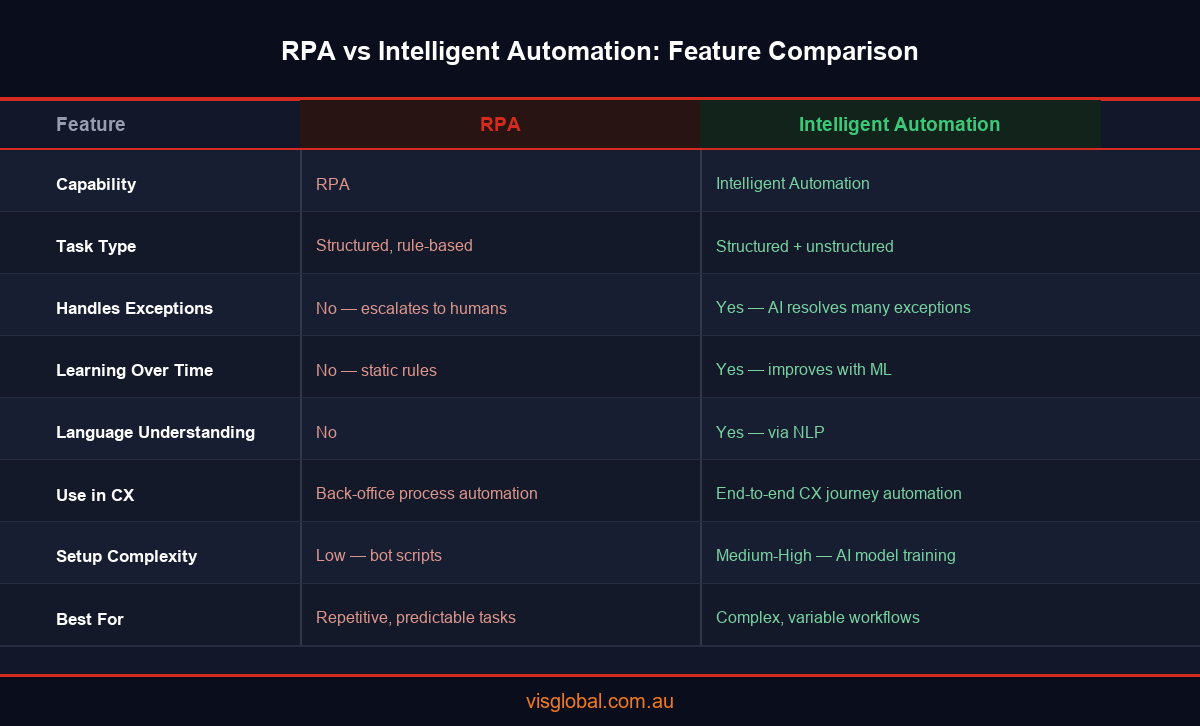
RPA automates structured, rule-based tasks using software bots that mimic human actions — it cannot handle exceptions or unstructured data.
Intelligent automation combines RPA with AI technologies such as NLP and machine learning to handle complex, variable workflows end to end.
Australian enterprises achieving the greatest CX outcomes deploy both in combination, using RPA for high-volume back-office tasks and IA for customer-facing journeys.
What Is RPA and Where Does It Excel?
Robotic process automation uses software bots that interact with applications the same way a human operator would: opening screens, reading fields, entering data, and triggering actions. RPA is highly effective for structured, high-volume, rule-based processes where the steps are predictable and the data is clean. Common RPA use cases in Australian enterprises include invoice processing, data migration between systems, report generation, and compliance data extraction. According to IDC research, organisations deploying RPA for back-office processes achieve 40 to 70 percent reductions in manual processing time within the first six months of deployment.
The limitation of RPA is its brittleness. When a process changes, when data arrives in an unexpected format, or when an exception occurs that was not anticipated in the bot script, RPA fails and escalates to a human. This makes pure RPA a poor fit for customer-facing processes, where variation and exceptions are the norm rather than the edge case.
What Is Intelligent Automation and How Does It Go Further?
Intelligent automation extends RPA by adding AI capabilities: natural language processing to understand unstructured text and speech, machine learning to identify patterns and improve over time, and process mining to discover automation opportunities from system logs. The result is an automation layer that can handle variation, resolve exceptions without human escalation, and continuously improve its own performance. In the context of customer experience management, IA enables end-to-end automation of customer journeys rather than isolated back-office tasks.
For Australian enterprises, the practical difference is visible in contact centre operations. RPA can automate the post-call wrap-up process by updating CRM records automatically. IA can go further: analysing the call transcript in real time, identifying the customer intent, triggering the appropriate back-end process, and generating a personalised follow-up without any agent involvement.
RPA vs Intelligent Automation: Choosing the Right Approach
The choice between RPA and intelligent automation is not binary. For most Australian enterprises, the right answer depends on the nature of the process being automated. RPA is the correct starting point for high-volume, structured back-office tasks where speed and cost reduction are the primary objectives. Intelligent automation is required when the process involves unstructured inputs such as emails, chat messages, or scanned documents, when exceptions are frequent, or when the automation needs to interact directly with customers.
A useful decision framework: if a new employee could follow a written checklist to complete the task without making any judgements, RPA is appropriate. If the task requires reading context, interpreting meaning, or handling variation, intelligent automation is required. Organisations in the banking sector commonly deploy RPA for regulatory reporting and reconciliation, while using IA for customer onboarding and dispute resolution workflows. For a complete view of intelligent automation in Australia, the enterprise guide covers platform selection, implementation sequencing, and ROI measurement.
How Australian Enterprises Are Combining Both
The most mature automation programmes in Australia use RPA and intelligent automation as complementary layers rather than competing alternatives. RPA handles the high-volume, predictable back-office layer: payroll processing, data entry, report generation. Intelligent automation handles the variable, judgement-intensive layer: customer communications, complaint triage, exception management, and real-time CX personalisation.
Organisations beginning their automation journey should start with RPA for quick wins on structured back-office processes, then progressively introduce intelligent automation for higher-complexity CX use cases. This phased approach manages risk, delivers early ROI, and builds the data foundation that AI models require to perform well.
Conclusion
RPA and intelligent automation each have a role in the modern Australian enterprise. The organisations achieving the best outcomes are those that understand the difference, deploy each approach where it performs best, and build a roadmap that progressively expands automation coverage across both back-office and customer-facing processes. Contact VIS Global to discuss which automation approach is right for your organisation's next CX improvement initiative.