Securing the Digital Workplace: Compliance for Australian Enterprises
 Digital Transformation
Securing the Digital Workplace: Compliance for Australian Enterprises
The expansion of hybrid work has dramatically increased the attack surface of the Australian enterprise. Employees accessing corporate systems from home networks, personal devices, and public Wi-Fi create security vulnerabilities that traditional perimeter-based security models cannot address. For organisations in banking, healthcare, and government, the stakes are compounded by strict regulatory obligations under the Privacy Act 1988 and the Australian Cyber Security Centre Essential Eight framework, which mandate proactive security controls across all digital workplace environments.
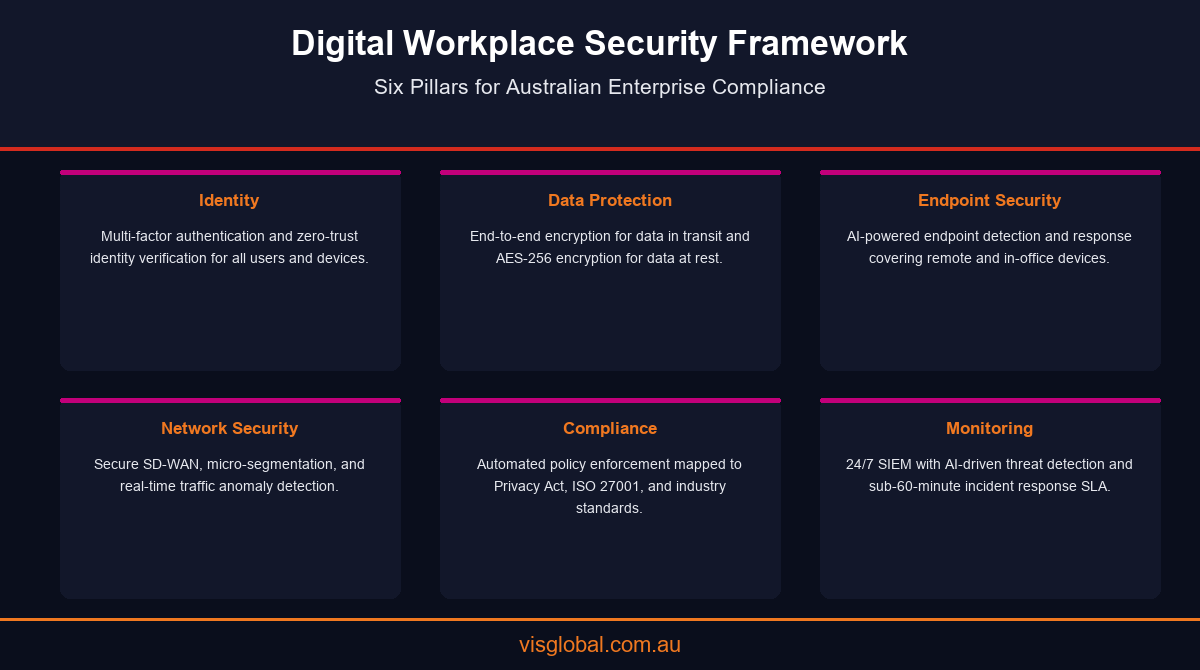
This guide covers the six pillars of digital workplace security for Australian enterprises, the compliance requirements that apply to hybrid and remote work environments, and the practical steps organisations should take to protect their people, data, and customers.
Key Takeaways
Digital workplace security requires a zero-trust architecture that verifies every user, device, and connection regardless of location.
Australian enterprises must align digital workplace security controls with the Privacy Act 1988, Essential Eight, and industry-specific standards.
Secure collaboration tools with built-in compliance features reduce configuration risk and accelerate audit readiness.
The Security Challenge of the Modern Digital Workplace
Traditional enterprise security was built around the office perimeter: secure the network boundary, trust everything inside. The modern digital workplace has rendered this model obsolete. When employees connect from dozens of different locations, on a mix of corporate and personal devices, using cloud applications that sit outside the corporate network, there is no longer a meaningful perimeter to defend.
Zero-trust security is the replacement model. Under zero-trust, every user, device, and application must be authenticated and authorised before accessing any resource, regardless of whether the request originates inside or outside the corporate network. For Australian enterprises, implementing zero-trust across a hybrid workforce requires coordinated investment in identity management, endpoint security, network controls, and continuous monitoring, all mapped to the compliance requirements of the regulatory frameworks that apply to your industry.
The ACSC reports that 76 percent of Australian businesses experienced a cybersecurity incident in the past 12 months, with phishing and credential compromise being the leading attack vectors. Both of these vectors target the human layer of the digital workplace: the employee using collaboration tools from a home office, often without the security awareness training or technical controls that would protect the same action in a corporate environment.
Key Compliance Requirements for Australian Digital Workplaces
Australian enterprises must align digital workplace security controls with multiple overlapping regulatory frameworks. The Privacy Act 1988 and the Notifiable Data Breaches scheme require that personal information held by the organisation is protected by reasonable security safeguards. For digital workplaces, this means encryption of customer data in transit and at rest, access controls that limit data visibility to authorised users, and documented incident response procedures. Full details are available at oaic.gov.au.
The ACSC Essential Eight provides a prioritised set of mitigation strategies that Australian government agencies are required to implement and that private sector organisations in critical industries are strongly encouraged to adopt. The eight strategies include application control, patching applications and operating systems, restricting administrative privileges, enabling multi-factor authentication, and regular backups. For digital workplace environments, MFA and application control are the highest-priority controls because they directly address the credential compromise and malware vectors most commonly exploited in hybrid work contexts.
Industry-specific standards add further obligations. Banking organisations must comply with APRA Prudential Standard CPS 234, which mandates information security capability commensurate with the threats and vulnerabilities relevant to the enterprise. Healthcare organisations must comply with My Health Records Act data handling requirements. Engaging a managed security services partner with Australian regulatory expertise ensures that digital workplace security controls are correctly mapped to the specific obligations that apply to your organisation.
Conclusion
Securing the digital workplace in Australia requires a zero-trust security architecture, compliance alignment with the Privacy Act and Essential Eight, and the right combination of secure collaboration tools and managed security services. Organisations that invest in a structured security framework protect their customers, their employees, and their regulatory standing. If your enterprise is ready to assess its digital workplace security posture, speak with VIS Global to design a security and compliance roadmap tailored to your industry.