Unified Communications Australia: Connecting Distributed Workforces
 Digital Transformation
Unified Communications Australia: Connecting Distributed Workforces
Australian enterprises are managing increasingly distributed workforces across multiple cities, states, and in many cases, across the Asia-Pacific region. Voice calls, video conferencing, instant messaging, and file sharing sit across separate platforms, creating communication friction that slows decisions and fragments the customer experience. Unified communications solutions bring all these channels together in a single, integrated platform, giving every team member a consistent and capable communication experience regardless of their location.
This guide explains what unified communications means for Australian enterprises, the business case for UCaaS adoption, and the key factors to consider when evaluating an enterprise communication platform for a distributed workforce.
Key Takeaways
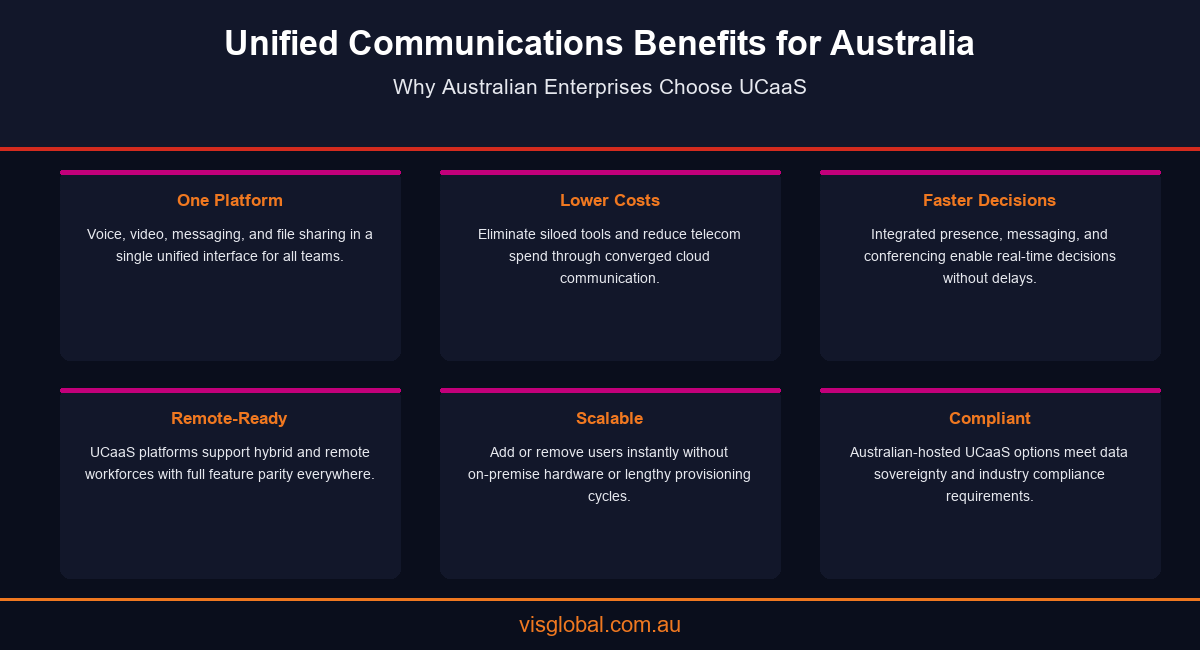
Unified communications consolidates voice, video, messaging, and collaboration in one platform, reducing tool sprawl and operational cost.
UCaaS platforms deliver full feature parity for remote and in-office employees, supporting hybrid workforce strategies at scale.
Australian enterprises should evaluate data sovereignty, uptime SLAs, and integration depth when selecting a UCaaS provider.
What Unified Communications Means for Australian Enterprises
Unified communications (UC) is the integration of real-time and asynchronous communication tools into a single platform. A UC platform replaces the fragmented stack of a separate desk phone system, a standalone video conferencing tool, a team messaging app, and an email-only collaboration environment with one interface that handles all of them. UCaaS (Unified Communications as a Service) delivers this capability from the cloud, making it accessible to Australian enterprises without large upfront infrastructure investment. For digital workplace teams managing hybrid and remote staff, UCaaS is particularly valuable because it provides full feature parity: a remote employee in Brisbane has access to the same communication tools as a colleague in the Sydney head office.
The Australian UCaaS market has grown significantly over the past three years, driven by hybrid work adoption and the retirement of legacy on-premise PBX systems. Organisations in banking, healthcare, government, and BPO are leading adoption, driven by compliance requirements that demand detailed communication audit trails and data sovereignty assurance.
Core Components of an Enterprise Communication Platform
An enterprise-grade unified communications platform must deliver four core capabilities to be effective for a distributed Australian workforce. First, integrated voice and video: a softphone or IP phone that uses the same platform as the video conferencing tool, so transfers between modalities are seamless. Second, persistent team messaging: a channel-based messaging environment where conversations, files, and decisions are searchable and accessible to the full team.
Third, presence and availability management: real-time visibility into whether a colleague is on a call, in a meeting, or available, so team members make informed decisions about when to reach out rather than interrupting unnecessarily. Fourth, deep CRM and helpdesk integration: for Australian contact centres, the UC platform must connect with the CRM so that agents have full customer context visible during every voice or video interaction. This integration is central to the customer experience management strategy for any enterprise deploying UC at scale.
Evaluating UCaaS Providers for the Australian Market
Australian enterprises face specific requirements when evaluating UCaaS providers that differ from global market considerations. Data sovereignty is the primary concern: customer communication data, including call recordings, chat logs, and voicemail, must be stored in Australia for organisations in regulated industries. Confirm that your UCaaS provider operates Australian data centres and that data does not transit through jurisdictions without equivalent privacy protections under the Privacy Act 1988.
Uptime SLAs are the second critical factor. Enterprise voice communication is not a best-effort service. Organisations that replace their on-premise PBX with UCaaS are accepting cloud availability as a substitute for the reliability of physical infrastructure. Require a minimum 99.99 percent uptime SLA with financial penalties for breach. Third, evaluate integration depth: the best UCaaS platforms offer native connectors to Salesforce, ServiceNow, and Microsoft 365, reducing the integration effort required to connect the communication layer to your existing enterprise systems. Speak with a managed services partner to assess integration complexity before signing a long-term UCaaS contract.
Conclusion
Unified communications in Australia is no longer a future-state aspiration; it is the operational foundation for enterprises managing distributed workforces at scale. The right UCaaS platform reduces tool sprawl, cuts communication costs, and ensures that every employee, regardless of location, has a consistent and compliant communication experience. If your organisation is evaluating enterprise communication platforms for your distributed workforce, speak with VIS Global to design a solution aligned with your industry and compliance requirements.