
CCaaS vs On-Premise: Choosing the Right Contact Center Model in Australia
Contact Centre as a Service (CCaaS) has moved from emerging technology to the dominant deployment model for Australian enterprises building or upgrading their contact centre capability. Yet a significant number of organisations continue to operate on-premise infrastructure, either because of sunk cost inertia, compliance uncertainty, or genuine operational requirements. This guide provides a clear framework for evaluating CCaaS against on-premise, structured around the criteria that matter most to Australian IT and operations decision-makers. VIS Global's customer experience management team has advised Australian enterprises across banking, healthcare, and BPO on this decision.
Key Takeaways
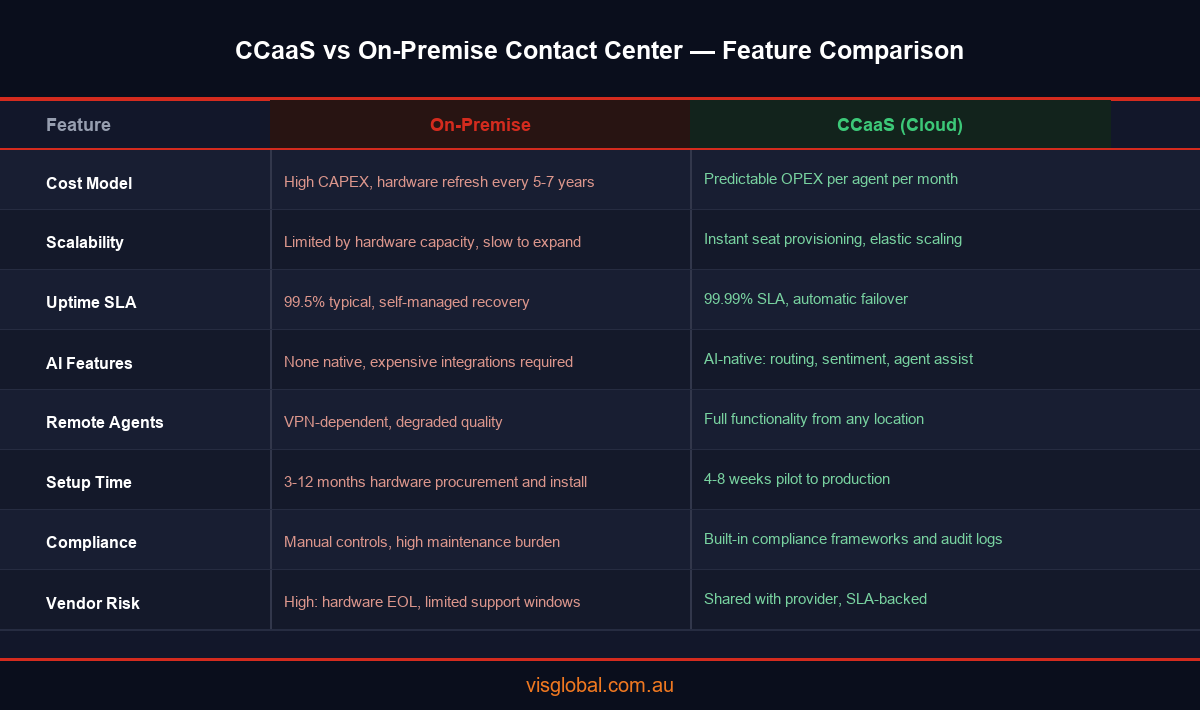
CCaaS delivers lower total cost of ownership than on-premise for most Australian enterprises, with OPEX pricing replacing high CAPEX hardware cycles.
CCaaS enables AI-native capabilities — intelligent routing, sentiment analysis, agent assist — that on-premise systems cannot support without costly custom integrations.
On-premise may remain appropriate for organisations with unique security classifications or legacy integrations that cloud platforms cannot replicate.
Cost Model: CAPEX vs OPEX
On-premise contact centre infrastructure requires significant upfront capital expenditure: servers, networking hardware, telephony equipment, software licences, and the professional services cost of initial deployment. This CAPEX is followed by recurring costs for hardware maintenance, software support contracts, and eventual refresh cycles every five to seven years. Total cost of ownership for a 100-seat on-premise contact centre typically runs to AUD 2 to 4 million over a five-year period. CCaaS replaces this with predictable per-agent subscription pricing. For the same 100-seat operation, IDC research indicates CCaaS reduces five-year total cost of ownership by 30 to 45 percent for mid-market enterprises.
The cost comparison shifts further in CCaaS's favour when network and power infrastructure costs are included. On-premise contact centres require dedicated network capacity, server room facilities, power and cooling, and IT staff to manage the physical environment. CCaaS eliminates all of these costs. The IT team manages users and configuration through a browser-based administration console rather than physical infrastructure.
AI and Innovation Capabilities
The most significant strategic difference between CCaaS and on-premise is the pace of AI innovation. CCaaS platforms are cloud-native and continuously updated with new AI capabilities: intelligent routing based on agent skills and customer history, real-time sentiment analysis, AI-powered agent assist that suggests responses during live interactions, automated post-call summarisation, and conversational AI for self-service channels. These capabilities are available as features of the platform subscription, not as separate projects requiring months of custom development. On-premise systems can integrate some AI capabilities, but each integration requires bespoke development, ongoing maintenance, and compatibility management across system upgrades. Explore the AI capabilities available through VIS Global's intelligent automation platform, which integrates natively with CCaaS environments.
Compliance and Security: Addressing the On-Premise Myth
The most common objection to CCaaS in regulated Australian sectors is the assumption that on-premise is inherently more secure. This assumption is not supported by evidence. On-premise security depends entirely on the organisation's own security investment, patch management discipline, and incident response capability. Enterprise CCaaS platforms operated by specialist providers typically deliver stronger security posture than the majority of self-managed on-premise environments, with ISO 27001, SOC 2 Type II, and IRAP certifications backed by full-time security engineering teams. For banking sector organisations, APRA-compliant CCaaS platforms with Australian data residency satisfy CPS 231 and CPS 234 requirements through pre-built compliance frameworks.
The compliance question for CCaaS comes down to vendor selection and contractual protections, not deployment model. Organisations that select CCaaS vendors with the right certifications, negotiate appropriate data sovereignty contractual commitments, and implement the security controls described in their risk assessments will achieve superior compliance outcomes compared to on-premise alternatives that require the same controls to be implemented and maintained entirely by internal teams.
When On-Premise May Still Be Appropriate
On-premise contact centre infrastructure remains appropriate in a small number of specific scenarios. Organisations with classified government workloads at the Protected or above classification level may face requirements that current commercial CCaaS platforms cannot satisfy. Operations with extremely low-latency requirements driven by real-time trading or critical infrastructure may have technical constraints that cloud introduces. And organisations with recent, high-value hardware investments may find that the remaining asset life justifies a delayed migration. For most Australian enterprises outside these specific scenarios, the operational and financial case for CCaaS is compelling. Review our case studies for examples of Australian organisations that have successfully made the transition.
Conclusion
For the majority of Australian contact centres, CCaaS delivers lower cost, greater agility, and access to AI-powered capabilities that on-premise systems cannot match. The compliance and security concerns that once justified on-premise deployment have been addressed by purpose-built enterprise CCaaS platforms with Australian data residency and sector-specific compliance frameworks. The strategic question is no longer whether to move to CCaaS, but how to do so in a way that minimises risk and maximises value. Contact VIS Global to discuss the right contact centre model for your organisation's specific requirements.