
Australian enterprises are under mounting pressure to modernise their communication infrastructure. Legacy systems are expensive to maintain, difficult to scale, and increasingly misaligned with the expectations of a hybrid workforce and digital-first customers. Cloud migration services in Australia have moved from a future consideration to an urgent operational priority. This guide covers everything enterprise leaders need to know about migrating communication systems to the cloud, from building the business case to selecting the right partner and navigating Australian compliance requirements.
↵
Key Takeaways
Cloud migration reduces communication infrastructure costs by 30 to 50 percent while enabling rapid scalability for Australian enterprises.
A phased migration approach minimises disruption and accelerates time to value for contact centres, unified communications, and collaboration platforms.
Selecting a partner with deep Australian regulatory knowledge and end-to-end managed services capability is critical for compliance and long-term ROI.
↵
Why Australian Enterprises Are Moving Communication Systems to the Cloud
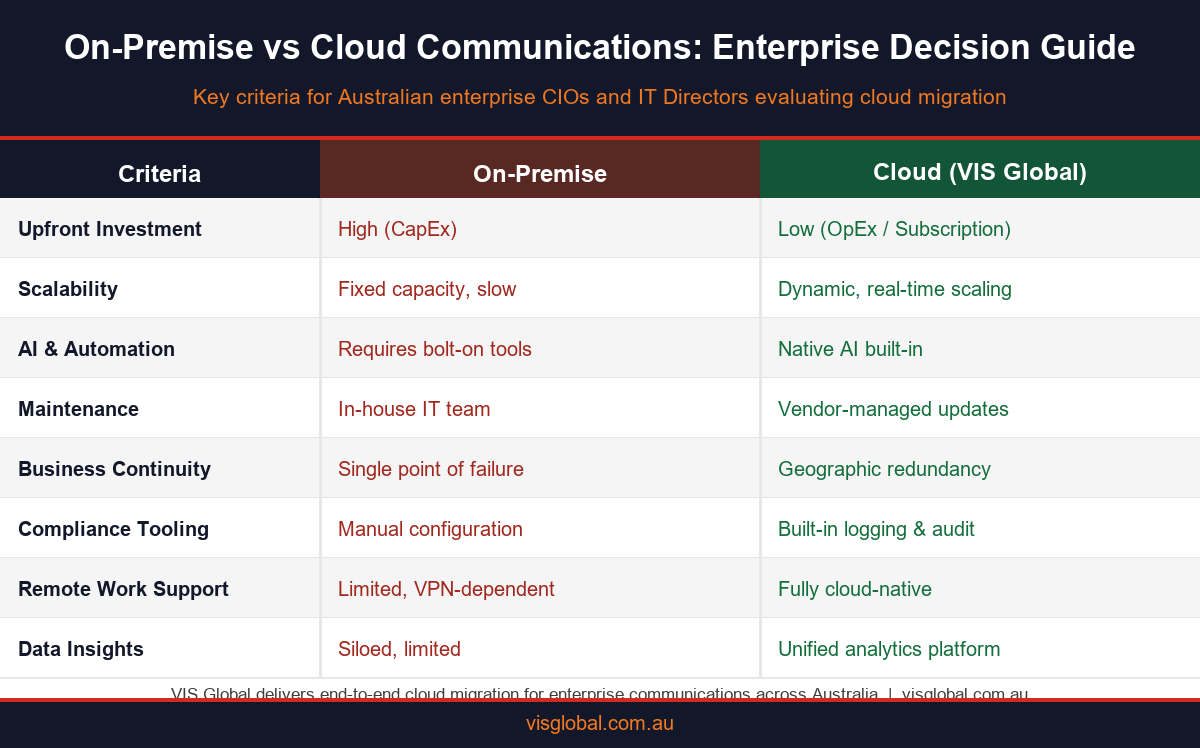
The pressure on Australian organisations to migrate communication infrastructure is intensifying. Legacy on-premise systems, many deployed a decade or more ago, were not designed for the demands of modern enterprise. They struggle to support remote work at scale, lack native AI integration, and generate disproportionate maintenance costs.
The shift to cloud-based communication is accelerating across every major sector.
↵
In banking and financial services, cloud platforms deliver the agility needed to meet evolving customer expectations and regulatory obligations. In healthcare, cloud communications underpin telehealth expansion and patient engagement. In government, cloud migration enables more responsive service delivery and secure data handling at scale.
There is also a talent dimension. Skilled IT professionals increasingly prefer working with modern cloud environments. Organisations still running legacy PBX and on-premise contact centre infrastructure face growing recruitment and retention disadvantages. The COVID-19 pandemic served as a permanent catalyst, shifting boardroom thinking about infrastructure resilience. Organisations that had already begun cloud migrations pivoted to remote operations within days. Those dependent on on-premise systems faced weeks of disruption.
↵
The Cost of Legacy Communication Infrastructure
Legacy communication systems carry a hidden cost burden that organisations routinely underestimate. Direct costs include hardware refresh cycles, software licensing, on-site maintenance, and specialist support contracts. Indirect costs include system downtime, poor integration with modern CRM and workflow platforms, and the productivity drag of fragmented communication tools.
↵
Research indicates that Australian enterprises running legacy contact centre infrastructure spend up to 40 percent more per agent seat than peers on modern cloud platforms. For a 200-seat contact centre, that premium compounds into millions of dollars annually. Cloud migration resets that cost structure, shifting from capital expenditure to a predictable, consumption-based operating model.
↵
Regulatory and Compliance Drivers in Australia
Australia's regulatory landscape is actively pushing enterprises toward cloud-based communication. The Australian Prudential Regulation Authority has updated its CPG 235 guidelines on data management, with implications for how financial services firms handle communication records. The Privacy Act 1988 and the Notifiable Data Breaches scheme require organisations to maintain rigorous control over personal information, including data transmitted through communication systems.
↵
Modern cloud platforms from certified providers offer built-in compliance tooling, encryption at rest and in transit, and audit logging that legacy systems cannot match. For regulated industries, cloud migration is not just an efficiency play; it is a compliance imperative.
↵
Understanding Cloud Migration for Enterprise Communications
Cloud migration for enterprise communications is not a single event. It is a structured transition of communication systems, including contact centres, unified communications, telephony, collaboration platforms, and customer engagement tools, from on-premise or hosted infrastructure to cloud-delivered services.
↵
The scope varies by organisation. Some enterprises begin with a lift-and-shift approach, rehosting existing systems on cloud infrastructure with minimal architectural change. Others pursue a full re-platforming, adopting cloud-native communication platforms with AI, analytics, and automation built in. For most Australian enterprises, a hybrid migration path offers the best balance. Core communication systems migrate in phases, with legacy components maintained in parallel until full cutover is validated. This approach reduces risk, preserves continuity, and allows teams to build cloud competency progressively.
↵
Types of Cloud Deployment Models
Public cloud deployments: such as those on AWS, Azure, or Google Cloud, offer the highest scalability and lowest upfront cost. They are well suited for contact centre as a service (CCaaS) platforms and unified communication tools where standardisation is acceptable.
Private cloud deployments: give organisations dedicated infrastructure with greater control over data residency and security configuration. They are preferred by financial services and government agencies with stringent data sovereignty requirements.
Hybrid cloud models: combine public and private cloud resources, allowing sensitive workloads to remain on dedicated infrastructure while less sensitive communication functions leverage public cloud economics. This model is increasingly common in Australian banking and healthcare.
↵
Key Communication Systems to Migrate
A comprehensive enterprise communications migration typically covers contact centre platforms (inbound and outbound voice, digital channels, and AI routing), unified communications systems (voice, video, messaging, and presence), telephony infrastructure replacing legacy PBX, collaboration platforms, and customer engagement tools including chatbots, IVR systems, and voice biometrics. Intelligent automation solutions are frequently deployed in parallel with migration to maximise the value of the cloud transition. Migration sequencing matters. Contact centre platforms typically deliver the highest immediate ROI and are prioritised in phase one. Our guide on cloud contact centre solutions in Australia covers the capabilities, compliance requirements, and CX outcomes enterprise leaders should expect from the transition.
↵
The Business Case: ROI of Cloud Communication Migration
Building a compelling business case for cloud migration requires translating technical change into financial and operational outcomes. For enterprise leaders, the conversation must move beyond infrastructure costs to encompass productivity, customer experience, and competitive positioning.
↵
The financial case is substantial. Cloud contact centre platforms reduce average cost per interaction by 25 to 35 percent through automation, intelligent routing, and self-service deflection. Unified communications in the cloud reduce travel and facilities costs by enabling effective hybrid work. Consumption-based pricing eliminates idle capacity costs inherent in on-premise provisioning. Beyond direct cost savings, cloud migrations unlock revenue-adjacent benefits. Faster deployment of new communication capabilities reduces time to market for customer experience improvements. AI-powered analytics, native to cloud platforms, provide insights that drive agent performance and customer satisfaction.
↵
Cost Savings and Operational Efficiency
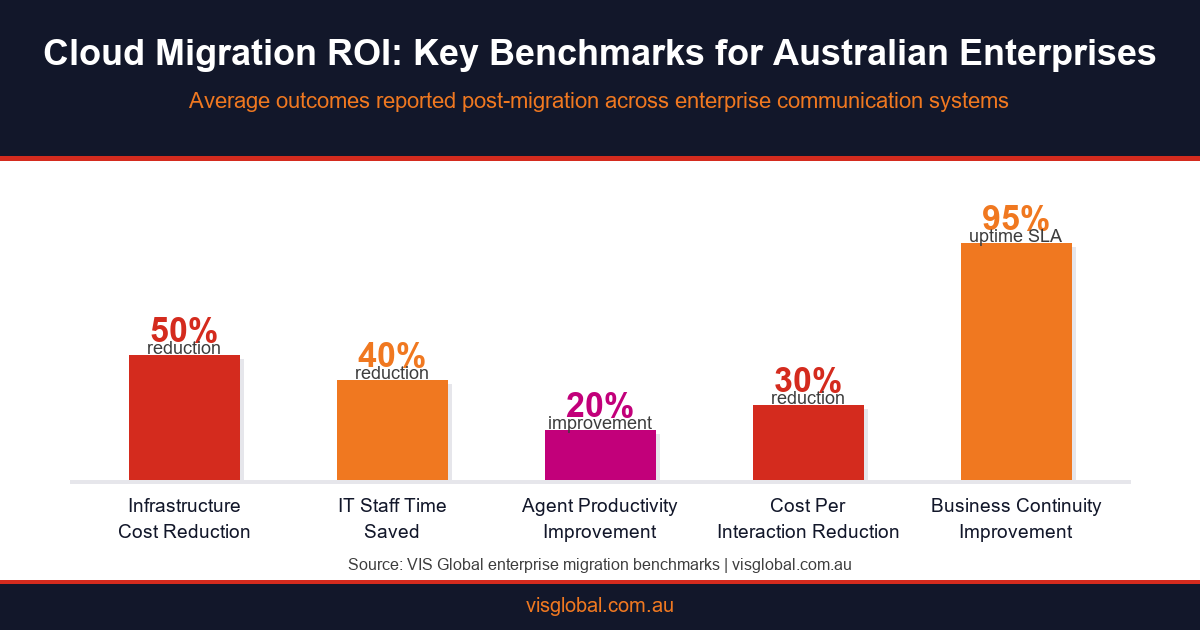
Australian enterprises that have completed cloud communication migrations report consistent patterns in savings. Hardware and maintenance costs typically fall by 40 to 60 percent in the first two years post-migration. IT staff time spent on infrastructure management drops by 30 to 50 percent, freeing capacity for strategic initiatives. Agent productivity improves by 15 to 25 percent through better tooling, integrated workflows, and reduced system latency.
For a 500-seat contact centre, these gains translate to annual savings of AUD 2 to 4 million, depending on the starting cost base and the degree of AI-enabled automation adopted alongside migration.
↵
Scalability and Business Continuity
On-premise communication infrastructure is provisioned for peak demand, which means organisations pay for capacity that sits idle most of the time. Cloud platforms scale dynamically, matching capacity to actual demand in real time. During peak periods, such as end-of-financial-year in banking or flu season in healthcare, cloud-hosted contact centres scale up without manual intervention or additional hardware procurement.
↵
Business continuity is equally transformed. Legacy systems with single points of failure create outage risk that cloud platforms eliminate through geographic redundancy and automatic failover. For Australian enterprises operating across multiple states, cloud-delivered communications ensure consistent service continuity regardless of localised infrastructure events.
↵
Cloud Migration Strategy: A Step-by-Step Framework
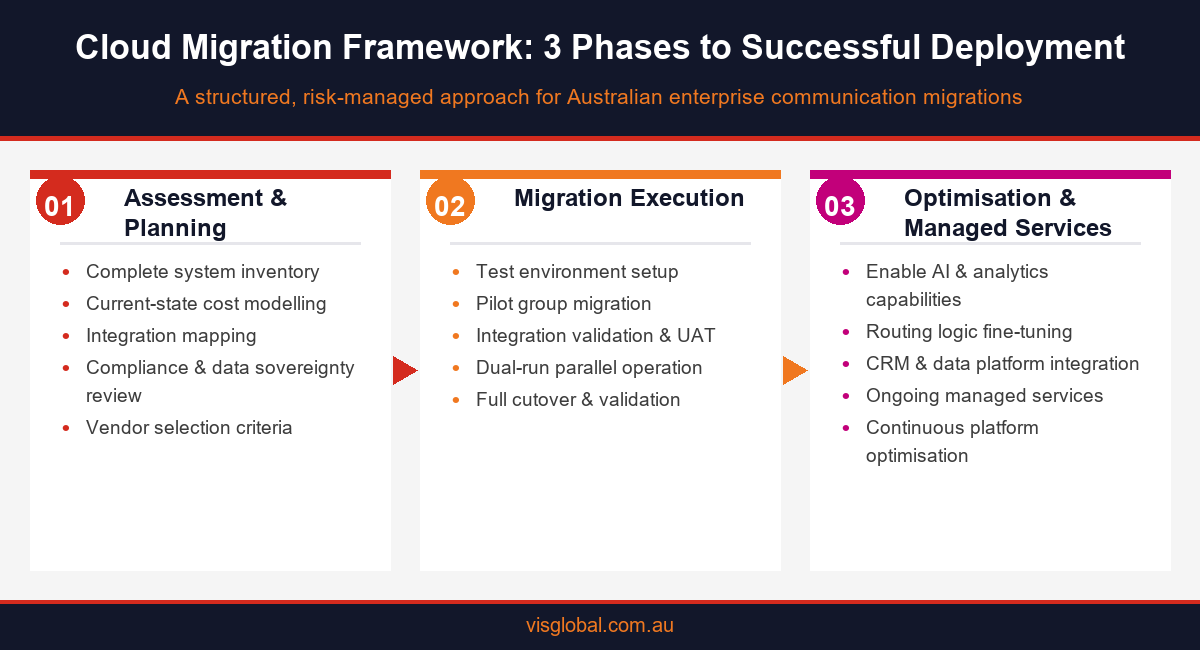
A successful cloud migration for enterprise communications follows a structured framework. Organisations that approach migration without a clear methodology face scope creep, cost overruns, and extended disruption to operations. The framework comprises three phases: assessment and planning, migration execution, and optimisation and managed services.
↵
Phase 1: Assessment and Planning
The assessment phase begins with a complete inventory of existing communication systems, including hardware, software, integrations, and usage patterns. A current-state cost model should be developed to establish the baseline against which cloud migration ROI will be measured. This model must capture all direct and indirect costs, including hidden costs such as productivity loss from system limitations and the opportunity cost of IT staff time spent on infrastructure maintenance.
↵
Integration mapping is a critical deliverable of this phase. Enterprise communication systems integrate with CRM platforms, workforce management tools, ticketing systems, and data warehouses. Every integration must be documented and a cloud-compatible replacement or bridge identified before migration begins. Compliance and data sovereignty requirements must also be assessed to confirm that target cloud platforms satisfy APRA, Privacy Act, and sector-specific obligations. For a practical planning tool, our cloud migration checklist for Australian contact centers covers all critical pre-migration steps in a ready-to-use format.
↵
Phase 2: Migration Execution
Migration execution follows the sequencing plan developed in phase one. Each migration wave follows a test, pilot, cutover pattern. A test environment is stood up in parallel with the live system, allowing integration validation and user acceptance testing without risk to production operations. A pilot group of agents is migrated first, allowing issues to be identified and resolved before full cutover.
↵
Cutover planning must account for the real-time nature of communication systems. Unlike ERP migrations, contact centre migrations require zero-downtime approaches. Dual-run configurations, where both old and new systems operate in parallel for a defined period, are standard practice for enterprise-scale migrations.
↵
Phase 3: Optimisation and Managed Services
Migration is not the end of the journey. The post-migration optimisation phase is where organisations capture the full value of cloud communication investment. This phase involves enabling AI capabilities that were not available on legacy infrastructure, fine-tuning routing logic, and integrating cloud communication data with enterprise analytics platforms.
↵
Ongoing managed services are critical to sustaining performance. Cloud communication platforms evolve rapidly, with new features and AI capabilities released on continuous deployment cycles. Without dedicated managed services support, organisations risk falling behind on platform capabilities and accumulating technical debt in their cloud configuration.
↵
Security and Compliance in Cloud Communications
Security is the most frequently cited concern among Australian enterprise leaders considering cloud migration for communication systems. In practice, leading cloud communication platforms offer security capabilities that exceed what most enterprises can achieve with on-premise infrastructure. Modern cloud contact centre and unified communications platforms provide end-to-end encryption for voice and data, role-based access controls, multi-factor authentication, continuous threat monitoring, and automated compliance logging.
↵
Australian Regulatory Framework
Australian enterprises in regulated industries must navigate a specific set of compliance obligations when migrating communication systems to the cloud. The key frameworks include the Privacy Act 1988, the Notifiable Data Breaches scheme, APRA's CPS 234 information security standard, and sector-specific requirements such as ASIC's RG 265 for financial services record-keeping. Cloud communication vendors serving the Australian market are required to demonstrate compliance with the Australian Signals Directorate's Essential Eight mitigation strategies and the ISM for government and defence-adjacent workloads.
↵
Data Sovereignty and Privacy
Data sovereignty is a specific concern for Australian enterprises, particularly in government and healthcare. The requirement that personal information about Australian residents be stored and processed within Australia is increasingly explicit in agency directives and procurement requirements. Leading cloud communication platforms offer Australian data residency options, ensuring that voice recordings, chat transcripts, and customer data remain within Australian borders. Organisations should verify data residency commitments contractually and confirm the data centre locations used by their vendor.
↵
Choosing the Right Cloud Migration Partner in Australia
The quality of the migration partner is the single greatest determinant of program success. Technical capability matters, but so does the partner's understanding of Australian regulatory requirements, their experience with enterprise-scale migrations, and their ability to provide ongoing managed services after go-live.
↵
When evaluating migration partners, Australian enterprises should assess depth of experience with cloud communication platforms relevant to their environment, including CCaaS, UCaaS, and CPaaS solutions. References from comparable Australian organisations in the same industry are essential. Managed services capability should be evaluated alongside migration capability. The partner that migrates your systems should be capable of managing them post-migration.
↵
VIS Global brings over a decade of enterprise communication migration experience across Australian banking, healthcare, government, and BPO sectors. With offices in Melbourne and Sydney, a network of 13 global technology partners, and dedicated post-migration managed services, VIS Global provides end-to-end capability from assessment through to ongoing optimisation. Learn more about cloud migration managed services and how VIS Global can accelerate your migration journey.
↵
Common Cloud Migration Challenges and How to Overcome Them
Even well-planned cloud migrations encounter challenges. Understanding the most common pitfalls in advance allows organisations to design mitigation strategies into the program from the outset.
Integration complexity: the most frequently underestimated challenge. Enterprise communication systems integrate with dozens of other applications, and many integrations were built for on-premise configurations that do not translate directly to cloud. Comprehensive integration mapping in the assessment phase, combined with dedicated integration testing environments, is the most effective mitigation.
Change management: consistently cited as a critical success factor that organisations underinvest in. Agents, supervisors, and IT staff all face significant workflow changes. Structured training programs, clear communication about migration rationale and timeline, and visible executive sponsorship all contribute to successful adoption.
Network readiness: a technical challenge that catches organisations unprepared. Cloud communication platforms are sensitive to network latency and jitter. Network infrastructure must be assessed and upgraded to support cloud-delivered communications before migration begins, not after.
Vendor lock-in: a legitimate concern that can be mitigated by selecting platforms with open APIs and standard integration frameworks, and by ensuring that data can be exported in standard formats.
↵
The Future of Enterprise Communications in the Cloud
Cloud migration is not the destination. It is the foundation for a continuous programme of communication capability enhancement. Organisations that complete cloud migration gain access to an accelerating stream of AI-powered features that were simply not available on legacy infrastructure.
↵
Generative AI is transforming contact centre operations. AI-powered agent assist tools provide real-time guidance and suggested responses during customer interactions, reducing average handle time and improving first-contact resolution rates. AI-driven quality assurance is replacing manual call scoring with automated analysis of 100 percent of interactions. Predictive analytics, powered by the data that cloud platforms generate, is enabling proactive customer engagement: identifying customers at risk of churn, predicting service demand spikes, and personalising communication at scale. These capabilities are available only to organisations that have completed the transition to cloud-based digital workplace and communication platforms.
↵
Australian enterprises that invest in cloud migration today are positioning themselves to capture these emerging capabilities as they mature. Those that delay are not just incurring higher current costs; they are falling further behind in the race to deliver AI-powered customer experiences.
↵
Conclusion
Cloud migration for enterprise communications in Australia is a strategic imperative, not a technology project. The organisations that approach migration with a clear business case, a structured methodology, and a partner with deep Australian expertise will capture substantial cost savings, compliance benefits, and competitive advantages. VIS Global partners with Australian enterprises at every stage of the cloud migration journey, from initial assessment through to ongoing managed services and AI-enabled optimisation.
↵
Contact VIS Global today to begin your cloud migration assessment and take the first step toward a modern, AI-ready communication infrastructure.