
How RPA Reduces Manual Effort in Contact Centres
Contact centre agents in Australia spend a significant portion of every shift on tasks that have nothing to do with helping customers: updating CRM records, logging complaints, running verification checks, and generating compliance reports. Robotic process automation targets this manual burden directly, deploying software bots that handle these tasks faster, more accurately, and at a fraction of the cost of manual processing. This guide covers where RPA delivers the greatest impact in Australian contact centres, the measurable outcomes organisations have achieved, and how to build a deployment roadmap. VIS Global's intelligent automation team has delivered RPA programmes across contact centres in banking, healthcare, and BPO sectors.
Key Takeaways
RPA bots eliminate after-contact work by automating CRM updates, complaint logging, and report generation — reducing agent wrap time by 40 to 65 percent.
Australian contact centres deploying RPA report 30 to 50 percent reductions in average handling time for structured, repetitive tasks.
The highest-ROI RPA use cases in contact centres are post-call wrap automation, verification lookups, and compliance report generation.
Where Manual Effort Accumulates in Contact Centres
The manual effort burden in a contact centre is most visible in two places: during the call, when agents switch between multiple systems to retrieve information, and after the call, during the after-contact work period where agents update records and log outcomes. Together, these two phases can account for 30 to 40 percent of total agent time in a typical Australian contact centre. Research from the McKinsey Global Institute indicates that up to 60 percent of contact centre activities involve tasks that are sufficiently structured to be automated without sacrificing quality.
The cost impact is direct. Every minute an agent spends on administrative tasks rather than customer interaction is a minute of licensed seat capacity consumed without customer value. For a contact centre with 100 agents at an average fully loaded cost of AUD 65,000 per year, reducing administrative time by 30 percent represents over AUD 1.9 million in annual efficiency gain.
High-Impact RPA Use Cases in Australian Contact Centres
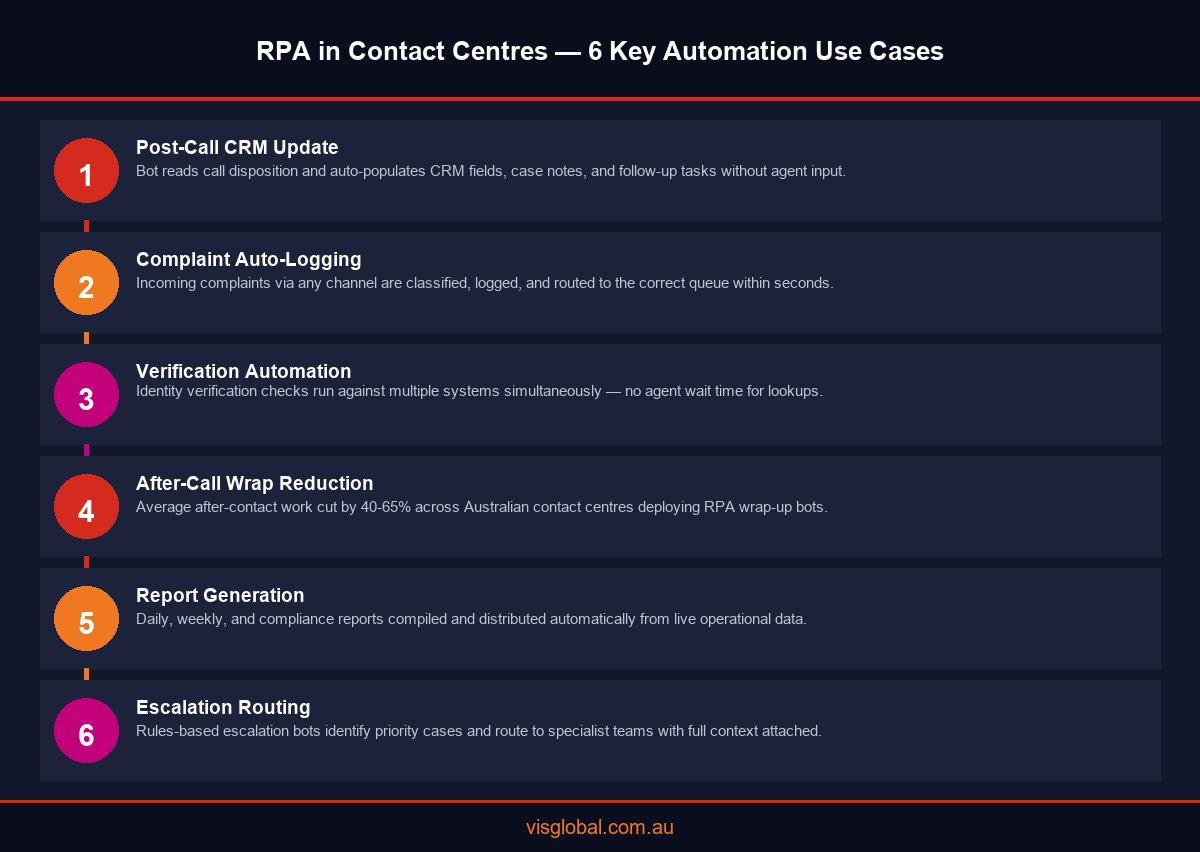
Post-call CRM update automation is the highest-adoption RPA use case in Australian contact centres. After each interaction, a bot reads the call disposition entered by the agent and automatically populates the CRM record, creates follow-up tasks, and triggers any required downstream processes such as policy amendments or escalation workflows. This eliminates the structured portion of after-contact work entirely, reducing wrap time by 40 to 65 percent. Explore how this integrates with broader customer experience management platforms to create a seamless operational environment.
Verification automation deploys bots to run identity and account verification checks across multiple systems simultaneously. Rather than an agent navigating between four screens to confirm a customer's identity, the bot retrieves all relevant information within seconds and presents it in a unified view. This reduces average handling time for verification-heavy interactions by 25 to 40 percent and eliminates manual data entry errors that create compliance risk.
Measuring RPA Performance in Contact Centre Operations
The primary metrics for RPA performance in contact centres are after-contact work time reduction, average handling time improvement, error rate reduction, and compliance adherence. Organisations should establish baseline measurements for each targeted process before deployment, then track improvement weekly for the first three months after go-live.
Australian contact centre benchmarks indicate that well-implemented RPA programmes reduce average after-contact work by 40 to 65 percent within sixty days of deployment. Error rates in automated processes typically fall to near zero, compared to three to five percent for equivalent manual processes. Compliance report generation time drops from hours to minutes. These gains compound: freed agent capacity can be redeployed to higher-value interactions, improving both customer satisfaction and revenue generation without increasing headcount. Our case studies document specific outcome data from RPA deployments across Australian contact centre environments.
Building Your RPA Deployment Roadmap
A successful RPA deployment in an Australian contact centre begins with process selection. Not every contact centre process is suitable for RPA. The best candidates are high-volume, structured, rule-based, and time-consuming. Process mapping workshops identify and rank candidates by automation potential and business value. The top two or three processes form the initial deployment scope. Following pilot validation, deployment expands to cover additional processes in a rolling programme. VIS Global's managed services team manages the full deployment lifecycle: process selection, bot development, testing, go-live, and ongoing optimisation.
Change management is as important as technical delivery. Agents who understand that RPA is removing administrative burden rather than replacing their role adopt new workflows more confidently and quickly. Organisations that invest in clear communication and training before go-live consistently report higher adoption rates and faster realisation of efficiency gains.
Conclusion
RPA is one of the most reliable and fastest-payback investments available to Australian contact centre operators. By targeting the structured, repetitive administrative tasks that consume agent time without delivering customer value, RPA delivers measurable efficiency gains within weeks of deployment. Combined with intelligent automation for more complex workflows, RPA forms the backbone of a fully automated contact centre operation. Contact VIS Global to begin your contact centre RPA assessment today.