
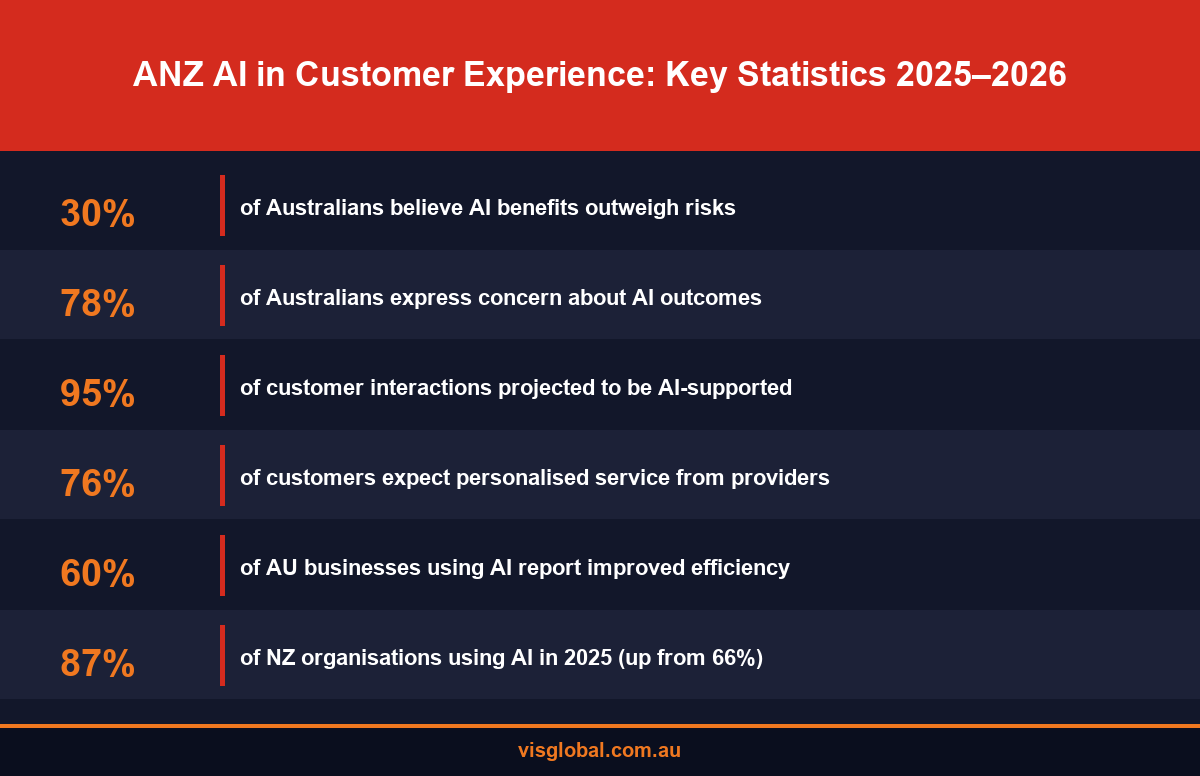
Australia's enterprise leaders are deploying artificial intelligence across customer experience at an unprecedented pace. Yet with only 30% of Australians believing the benefits of AI outweigh the risks — the lowest trust rating of any country surveyed globally — the central challenge is clear. The question is no longer whether to adopt AI in customer experience. It is how to do so responsibly. This guide draws on VIS Global research, Australia's AI Ethics Principles, the latest ANZ regulatory developments, and proven enterprise frameworks to give CX leaders a comprehensive guide to responsible AI in customer experience. From the trust deficit reshaping consumer expectations to the four-step implementation roadmap, this guide covers every dimension of responsible AI deployment for Australian and New Zealand enterprises.
Key Takeaways
Only 30% of Australians trust AI benefits to outweigh risks — making responsible AI a commercial priority, not just a compliance checkbox.
Australia's regulatory landscape is evolving fast, with mandatory guardrails for high-risk AI settings proposed in September 2024.
The seven pillars of responsible AI in CX — fairness, transparency, privacy, oversight, contestability, reliability, and accountability — form the foundation of every compliant deployment.
A proven four-step roadmap covers assessment, design, implementation, and ongoing monitoring to sustain responsible AI practice at enterprise scale.
Why Responsible AI in Customer Experience Matters for Australian Enterprises
AI is reshaping every dimension of customer engagement in Australia and New Zealand. Virtual agents, predictive call routing, sentiment analysis, hyper-personalisation, real-time decisioning, and generative AI-powered self-service are now standard capabilities in modern contact centres. The efficiency gains are measurable: approximately 60% of Australian businesses using AI-powered contact centre solutions report improved efficiency and cost savings (CSIRO, 2024). Generative AI adoption globally rose from 55% in 2023 to 75% in 2024, and ANZ businesses planned to invest more in generative AI than the global average. But the scale of adoption amplifies the stakes of getting it wrong. Customer experience is the primary battleground for brand loyalty and competitive differentiation. When AI fails through bias, lack of transparency, or privacy breaches, the damage extends far beyond a single interaction. It erodes the foundational trust that enterprise CX programmes are designed to build.
The Trust Deficit Reshaping AI Deployment in Australia
A 2025 study by KPMG and the University of Melbourne — the KPMG AI Trust in Australia 2025 report — found that only 30% of Australians believe the benefits of AI outweigh the risks. This was the lowest ranking of any country surveyed globally. Meanwhile, 78% of Australians express concern about a range of negative AI outcomes. This is not a niche sentiment. It is the baseline expectation that every enterprise omnichannel customer experience management initiative must address before deploying AI in customer-facing environments. The trust deficit is a commercial problem, not just a reputational one. Customers who distrust AI are less likely to engage with AI-driven service channels, more likely to escalate to human agents at higher cost, and more likely to churn following a negative AI interaction. Building responsible AI practices is therefore a direct lever for CX performance and customer lifetime value.
The Scale of Exposure Across ANZ
The exposure is significant. Around 95% of all customer interactions are projected to be AI-supported in the coming years. AI adoption across Australian businesses reached approximately 40% in 2024, while New Zealand organisations saw AI usage surge from 66% in 2024 to 87% in 2025 (Datacom State of AI Index, 2025). For the banking and financial services sector, healthcare organisations, government agencies, and BPO providers, the combination of high interaction volumes, sensitive personal data, and vulnerable customer segments makes responsible AI governance non-negotiable. These sectors face the highest regulatory scrutiny, the most consequential AI-driven decisions, and the greatest trust exposure when AI systems underperform or behave unfairly.
The Seven Pillars of Responsible AI in Customer Experience
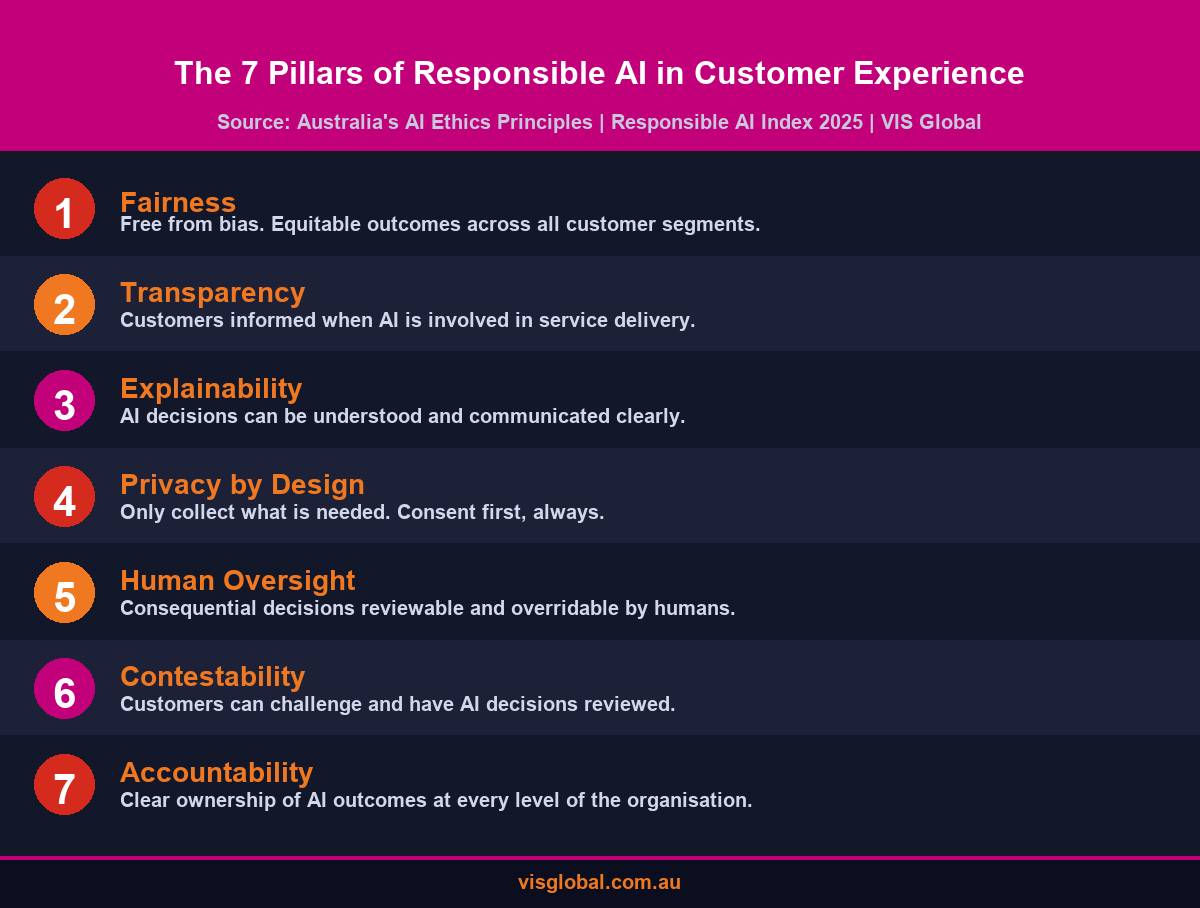
Responsible AI in CX is not a single technology or a compliance checklist. It is an interlocking set of principles, governance structures, and design practices that must be embedded into every stage of the AI development and deployment lifecycle. Drawing from Australia's AI Ethics Principles, the Voluntary AI Safety Standard, and the Responsible AI Index 2025, VIS Global identifies seven core pillars for organisations deploying AI in customer-facing environments. Each pillar represents a governance requirement, not merely an aspiration.
Fairness, Transparency, and Explainability
AI systems deployed in CX environments must be free from discriminatory bias and must produce outcomes that are equitable across all customer segments. This requires systematic fairness testing across demographic variables including age, location, language, and economic status. Transparency means customers are informed when they are interacting with AI and have access to meaningful explanations of how decisions affecting them were reached. Explainability is increasingly a regulatory expectation. Under the proposed mandatory guardrails for high-risk AI settings, organisations must be able to demonstrate the rationale for consequential AI-driven decisions. For AI systems used in intelligent automation solutions for credit assessment, fraud detection, or service prioritisation, explainability is directly linked to legal compliance risk.
Privacy by Design, Human Oversight, and Contestability
Privacy by design means AI systems collect only the personal data required for their stated purpose, with explicit and informed consent from the customer. Data is retained only as long as necessary and secured against unauthorised access. For CX applications handling voice recordings, chat transcripts, or biometric data, privacy by design is mandatory under the Privacy Act 1988 and the Australian Privacy Principles. Human oversight ensures that consequential AI-driven customer interactions remain subject to human review, challenge, and correction. Every consequential AI decision must have a documented oversight pathway. Contestability gives customers a genuine right to have AI-driven decisions reviewed by a human with the authority to change them — a requirement that is rapidly moving from best practice to regulatory expectation. The remaining pillars of reliability, accountability, and human-centred values complete the governance structure that enterprise leaders must embed across the entire CX AI lifecycle.
Australia's AI Regulatory and Compliance Landscape
The regulatory environment for AI in Australia is evolving at a pace that demands proactive enterprise attention. While there is currently no single AI-specific legislation, a layered framework of existing laws, voluntary standards, and forthcoming mandatory requirements creates significant compliance obligations for organisations deploying AI in customer-facing contexts. Understanding this landscape is essential for any enterprise operating AI-powered CX programmes in Australia and New Zealand.
Privacy Act 1988, the 2024 Amendments, and AI-Specific Obligations
The Privacy Act 1988 and the Australian Privacy Principles apply directly to all AI systems that handle personal information. This includes customer service chatbots, voice analytics platforms, voice biometrics technology, and any AI system processing behavioural, transactional, or biometric customer data. The Office of the Australian Information Commissioner (OAIC) issued landmark guidance in October 2024 specifically addressing AI deployments in enterprise environments, including generative AI products used within CX stacks. The Privacy and Other Legislation Amendment Act 2024, passed in November 2024, introduces new disclosure obligations for automated decision-making — meaning customers must be informed when significant decisions about them are made by AI. It also provides enhanced enforcement powers for the OAIC. A second tranche of reforms, expected in 2025, will introduce a tort for serious privacy invasion. For enterprises using managed services arrangements that involve customer data processing on behalf of third parties, the implications are immediate and material.
Mandatory Guardrails for High-Risk AI and New Zealand Requirements
The Australian Government's September 2024 proposals paper outlines ten mandatory safeguards for AI used in high-risk settings, covering accountability, data quality, testing, transparency, human oversight, and security. Any AI system that makes or meaningfully influences consequential customer decisions is likely within scope. The Voluntary AI Safety Standard, released by the Department of Industry, Science and Resources, provides a compliance framework for organisations ahead of mandatory requirements. New Zealand organisations face comparable obligations under the NZ AI Strategy and the Privacy Act 2020. ANZ enterprises operating across both markets must ensure their responsible AI frameworks are jurisdictionally aligned, particularly for data residency, consent mechanisms, and cross-border data flows. The NZ AI Strategy specifically emphasises government leadership in responsible AI adoption and investment in AI safety infrastructure — a framework that aligns closely with the Australian approach.
The Business Cost of Irresponsible AI in Customer Experience
The financial and reputational consequences of AI failures in CX are increasingly well-documented. The OAIC's landmark determination on Clearview AI's facial recognition data collection and the subsequent Bunnings investigation into in-store biometric surveillance established that unlawful AI deployment in customer environments carries significant enforcement risk. The consequences include public findings, remediation orders, and reputational damage that extends well beyond the immediate investigation. Beyond enforcement actions, irresponsible AI deployment creates operational costs that compound over time. AI systems producing biased outcomes drive customer escalations to human agents, increase complaint volumes, and elevate cost-per-interaction. Systems that lack explainability drive regulatory inquiries requiring expensive legal and technical remediation. AI deployments that violate customer privacy create class action exposure and long-term trust deficits that erode brand equity over time. The risk calculus is clear for enterprises in regulated industries. For the banking and financial services sector, ASIC and APRA regulatory expectations around AI in financial decision-making add a further compliance layer. For healthcare organisations, clinical AI systems within the CX environment intersect with the Therapeutic Goods Administration's evolving digital health regulations. For government agencies, the Australian Government's Responsible AI Framework creates direct procurement and accountability obligations. Enterprise leaders must treat responsible AI as a risk management discipline with defined ownership, regular audit cycles, and board-level visibility. The alternative — discovering an AI failure through an OAIC investigation or regulatory action — is a materially worse outcome than investing proactively in responsible AI governance from the outset.
Automation Opportunities in the Contact Centre
Intelligent automation is transforming ANZ contact centres. Each of the following high-value automation opportunities can be deployed responsibly when implemented within an appropriate governance framework. The key is not to avoid automation — it is to automate thoughtfully, with clear accountability, transparency, and ongoing human oversight at every touchpoint where consequential customer decisions are made.
Ethical Conversational AI and Intelligent Call Routing
Large language model and generative AI-powered chatbots and virtual agents can handle a substantial proportion of inbound customer interactions autonomously. Responsible deployment requires clear disclosure that the customer is interacting with AI, seamless and context-preserving handoffs to live agents when AI cannot help, and continuous monitoring for biased, harmful, or misleading outputs. Responsible conversational AI also requires active monitoring of model drift — the gradual degradation in output quality that occurs as underlying data distributions shift over time. AI-powered intelligent call routing (ICR) matches customers to the right agent based on conversation history, real-time sentiment, and stated needs, rather than arbitrary queue position. Responsible ICR must be tested for unintended discrimination: routing algorithms must not systematically disadvantage customers based on postcode, language preference, or perceived economic status. For enterprises deploying RPA and AI workflow automation alongside ICR, governance frameworks must ensure that automated routing and workflow decisions remain subject to regular fairness audits and human review.
Voice Biometrics, Real-Time Assistance, and Automation at Scale
Voice biometrics and ethical authentication can significantly reduce friction in the customer journey by identifying callers through their voiceprint, eliminating lengthy security question processes. However, biometric data collection is subject to strict requirements under the Privacy Act 1988 and the APPs. Following the landmark OAIC determinations on Clearview AI and Bunnings, consent, transparency, and data minimisation are non-negotiable. Biometric data must never be collected without explicit opt-in consent, and voiceprint records must be subject to defined retention limits and secure deletion protocols. Real-time agent guidance systems — which provide suggested responses, knowledge base recommendations, and compliance alerts to human agents during live interactions — represent the highest-value, lowest-risk automation opportunity available. These systems augment rather than replace human agents, maintaining the human oversight that both customers and regulators increasingly expect. Combined with an end-to-end intelligent automation programme that encompasses back-office processes and workflow orchestration, real-time assistance creates a layered automation architecture that delivers efficiency without sacrificing accountability or customer trust.
Proven Benefits of Responsible AI Adoption in CX
Responsible AI is not a constraint on CX performance. It is a proven value driver. The Responsible AI Index 2025 demonstrates that organisations at the forefront of ethical AI practices are achieving tangible commercial and operational benefits — and doing so with greater sustainability than competitors who deprioritise governance. Around 60% of Australian businesses using AI-powered customer service report improved efficiency and cost savings (CSIRO, 2024). Organisations with mature responsible AI practices demonstrate stronger customer retention rates, higher Net Promoter Scores, and lower total cost of compliance. A 2025 KPMG study found that Australian consumers who do trust AI are significantly more likely to proactively engage with AI-driven service offerings — making trust itself a commercial lever with measurable revenue impact. For enterprises operating under managed services arrangements, responsible AI is increasingly a contractual expectation from enterprise clients. Banking, government, and healthcare procurement teams now embed AI ethics and compliance requirements directly into vendor selection criteria. Organisations that can demonstrate responsible AI maturity — documented frameworks, audit trails, fairness testing results — have a material competitive advantage in enterprise procurement cycles. Responsible AI also drives workforce and operational resilience. Digital workplace solutions that combine AI augmentation with human oversight create environments where agents are freed from repetitive query handling and empowered to manage complex, high-value customer interactions. This reduces agent burnout, improves retention, and elevates the quality of human-AI collaboration across the contact centre. The result is a compounding performance improvement that pure automation — without human oversight and responsible governance — cannot deliver on its own.
A Four-Step Roadmap to Responsible AI in Customer Experience
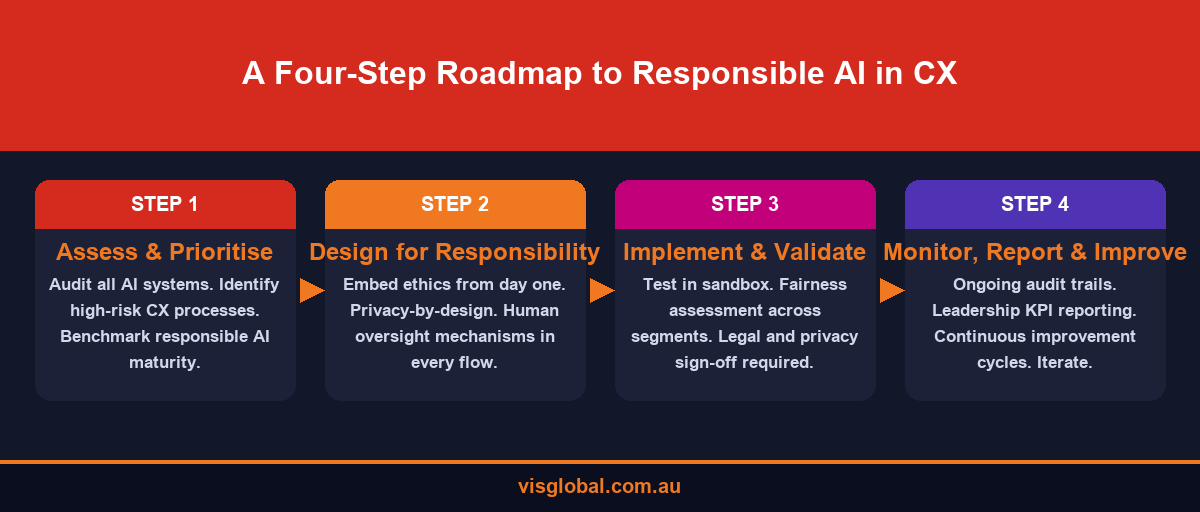
Implementing responsible AI in CX is a structured and continuous journey, not a one-time project. VIS Global recommends a four-step approach drawn from the Australian Government's AI evaluation framework and the Responsible AI Index maturity model. Each step builds on the last, creating a governance discipline that improves over time rather than degrading.
Step 1: Assess and Step 2: Design for Responsibility
The starting point for any responsible AI programme is a comprehensive audit of all existing and planned AI systems within the CX environment. Organisations should identify high-risk processes — those involving consequential customer decisions, biometric or sensitive personal data, or interactions with vulnerable customer segments — and prioritise remediation and governance investment based on customer impact versus implementation complexity. The Fifth Quadrant Responsible AI Self-Assessment Tool provides a structured benchmarking methodology for this exercise and produces a maturity rating that can be tracked over time. Design for responsibility must follow assessment immediately. Responsible AI principles cannot be retrofitted to systems designed without them — they must be embedded from the outset of every CX design engagement. Privacy-by-design principles mean data collection is scoped to the minimum required, consent mechanisms are explicit and auditable, and data retention policies are enforced by technical controls rather than manual processes. Every consequential AI interaction must include documented human oversight mechanisms: defined escalation pathways, assigned human reviewers, and clear accountability for AI-driven outcomes.
Step 3: Implement and Validate and Step 4: Monitor and Improve
Thorough testing in sandbox environments before production deployment is essential and non-negotiable for high-risk AI systems. Testing must include fairness assessments across diverse customer segments, covering age, location, language, and indicators of customer vulnerability. Legal and privacy teams must validate compliance with the Privacy Act APPs and the proposed mandatory guardrails before any AI system goes live in a customer-facing environment. Post-deployment monitoring is where responsible AI frameworks are either sustained or abandoned. Organisations must establish audit trails for all AI-driven customer decisions — as required under the 2024 Privacy Act amendments — and report regularly to leadership on responsible AI KPIs: model drift indicators, bias metrics, escalation rates, customer satisfaction scores, and complaint volumes. Responsible AI is a continuous improvement discipline, not a one-time certification. Iteration, review, and improvement cycles must be embedded into the operating model alongside standard CX performance management rhythms.
How VIS Global Enables Responsible AI in Customer Experience
VIS Global is a trusted enterprise partner for Australian and New Zealand organisations navigating the complexity of responsible AI deployment in CX. With over 1,000 enterprise clients, operations across seven countries, and partnerships with 13 leading global technology vendors, VIS Global brings deep technical expertise and governance capability to responsible AI engagements across every major industry vertical. Our enterprise AI and CX consulting practice covers the full responsible AI lifecycle — from initial maturity assessment and governance framework design through to compliant system implementation, platform integration, and ongoing performance monitoring and optimisation. Whether your organisation is deploying conversational AI for the first time or scaling an existing responsible AI programme, VIS Global provides the frameworks, tools, and technical depth to do so in full alignment with Australia's evolving regulatory requirements. For BPO providers and large-scale contact centre operations, VIS Global offers purpose-built responsible AI frameworks aligned to the Privacy Act 1988, the proposed mandatory guardrails, and emerging ANZ AI governance standards. For the banking and financial services sector, healthcare organisations, and government agencies, VIS Global delivers industry-specific responsible AI implementation that accounts for sector-specific regulatory obligations and customer expectations. Explore our customer experience case studies across banking, government, and BPO to see measurable outcomes in production environments. Access our whitepapers and enterprise resources for in-depth technical and regulatory guidance tailored to the ANZ market.
Conclusion
Responsible AI in customer experience is the defining strategic imperative for Australian enterprise leaders in 2026 and beyond. The trust deficit is real, the regulatory timeline is accelerating, and the commercial stakes of getting it wrong are significant and growing. Organisations that embed fairness, transparency, privacy by design, and human oversight into their AI-powered CX programmes from the outset will build durable competitive advantages in customer loyalty, regulatory resilience, and operational performance. VIS Global stands ready to partner with your organisation at every stage of this journey. To schedule a responsible AI assessment tailored to your industry and regulatory context, connect with our team today.