AI Contact Center Solutions for Healthcare: The Complete Guide for Australian Hospitals and Health Services (2026)
 Customer Experience Management
Australian hospitals and health services face a contact centre challenge unlike any other industry. Appointment volumes, after-hours demand, and the complexity of patient queries are rising faster than staffing budgets can absorb. AI contact center solutions for healthcare offer a direct answer: intelligent automation that handles routine patient interactions at scale, reduces wait times, and frees clinical and administrative staff for work that genuinely requires human attention. VIS Global's AI-powered customer experience management solutions are purpose-built for this challenge, deployed across public hospital networks, private health groups, and aged care providers throughout Australia.
Our complete enterprise guide to AI contact centre solutions in Australia covers the broader landscape across all industries; this guide goes deeper on what AI contact centre technology delivers specifically for Australian healthcare settings — the compliance requirements, measurable ROI outcomes, and how to build a deployment roadmap within the constraints of the Australian health system.
Key Takeaways
Australian health services deploying AI contact centre solutions reduce inbound call volumes by 30 to 45 percent through automated appointment scheduling, reminders, and triage navigation.
Compliance with the Australian Privacy Act, My Health Record framework, and state health information legislation is achievable with the right AI platform architecture and governance protocols.
Healthcare-specific AI contact centre deployments typically achieve full ROI within 12 to 18 months, driven by reduced wait times, lower per-contact costs, and improved patient satisfaction scores.
The Patient Contact Crisis in Australian Healthcare
Australian healthcare contact centres are under sustained pressure. The Australian Institute of Health and Welfare reports that public hospital demand has grown at twice the rate of workforce capacity over the past decade. A single medium-sized public hospital network can receive upwards of 3,000 inbound calls per day covering appointment bookings, prescription refill queries, results follow-up, and general triage. Private health groups face equivalent volumes across specialist and GP networks, compounded by rising patient expectations for digital and on-demand service.
The result is a system where patients frequently wait 15 to 30 minutes to speak with an administrative staff member for a task that could be resolved in seconds with the right automation. Across VIS Global's healthcare client base, this structural mismatch between a voice-heavy manual contact model and the expectations of the modern patient population is the most consistent starting point for the AI contact centre business case.
Volume and Complexity at Breaking Point
The volume challenge in healthcare is compounded by query complexity. Unlike retail or banking contact centres where queries follow predictable patterns, healthcare contacts can escalate rapidly: a call about appointment availability becomes a clinical question; a prescription query reveals an urgent medication concern. Contact centre staff must balance speed with clinical sensitivity, creating a high-cognitive-load environment that drives burnout at rates well above the national contact centre average.
AI contact centre platforms address volume without compromising sensitivity. By handling routine queries automatically, AI frees staff to focus exclusively on complex, escalated, or clinically sensitive contacts. Pairing AI contact centre solutions with back-office intelligent automation solutions that automate after-contact administrative tasks — CRM updates, outcome logging, compliance records — creates a fully streamlined contact operation from first ring to case closure.
Staff Burnout and Retention Pressures
Staff turnover in Australian healthcare contact centres runs at 25 to 35 percent annually in major health networks, significantly above the 20 percent contact centre industry average. The primary driver is workload pressure combined with the emotional weight of managing distressed patients. Every routine task automated by AI directly reduces this burden. Health services that have deployed AI-assisted contact centres report improved agent satisfaction scores and measurable reductions in unplanned absence within the first six months of operation.
Core AI Contact Center Capabilities Purpose-Built for Healthcare
Modern AI contact center platforms deliver capabilities that address the specific interaction patterns of healthcare contact centres. Unlike generic contact centre automation, healthcare-configured AI includes clinical pathway awareness, appointment system integration, and privacy-compliant data handling as foundational features rather than optional add-ons. VIS Global's customer experience management solutions are purpose-configured for Australian healthcare environments, integrating with existing telephony, patient administration systems, and CRM platforms.
Intelligent Appointment Scheduling and Reminders
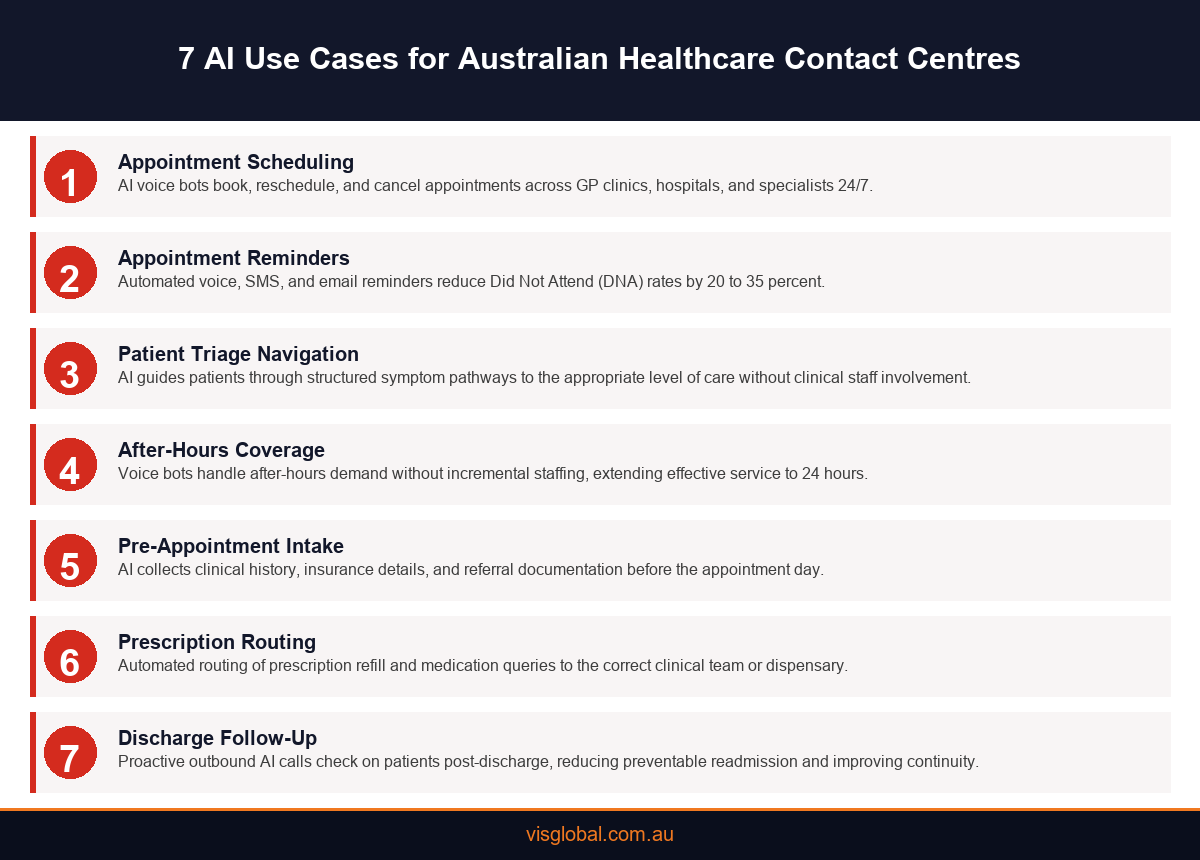
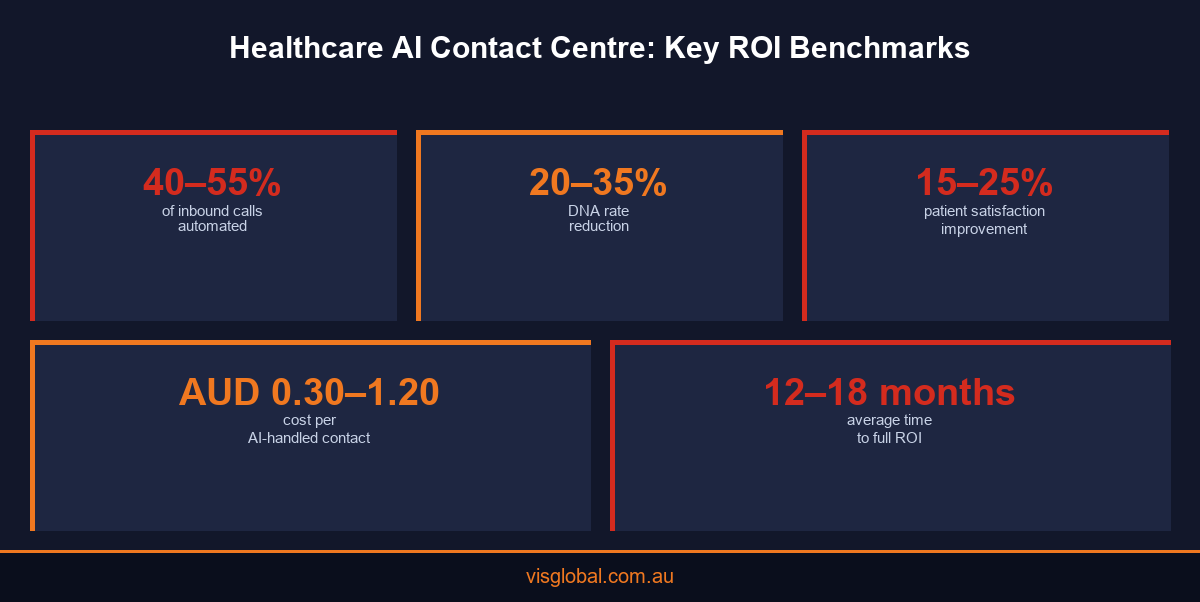
Appointment management is the highest-volume contact type in Australian healthcare, accounting for 40 to 55 percent of all inbound calls across GP clinics, specialist networks, and hospital outpatient departments. AI voice bots and chat automation handle this end to end: checking availability, booking, rescheduling, and sending confirmation and reminder messages without human involvement.
The impact on Did Not Attend (DNA) rates is significant. Healthcare AI platforms delivering automated reminders via voice, SMS, and email consistently achieve 20 to 35 percent reductions in DNA rates. For health services seeking a unified patient engagement strategy, this appointment automation integrates with an omnichannel customer experience management approach that delivers consistent patient touchpoints across every channel — voice, chat, email, and digital self-service.
AI-Powered Patient Triage and Symptom Navigation
AI triage tools guide patients through structured clinical pathways before escalating to a clinical staff member. The AI does not make clinical decisions: it navigates patients to the appropriate level of care based on described symptoms and history. This mirrors and augments triage protocols already used by services like healthdirect Australia and Nurse-on-Call.
For hospital emergency departments, pre-contact AI triage reduces inappropriate presentations. For GP networks, it reduces clinical staff time spent on calls that can be resolved with a structured symptom questionnaire and appropriate referral.
Voice Bots for After-Hours and Overflow Management
The majority of Australian healthcare contact centres operate eight to twelve hour windows, leaving significant after-hours demand unaddressed. AI voice bots extend effective coverage to 24 hours without incremental staffing cost. After-hours callers can book, reschedule, or request callbacks; urgent symptom queries are triaged and escalated to an on-call clinical pathway; routine queries are resolved instantly.
For health services already executing a cloud migration for their contact centre infrastructure, AI voice bot deployment integrates naturally with the cloud contact centre build — reducing the complexity of adding AI capabilities to a modern, scalable environment. Explore VIS Global's intelligent automation solutions for a complete picture of how AI and automation combine in modern contact centre operations.
Healthcare-Specific Use Cases Across the Australian Sector
Healthcare in Australia spans a diverse delivery landscape: public hospital networks, private hospital groups, specialist medical centres, GP super clinics, aged care facilities, NDIS support coordinators, allied health practices, and telehealth providers. AI contact centre requirements differ meaningfully across each of these settings.
Public Hospital Networks
Public hospital networks in New South Wales, Victoria, and Queensland face the most complex contact centre environments in Australian healthcare, handling millions of calls annually across appointment bookings, discharge follow-up, pharmacy queries, referral coordination, and patient support. AI contact centre platforms combined with back-office intelligent automation solutions enable automated appointment booking, discharge reminder workflows, and real-time wait time information without adding administrative headcount.
The governance requirements for public hospitals are stringent. AI platforms deployed here must comply with the Australian Privacy Principles, state health records legislation, and the Australian Digital Health Agency's data standards for digital health systems.
Private Health Groups and Specialists
Private health groups operate in a competitive patient experience environment where poor contact — long wait times, missed callbacks, or impersonal interactions — directly drives patient attrition. A purpose-built customer experience management platform for private health groups focuses on frictionless appointment access, proactive health reminders, and personalised communication that reinforces the premium experience expectation.
Specialist networks benefit particularly from AI pre-appointment intake automation: collecting clinical history, insurance details, and referral documentation before the appointment via conversational AI, reducing administrative time on the day and improving clinical preparation.
Aged Care and NDIS Providers
Aged care and NDIS service providers face a specific AI contact centre challenge: their populations include individuals with complex communication needs, cognitive impairment, and low digital literacy. AI contact centre design in this context prioritises simple voice-first interaction, human escalation triggers at the first sign of distress or confusion, and integration with care coordination systems.
The Royal Commission into Aged Care Quality and Safety highlighted the critical role of consistent, responsive communication in quality care. AI contact centres that deliver fast, accurate, empathetic responses and seamless escalation directly support the standards required under the Aged Care Quality and Safety Commission framework. VIS Global's end-to-end managed services support model ensures aged care and NDIS providers have ongoing technical and operational support after go-live.
Compliance, Privacy, and Clinical Governance in Healthcare AI
Healthcare is one of the most heavily regulated sectors for data handling in Australia. AI contact centre deployments must navigate the Australian Privacy Act 1988, the My Health Record Act 2012, state health information legislation, and clinical governance requirements that govern patient-facing technology. VIS Global's compliance architecture experience across banking, government, and healthcare sectors has produced a compliance-first implementation methodology that maps AI platform design to regulatory obligations before a single line of configuration is written.
My Health Record and Australian Privacy Principles
The My Health Record system establishes strict requirements for handling personal health information in digital systems. AI contact centre platforms that access or process patient data must comply with authorised access frameworks and audit trail requirements. VIS Global's healthcare AI architecture includes role-based access controls, full interaction audit logs, and data residency in Australian-based cloud infrastructure.
The Australian Privacy Principles require that health information be collected only for the primary purpose of care, stored securely, and not disclosed without patient consent. AI contact centre systems that record, transcribe, or analyse patient interactions must have consent mechanisms and data minimisation protocols built in from the outset. Our resources and whitepapers include detailed compliance guidance for healthcare AI contact centre implementations.
Clinical Governance and AI Decision Support
Clinical governance frameworks require that technology used in patient-facing care supports, rather than replaces, clinical decision-making. AI triage tools must be validated against clinical pathways approved by credentialled governance bodies. Just as RPA in contact centres removes the administrative burden of after-contact work from agents, AI triage tools remove the informational burden of routine navigation queries from clinical staff — handling the structured layer so human expertise is reserved for decisions only a qualified practitioner should make.
The best healthcare AI contact centre implementations are those where AI handles the administrative and informational layer with high accuracy, and where clinical escalation pathways to qualified staff are fast, frictionless, and clearly signposted. This bounded scope is precisely what allows AI contact centre technology to earn the trust of clinical governance bodies and patient populations alike.
Measuring ROI in Healthcare AI Contact Centres
The ROI case for AI contact centre deployment in healthcare is supported by measurable outcomes across patient experience, operational efficiency, and staff retention. Health service executives evaluating the business case should focus on three primary ROI drivers: reduced cost per contact, improved patient satisfaction and retention, and staff efficiency gains that offset workforce cost pressures. Our case studies document specific outcome data from AI contact centre deployments across regulated industries including healthcare, banking, and government.
Patient Satisfaction and Net Promoter Score
Patient satisfaction in healthcare is measured through frameworks such as the Australian Hospital Patient Experience Question Set (AHPEQS) and Net Promoter Score surveys. Contact centre interactions are a leading determinant of overall satisfaction — the ease of booking, responsiveness of follow-up, and consistency of information all feed directly into the patient experience score.
Health services deploying AI contact centre solutions consistently report Patient Satisfaction Score improvements of 15 to 25 percent within 12 months, driven by faster response times, reduced abandonment rates, and 24-hour availability. Improved satisfaction scores correlate directly with patient retention in competitive private health markets, translating to measurable revenue impact.
Cost-Per-Contact and Staff Efficiency
The average cost per inbound contact in an Australian healthcare contact centre runs at AUD 12 to 18 per call. AI-handled contacts — automated appointments, reminders, triage navigation — cost AUD 0.30 to 1.20 per interaction. A health service handling 2,000 calls per day, with AI resolving 40 percent, generates annual cost savings of AUD 2.5 million to 4.5 million at these benchmarks. These economics compare favourably with both in-house enterprise and BPO outsourcing models, making AI automation the strongest single cost-reduction lever available to Australian health services.
Staff efficiency gains compound this further. When agents are freed from routine contacts, they handle more complex cases per shift, reducing overtime and callback backlogs. Reduced after-hours volumes lower extended-hours coverage costs, and lower agent burnout reduces the annual cost of recruitment, onboarding, and training driven by high turnover.
Building Your AI Contact Centre Implementation Roadmap
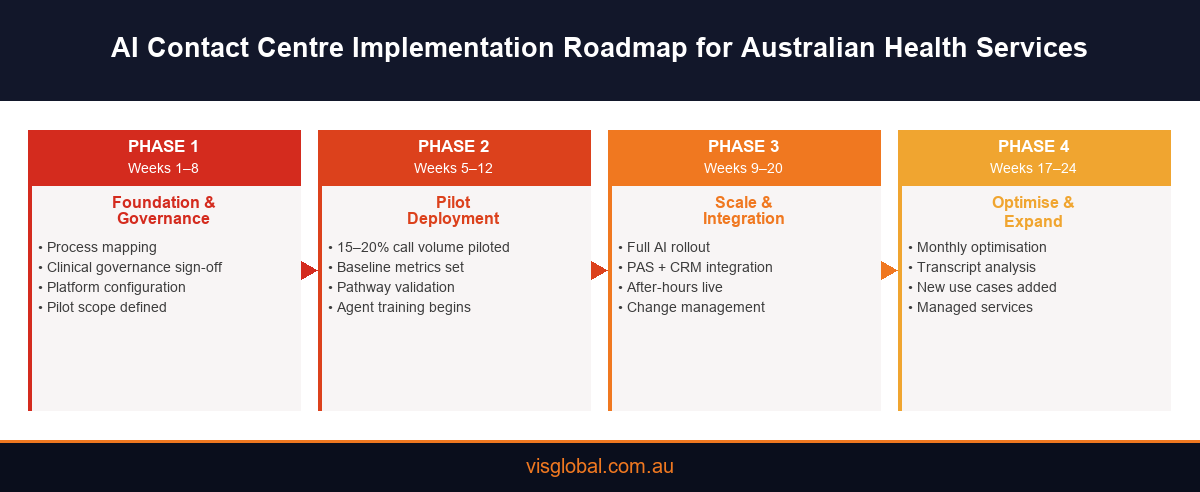
A successful AI contact centre deployment in Australian healthcare follows a structured roadmap that manages clinical governance, technical integration, staff change management, and compliance requirements in sequence. The deployment timeline for a fully operational AI contact centre in a medium-sized health service typically runs 12 to 24 weeks from project start to live operation at scale.
Phase 1 — Foundation and Pilot (Weeks 1–8)
Phase 1 covers process mapping, platform configuration, and controlled pilot deployment. The health service identifies the three to five highest-volume, lowest-clinical-complexity contact types — typically appointment booking, appointment reminders, and general service information — and configures AI workflows for these use cases. Clinical governance sign-off is obtained for triage pathway content before any patient-facing deployment goes live.
The pilot runs on 15 to 20 percent of inbound call volume on specific lines or time windows. Performance is measured against baseline metrics: call resolution rate, patient satisfaction, escalation rate, and compliance incident frequency. Lessons from the pilot directly inform the Phase 2 scaling plan.
Phase 2 — Scale and Optimise (Weeks 9–24)
Phase 2 rolls AI automation across all identified use cases, integrates with appointment systems, patient administration platforms, and CRM, and deploys after-hours and overflow coverage. Staff training covers the new escalation workflow — how agents receive AI-triaged calls, what context the AI passes on handoff, and how to handle patients who wish to speak to a human from the outset.
Continuous optimisation runs monthly for the first six months: reviewing unresolved query types, updating triage pathways based on clinical governance feedback, and identifying new automation candidates from call transcript analysis. VIS Global's managed services team provides ongoing optimisation support throughout and after deployment, ensuring your AI contact centre continues to deliver measurable value as patient demand evolves.
Choosing the Right AI Contact Centre Partner for Healthcare
Healthcare AI contact centre deployments are more complex than standard enterprise deployments. The right technology partner must demonstrate direct experience in Australian healthcare environments, deep understanding of the compliance landscape, and the clinical governance capability to design AI pathways that meet the standards of Australian health services. Generic contact centre vendors with a healthcare checkbox in their sales materials are not sufficient.
Evaluation criteria should include: documented healthcare deployments in Australia at comparable scale, demonstrated compliance with the Australian Privacy Principles and state health information legislation, a clinical governance framework for AI triage content, Australian cloud data residency, and integration experience with the patient administration and CRM systems your health service already operates.
VIS Global has delivered AI contact centre solutions across healthcare, banking, government, and BPO sectors in Australia, with over 1,000 enterprise clients served across seven countries. Our healthcare practice combines deep AI and contact centre engineering expertise with the clinical governance and privacy compliance knowledge that distinguishes healthcare deployments from other enterprise contexts. Contact VIS Global to discuss your healthcare AI contact centre requirements with our Australian team.
Conclusion
AI contact center solutions for healthcare are no longer a future investment for Australian hospitals and health services — they are a present operational necessity. Rising patient contact volumes, staff retention pressures, and escalating patient experience expectations have converged at a point where manual contact centre models cannot keep pace. Platforms built for the specific compliance, clinical governance, and patient sensitivity requirements of Australian healthcare deliver measurable ROI: reduced cost per contact, improved patient satisfaction, lower DNA rates, and freed staff capacity for complex, human interactions that define quality care. Contact VIS Global to begin your healthcare AI contact centre assessment today.