Digital Workplace Transformation in Australia: The Complete Enterprise Guide (2026)
 Digital Transformation
Digital Workplace Transformation in Australia: The Complete Enterprise Guide (2026)
The way Australian enterprises work has changed permanently. Hybrid arrangements, distributed teams, and rising employee expectations around technology have made digital workplace transformation a board-level priority rather than an IT project. Yet many organisations are still operating with a patchwork of disconnected tools that create friction instead of flow. This guide covers everything Australian IT leaders and operations executives need to know about building a digital workplace that drives productivity, secures data, and scales with the business. VIS Global's digital workplace solutions help Australian enterprises design and deliver this transformation end to end.
↵
Key Takeaways
Digital workplace transformation unifies communications, collaboration, and automation tools into a single, secure, cloud-native environment.
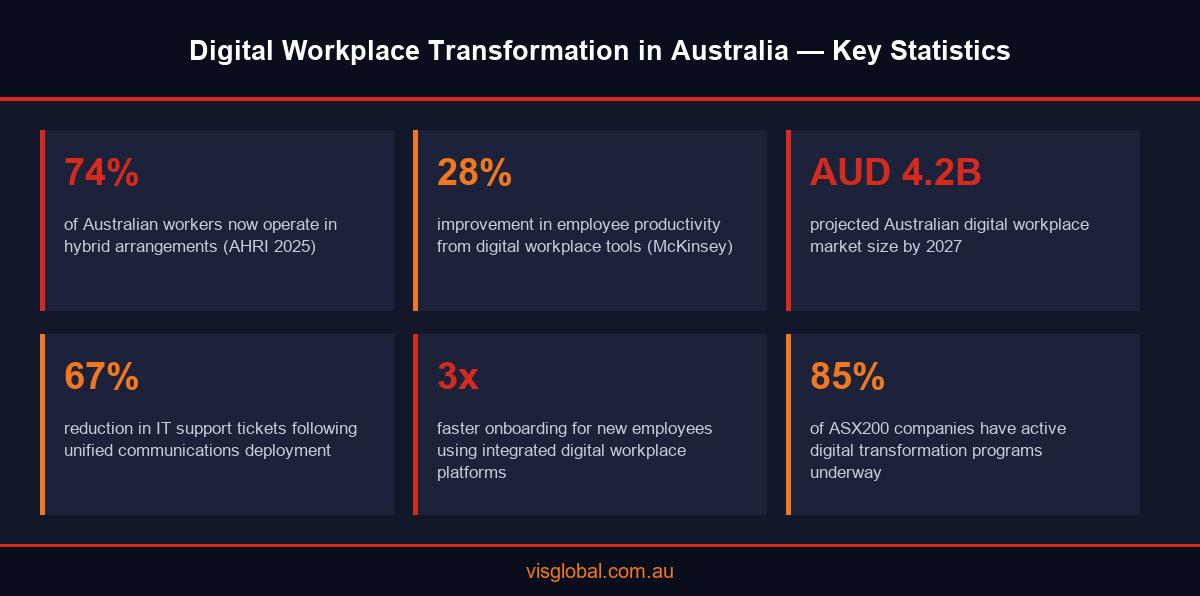
Australian enterprises that have completed transformation report 28% improvements in employee productivity and 67% reductions in IT support burden.
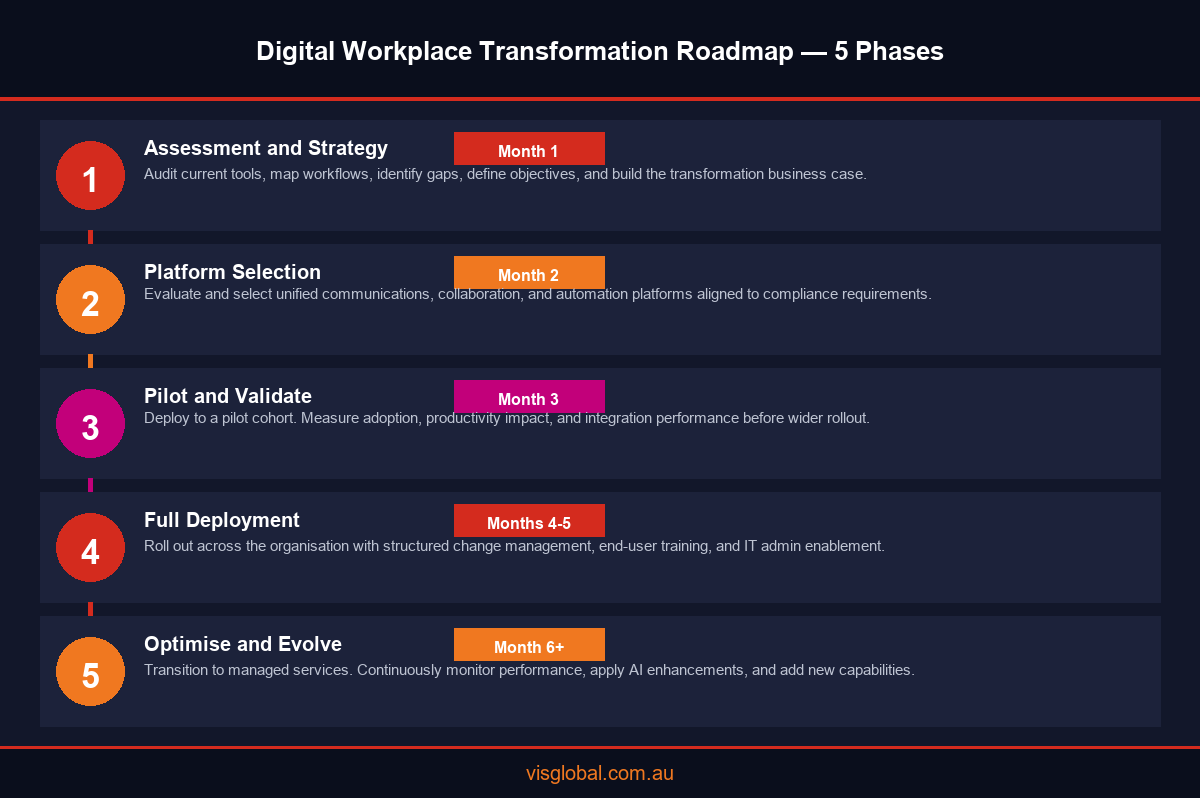
A phased approach covering assessment, platform selection, pilot, deployment, and managed services delivers measurable outcomes within six months.
↵
What Digital Workplace Transformation Means for Australian Enterprises
Digital workplace transformation is not simply the adoption of video conferencing or cloud storage. It is the deliberate redesign of how people, processes, and technology interact across an organisation. AHRI research shows that 74% of Australian workers now operate in hybrid arrangements, creating demand for technology environments that perform equally well in the office, at home, and on mobile. Our guide on why digital workplace solutions are essential for the future of work in Australia explores how enterprises are responding to this shift.
↵
The organisations achieving the greatest outcomes from digital workplace programs are those that have moved beyond point solutions. Rather than deploying a collaboration tool here and a new ITSM platform there, they have invested in integrated environments where unified communications, workflow automation, AI-powered tools, and security architecture work together as a single managed system.
↵
Beyond Remote Work: What the Digital Workplace Actually Delivers
The narrative around digital workplace transformation has often focused on enabling remote work. That framing understates the full opportunity. A properly designed digital workplace reduces the time employees spend searching for information, switching between applications, and waiting for manual approvals. Our analysis of the top challenges in hybrid work and how digital workplace solutions solve them covers the most common friction points and proven remedies. It accelerates onboarding, improves collaboration across geographies, and gives leadership real-time visibility into workforce patterns and productivity signals that support better decision-making.
↵
Research by McKinsey indicates that digital workplace tools improve knowledge worker productivity by 28% on average. For an Australian enterprise with 500 employees, that represents a material competitive advantage in output quality, customer response times, and speed of innovation.
↵
The Business Case for Transformation
The business case for digital workplace transformation in Australia is increasingly straightforward. IT support costs decline significantly when employees move to unified, well-integrated platforms. Recruitment and retention outcomes improve when candidates encounter modern, intuitive tooling rather than ageing infrastructure. And the risk profile of the organisation improves when security, identity management, and compliance controls are embedded in the workplace environment rather than bolted on after the fact.
↵
The Australian digital workplace market is projected to reach AUD 4.2 billion by 2027, driven by continued hybrid work adoption, AI integration into collaboration tools, and the growing recognition that workplace technology is a competitive differentiator rather than a commodity.
↵
Core Technologies Powering the Digital Workplace
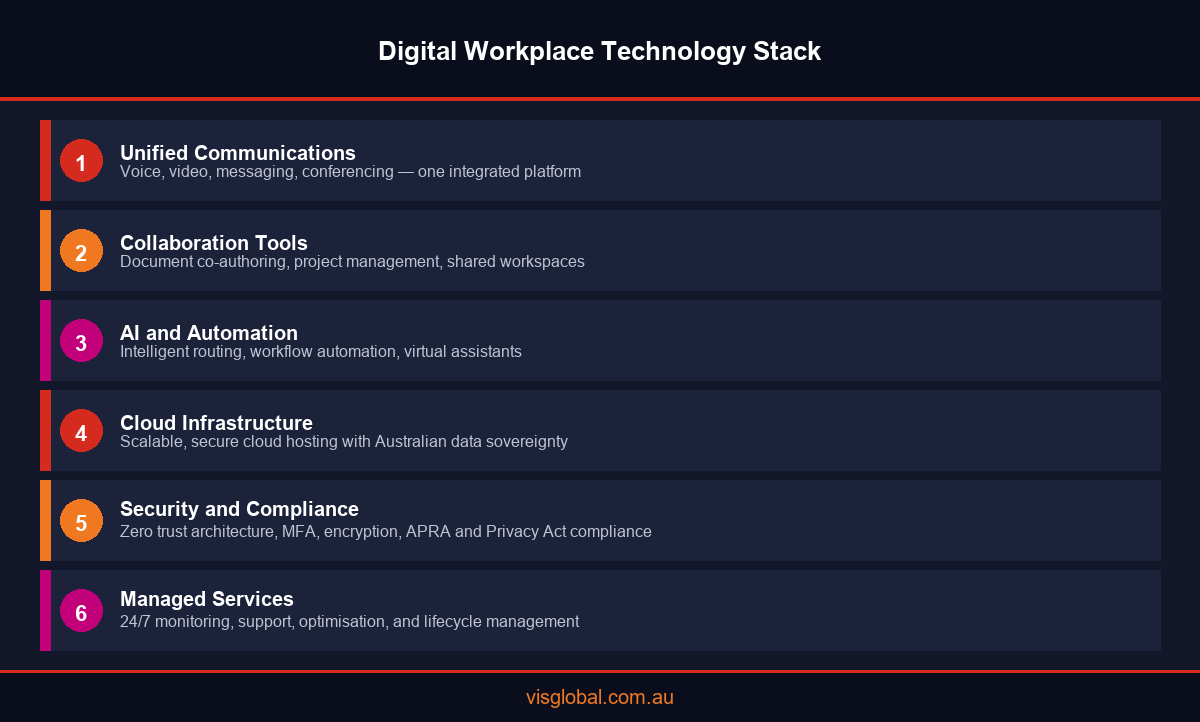
A modern digital workplace is not defined by any single technology. It is defined by the quality of integration between the components that employees rely on daily. Understanding what belongs in each layer of the technology stack is the foundation of effective transformation planning.
Unified Communications and Collaboration
Unified communications platforms consolidate voice, video, instant messaging, and conferencing into a single interface accessible from any device or location. For Australian enterprises with distributed teams, this consolidation eliminates the friction of navigating between disconnected tools and ensures that communication quality does not degrade based on an employee's location or device.
↵
Collaboration layers sit above unified communications, providing shared document workspaces, project management views, and asynchronous content that supports deep work alongside real-time interaction. Platforms such as Microsoft 365, Google Workspace, and Atlassian operate in this layer. When paired with robust cloud infrastructure, they form the backbone of the digital workplace. Organisations looking to maximise customer experience management outcomes will find that collaboration tools directly influence how quickly internal teams can respond to customer needs and resolve issues.
↵
AI-Powered Productivity Tools
AI is rapidly becoming embedded in every layer of the digital workplace. Meeting transcription and summarisation tools reduce the cognitive load of note-taking and follow-up. AI-powered search surfaces relevant documents and knowledge base articles without requiring employees to know exactly where to look. Workflow automation eliminates manual approval chains, data entry tasks, and repetitive handoffs between systems. Our intelligent automation capabilities integrate directly with digital workplace platforms to automate workflows that previously required manual intervention.
↵
Australian enterprises in banking, healthcare, and government are discovering that AI-powered workplace tools deliver the most value when they are configured to the specific compliance and process requirements of the sector. Generic AI tool deployments often underperform because they are not tuned to the workflows and data structures of the organisation.
↵
Digital Workplace in Regulated Australian Sectors
Regulated industries face a more complex transformation journey than unregulated sectors. The requirement to maintain compliance with privacy, data sovereignty, and sector-specific standards shapes every technology decision. However, regulation should not be treated as a barrier to transformation. The right digital workplace architecture makes compliance easier to maintain, not harder.
↵
Banking and Financial Services
Australian financial services organisations operating under APRA oversight must ensure that digital workplace platforms satisfy CPS 231 outsourcing requirements and CPG 234 information security standards. For the banking sector, this means selecting vendors who can provide documented evidence of security certifications, Australian data residency, and audit rights. It also means implementing identity governance, privileged access management, and data loss prevention controls within the workplace platform itself.
↵
The good news for financial services IT leaders is that modern digital workplace platforms designed for regulated industries address these requirements out of the box. Pre-built compliance frameworks, integrated DLP, and built-in audit trails significantly reduce the manual compliance burden compared to legacy environments where these controls must be retrofitted.
↵
Healthcare and Government
Healthcare organisations must ensure that any digital workplace platform handling patient data complies with the Privacy Act 1988 and Australian Privacy Principles. This includes controls around access logging, data minimisation, and breach notification. Purpose-built healthcare digital workplace solutions provide these controls alongside integrations with clinical systems, secure messaging for clinical teams, and role-based access that aligns with clinical workflows.
↵
Government agencies face obligations under the Protective Security Policy Framework, ASD Essential Eight guidelines, and increasingly the Australian Government's Digital Transformation Strategy. Agency-wide digital workplace programs must address classification-appropriate data handling, secure remote access for field and mobile workers, and integration with whole-of-government identity and authentication frameworks.
↵
Building a Secure Digital Workplace
Security is the foundation of any sustainable digital workplace. An environment where employees can work from anywhere is only valuable if the data they access and the communications they conduct are protected to the same standard as they would be on a managed corporate network.
↵
Zero Trust Architecture
Zero trust security assumes that no user, device, or network segment is inherently trusted. Every access request is verified based on identity, device health, location context, and behavioural signals before access is granted. For digital workplaces where employees connect from personal devices, public networks, and co-working spaces, zero trust is not an optional enhancement. It is the baseline security model required to safely enable the flexibility that hybrid work demands.
↵
Implementing zero trust in the digital workplace requires investment in identity and access management, multi-factor authentication, endpoint detection and response, and network micro-segmentation. These capabilities need to be integrated into the workplace platform, not managed as separate security products that employees can circumvent.
↵
Compliance and Data Protection Controls
Data loss prevention (DLP) policies embedded in collaboration tools prevent sensitive information from being shared outside authorised channels. Information barriers enforce regulatory requirements around communication between teams that must remain separate, such as front-office and back-office functions in financial services. Retention policies and legal hold capabilities ensure that communications and documents are preserved in line with regulatory requirements. Our managed services team configures and continuously monitors these controls to ensure they remain effective as the workplace environment evolves.
↵
Managing Change and Driving Adoption
Technology is only half of the digital workplace transformation equation. Organisations that invest in platform selection and deployment without investing equally in change management consistently underperform on adoption metrics. Employees who do not use new tools as intended generate workarounds that undermine the value of the investment and create security risks.
↵
Building an Effective Adoption Strategy
Successful adoption strategies begin before deployment. Engaging employee representatives in platform selection, communicating the rationale for change clearly, and identifying internal champions who can demonstrate new tools to their peers dramatically improves uptake. Training programmes should be role-specific rather than generic, addressing the workflows and pain points relevant to each team rather than delivering a one-size-fits-all walkthrough of platform features.
↵
Onboarding is one of the most visible indicators of digital workplace maturity. Organisations with well-integrated digital workplaces onboard new employees three times faster than those with fragmented tooling, because system access, device provisioning, and role-specific application setup can be automated rather than handled manually by IT teams.
↵
Measuring Transformation Success
Transformation success must be measured against business outcomes, not technology deployment milestones. Key metrics include employee satisfaction with workplace tools, IT support ticket volume, collaboration tool adoption rates, time-to-productivity for new hires, and incident response times for security events. Organisations that establish baseline measurements before transformation begins can demonstrate clear ROI and identify areas requiring further attention. Our case studies document how Australian enterprises across banking, healthcare, and BPO have measured and achieved measurable outcomes from digital workplace programs.
↵
Calculating ROI on Digital Workplace Investment
Return on investment from digital workplace transformation operates across multiple dimensions. Organisations that model ROI only against direct technology cost savings consistently underestimate the full value and make suboptimal investment decisions as a result.
↵
Direct cost savings include reduction in IT support costs (typically 30 to 40 percent for organisations moving from fragmented tooling to unified platforms), elimination of redundant software licences, and lower infrastructure costs through cloud consolidation. These savings are predictable and measurable within the first twelve months of deployment.
↵
Productivity gains are the largest component of digital workplace ROI but require more structured measurement to capture. Reduced application switching time, faster document retrieval, automated approval workflows, and improved meeting effectiveness each contribute to productivity improvements that accumulate across the workforce. At an organisation with 500 employees averaging a 28% productivity improvement in collaborative tasks, the annualised value can significantly exceed the total cost of the workplace platform.
↵
Talent outcomes are the third major ROI dimension. Organisations with modern digital workplaces report lower voluntary turnover among knowledge workers and higher success rates in recruiting technology-literate candidates. Quantifying the cost of avoided turnover and faster time-to-hire typically adds meaningful value to the ROI model that is often overlooked in technology investment cases.
↵
Designing Your Digital Workplace Transformation Roadmap
Every digital workplace transformation is unique. The right roadmap depends on the organisation's current technology maturity, regulatory context, workforce distribution, and strategic priorities. However, the structure of a successful roadmap follows a consistent pattern regardless of sector or size.
↵
Assessment comes first. Before any platform selection or vendor engagement, organisations need a clear picture of what they currently have, what their employees need, and what compliance obligations must be satisfied. This assessment typically surfaces legacy integrations and shadow IT that are invisible to central IT but widely used across the organisation.
Platform selection follows assessment. The goal is to identify the minimum number of well-integrated platforms that satisfy the full requirements of the workforce, rather than consolidating everything into a single vendor at the cost of functionality. Our guide to choosing the right digital workplace platform covers vendor evaluation criteria and comparison frameworks in detail. Pilot programmes validate platform performance and adoption dynamics in a controlled setting before full deployment commits the organisation to a new environment.
↵
Full deployment is followed by transition to ongoing managed services, which maintain platform performance, apply security updates, onboard new users, and continuously optimise the environment as business requirements evolve. The digital workplace solutions team at VIS Global supports Australian enterprises through every phase of this journey, from initial assessment through to long-term managed operations.
↵
Conclusion
Digital workplace transformation in Australia is no longer optional for enterprises competing for talent, customers, and operational efficiency. The combination of hybrid work expectations, AI integration, and tightening compliance requirements has made a unified, secure, and intelligent digital workplace the foundation of enterprise performance.
↵
Organisations that approach this transformation with a structured roadmap, the right technology partners, and a genuine commitment to adoption will recover their investment within twelve months and build a workplace that attracts the best people and serves customers better. To understand what a truly future-ready environment looks like in practice, read our guide to building a future-ready digital workplace for hybrid and remote teams. Contact VIS Global to begin your digital workplace assessment today.