Hyper-Personalised Customer Journeys in Australia: The Complete Enterprise Guide 2026
 Customer Experience Management
Australian enterprises are entering a defining era of customer engagement. Hyper-personalised customer journeys are no longer a future ambition. They are the present-day competitive standard that every CX leader in Australia must meet to protect revenue, retention, and market share. According to Publicis Sapient, 53% of Australian consumers would switch brands after a single poor digital experience. The contact centre call, the banking app notification, the retail checkout: every touchpoint is now a moment of competitive truth. VIS Global's customer experience management solutions help enterprise organisations in Australia design and deploy the AI-powered personalisation capabilities that today's customers demand. This guide covers the four pillars of hyper-personalisation, the AI technologies enabling it at scale, the regulatory environment shaping it, and a practical four-step readiness roadmap.
Key Takeaways
62% of ANZ consumers want more personalised recommendations, yet only 35% feel they receive them. This 27-point gap is the commercial opportunity hyper-personalisation directly addresses.
Hyper-personalisation is built on four foundations: unified customer data, AI and machine learning, omnichannel delivery, and trust and governance. All four must be in place for the capability to function.
Australian enterprises deploying real-time AI decisioning are achieving 40% reductions in operational costs, 50% increases in conversion rates, and near-doubling of application completion rates.
What Is Hyper-Personalisation and Why Does It Matter?
Hyper-personalisation uses artificial intelligence, machine learning, and real-time data to deliver content, products, and experiences uniquely tailored to each individual customer at the precise moment they need them. This is not a marketing upgrade. It is a foundational shift in how organisations relate to customers. Digital experience in Australia is no longer a differentiator. It is the baseline expectation. Every touchpoint is now a moment of competitive truth, and organisations failing to meet this standard are not simply losing market share. They are actively driving customers toward competitors who do.
Traditional segmentation groups customers by broad shared attributes and applies rule-based communications to them. Standard personalisation builds individual profiles and uses basic AI for product recommendations. Hyper-personalisation is the next evolution. It combines real-time behavioural signals with generative AI to deliver one-to-one engagement across every channel, carrying full customer context throughout the journey without interruption or repetition. Real-time decisioning engines process thousands of signals per interaction in under 200 milliseconds, determining the right content, channel, tone, and timing for each individual at the precise moment of need.
The Business Case Is Already Proven in Australia
The commercial returns from hyper-personalisation are substantial and measurable across the Australian enterprise landscape. Organisations with best-in-class personalisation see revenue increases of up to 40%. Optimising customer journeys across the lifecycle delivers revenue uplifts of up to 15%. Cost-to-serve reductions of up to 20% are achievable through journey optimisation alone. NAB deployed 800 adaptive AI models across 150 next-best actions, achieving a 40% uplift in customer engagement and a 50% increase in mortgage conversions within 24 months. ANZ Bank nearly doubled application completion rates using a central AI decisioning platform processing over 1,000 data attributes.
The contact centre is the primary channel through which hyper-personalisation is delivered and measured. To understand how AI is transforming this channel, read our complete guide to AI contact centre solutions in Australia.
The Distinction Between Standard and Hyper-Personalisation
What separates hyper-personalisation from its predecessors is the combination of real-time signal processing and generative AI working at the individual customer level. Standard personalisation relies on historical data and rule-based logic applied to segments. Hyper-personalisation processes thousands of live signals per interaction including browsing behaviour, transaction history, life events, channel preferences, and emotional context, and uses AI to determine the optimal response in real time. This is where intelligent automation plays a critical role, connecting data systems, decisioning engines, and customer-facing channels into a single orchestrated flow that treats every customer as a market of one.
The ANZ Personalisation Gap: What the Data Reveals
The gap between what Australian consumers expect and what organisations are delivering is significant and commercially urgent. Research across the ANZ region tells a consistent story: customers want relevance, they are increasingly sceptical about how their data is used, and they will leave if either expectation goes unmet. Brands that resolve this tension by delivering personalisation relevance while protecting privacy will capture disproportionate loyalty.
Consumer Expectations vs. Delivery Reality
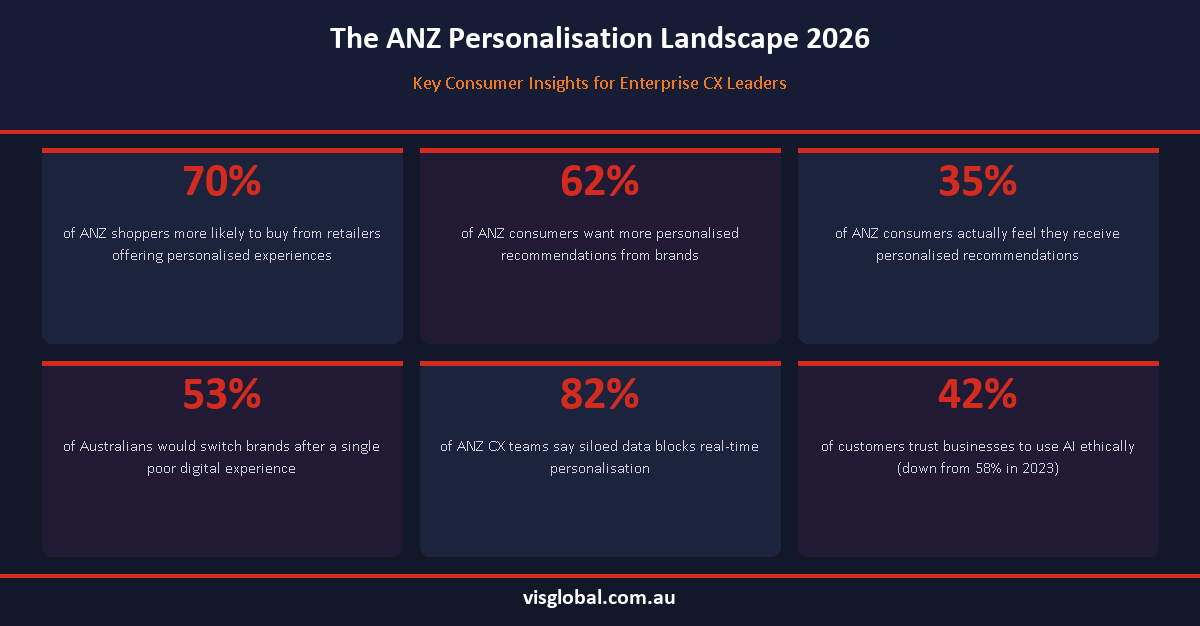
Seventy percent of ANZ shoppers are more likely to buy from retailers that offer personalised experiences. Sixty-two percent of ANZ consumers want more personalised recommendations. Yet only 35% feel they actually receive them. This 27-point personalisation gap is not a technology problem. It is an execution problem caused by siloed data, unclear ownership, and fragmented channel strategies. According to Salesforce's State of the AI Connected Customer report, the proportion of customers who feel treated as a unique individual rose from 39% in 2023 to 73% in 2024. Yet only 42% trust businesses to use AI ethically, down from 58%. Most Australian organisations are not failing on ambition. They are failing on foundation.
Eighty-two percent of ANZ CX front-line teams report that siloed data still blocks real-time personalisation. Only 14% of ANZ brands are advancing a unified customer view, which is the foundational requirement for everything else. Forty-two percent of CX teams still operate in silos, preventing cohesive execution. The organisations that move first to resolve this structural gap will build compounding advantages in data quality, AI maturity, and customer trust that become progressively harder for competitors to close.
A Parallel Trust Crisis Running Beneath the Surface
Customers are experiencing better personalisation and trusting organisations less at the same time. According to KPMG's Customer Experience Excellence report, Integrity is the most influential driver of customer loyalty in Australia, accounting for 18.9% of the total CX excellence score. Yet broader corporate trust is at a record low, with only 29% of customers trusting companies more than they did a year ago. Ethical AI concerns have grown 68% in four years and show no sign of slowing. This creates a paradox every ANZ enterprise must resolve: delivering increasing personalisation relevance while rebuilding the trust that makes customers willing to share the data that makes personalisation possible.
The Four Pillars of Hyper-Personalisation
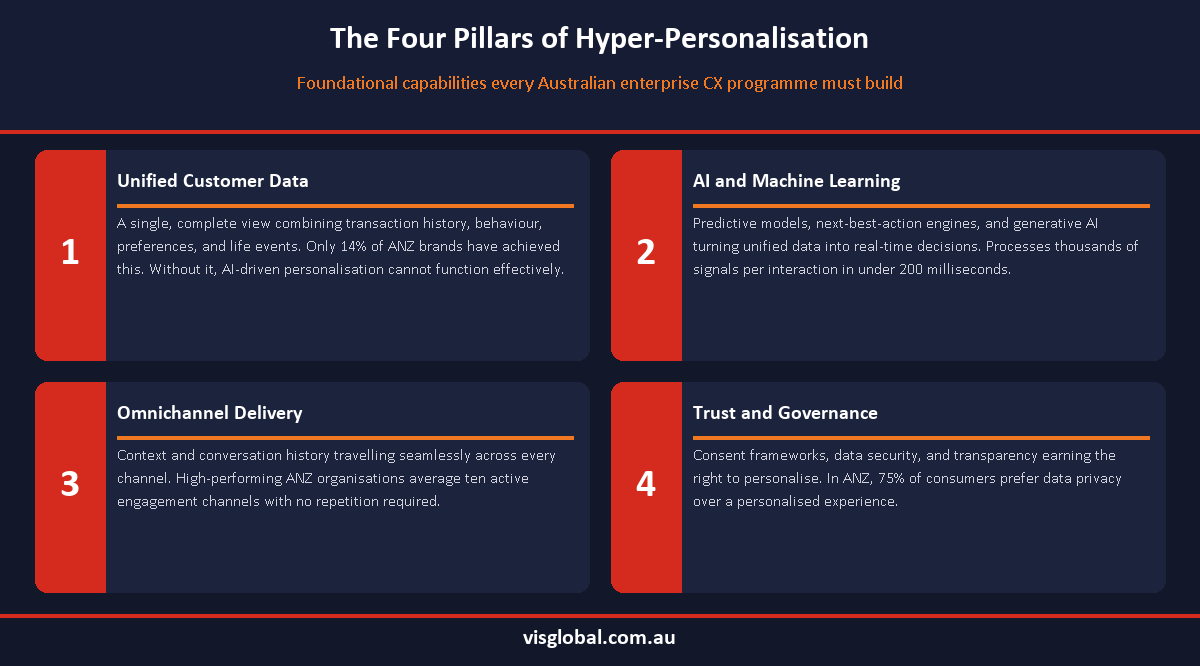
Hyper-personalisation is not a single technology purchase. It is a cross-functional capability that connects data, technology, and customer insight across every organisational touchpoint. Four pillars must be in place for it to function effectively. The absence of any one of them limits the performance of the others and caps the commercial results achievable. Organisations attempting to shortcut this architecture by deploying AI on top of siloed, incomplete, or ungoverned data will produce inconsistent outcomes and erode customer trust.
Pillar 1: Unified Customer Data
A single, complete view of the customer is the non-negotiable foundation. Without it, AI-driven personalisation cannot function effectively. This means combining transaction history, behavioural data, channel preferences, service interaction records, and life event signals into one accessible and continuously updated platform. Only 14% of ANZ brands have achieved this. A customer data platform unifies data from CRM, contact centre, digital properties, and loyalty programmes into a real-time customer profile. For the 86% of Australian enterprises that have not yet achieved this unified view, establishing it is where every hyper-personalisation roadmap must begin.
Pillar 2: AI and Machine Learning
Predictive models, next-best-action engines, and generative AI turn unified data into real-time, context-aware decisions. The technology processes thousands of signals per customer interaction to determine the right response at the right moment across the right channel. NAB's enterprise customer brain covers over 150 next-best actions and reached 75% of all customer interactions within 24 months. The AI and machine learning layer is what converts raw, unified data into the individual-level engagement that customers now expect as standard. Without it, a unified data asset remains underutilised and the personalisation gap persists.
Pillar 3: Omnichannel Delivery
Context and conversation history must travel seamlessly with the customer across every channel: app, web, branch, phone, chatbot, and social. The customer should never need to repeat themselves. High-performing ANZ organisations average ten active engagement channels. Read our complete guide to omnichannel customer experience management in Australia to understand how to build a context-carrying, channel-agnostic engagement architecture. Complementing omnichannel CX, digital workplace solutions play an equally important role by equipping frontline employees with the AI-powered tools they need to deliver personalised service at every touchpoint without friction or manual effort.
Pillar 4: Trust and Governance
In Australia, 75% of consumers prefer data privacy over a personalised experience. This is not a barrier to personalisation. It is a design requirement. Consent frameworks, data security practices, and transparency mechanisms must earn the right to personalise before the organisation exercises it. KPMG identifies Integrity as the most influential pillar of CX excellence in Australia at 18.9% of the total score. Privacy-by-design is no longer a compliance checkbox. It is the commercial foundation upon which every other personalisation investment depends.
AI and Generative AI: The Technology Enabling Personalisation at Scale
Two distinct AI capabilities are reshaping the economics of personalisation in Australia. Generative AI makes one-to-one personalisation affordable at enterprise scale. Agentic AI shifts organisations from reactive to proactive customer engagement. Together they represent a step-change in what is possible and, increasingly, what is expected by Australian consumers across every sector.
Generative AI Makes Individual Personalisation Economically Viable
Previously, personalising at an individual level was financially infeasible for large organisations. Generative AI changes the economics entirely. In ANZ, 71% of Australian marketers and 91% of New Zealand marketers are already experimenting with or have fully implemented AI into their workflows. High-performing ANZ marketing teams are 2.8 times more likely than underperformers to have fully integrated AI. Real-time decisioning engines process customer signals in under 200 milliseconds. ANZ Plus built personalised AI capabilities directly into their banking app, surfacing the customer's preferred name and account context before they type a word. To understand how generative AI integrates with broader automation to power individual-level personalisation, read our guide to intelligent automation solutions in Australia.
Agentic AI Shifts the Paradigm to Proactive Engagement
Agentic AI systems have goals, autonomy, and decision-making capability. Unlike traditional AI that only responds when prompted, agentic systems sense, reason, and execute independently within defined boundaries. Four types are relevant to enterprise CX. Taskers handle repeatable tasks autonomously: ANZ contact centres achieve 95% auto-resolution rates using these agents. Automators handle multi-step workflows including document processing and credit assessment. Collaborators work alongside human agents, surfacing real-time next-best actions as NAB's customer brain does for frontline bankers. Orchestrators coordinate multiple agents, channels, and functions for seamless end-to-end journeys. ANZ Bank's agentic AI identifies customers showing signs of financial stress approximately 40 days earlier than traditional methods. For enterprise organisations evaluating their AI and CX stack, our guide to customer experience platforms in Australia provides a complete assessment framework for platform selection and integration.
Hyper-Personalisation in Action Across Australian Industries
The evidence from across the ANZ market is not theoretical. Australian enterprises in banking, retail, and telecommunications are generating measurable, audited results from hyper-personalisation programmes already in production. The following outcomes offer both proof of what is achievable and a benchmark for where your organisation should be targeting its investments.
Banking and Financial Services
Banking is the most data-rich and relationship-intensive sector in Australia, making it the most advanced arena for hyper-personalisation. ANZ Bank deployed a central AI decisioning platform fed by over 1,000 data attributes, processing signals in under 200 milliseconds. The ANZ Plus app surfaces the customer's preferred name and account context before any interaction begins. Results include a near-doubling of application completion rates and high single-digit improvements in retention. NAB built an enterprise customer brain using 800 adaptive AI models covering 150 next-best actions, achieving a 40% uplift in engagement, a 50% increase in mortgage conversions, and three times more opportunities from improved targeting. Westpac New Zealand won the FICO Pioneer Award 2024, delivering a 25% increase in digital engagement, a 40% reduction in operational costs, and a 10% improvement in customer rehabilitation rates. Read our guide to intelligent automation for banking in Australia for a deeper look at AI-driven outcomes in financial services.
VIS Global's expertise in the banking sector means we understand the unique data architecture, compliance requirements, and customer relationship dynamics that make banking the most demanding and rewarding environment for hyper-personalisation. Our implementations are designed to deliver measurable results while meeting the full obligations of Australian banking regulation.
Retail and Telecommunications
Retail leads Australia's CX performance rankings in 2025. Nine of the top ten brands in the KPMG Customer Experience Excellence report belong to the retail sector, driven by AI-powered loyalty ecosystems, seamless omnichannel execution, and data-driven personalisation at the point of purchase. Sixty-six percent of ANZ shoppers engage with brands on social media for shopping purposes, and 51% make purchases through platforms like Instagram and TikTok. Augmented reality tools allow customers to visualise products before purchase, reducing anxiety and return rates. Telecommunications companies hold a unique personalisation advantage through real-time location data, device usage patterns, network behaviour, and billing history, enabling personalisation delivered at the moment of maximum relevance. These same capabilities extend directly into BPO and contact centre operations where AI-powered triage, predictive churn detection, and proactive outreach are transforming how outsourced service teams deliver personalised customer engagement at scale.
Employee experience is an equally important dimension. Giving frontline teams the right AI tools and connected data directly determines the quality of personalised service they can deliver. Our guide to digital workplace transformation in Australia covers how enterprise organisations are equipping their people with the AI-powered tools that make individual-level customer engagement possible across every channel.
The Trust and Privacy Imperative in Australia
The central tension in hyper-personalisation is that consumers simultaneously want more relevant experiences and are deeply sceptical about how their data is being used. Organisations that resolve this tension through genuine transparency, strong governance, and ethical design will earn disproportionate loyalty. Those that ignore it face compounding consequences: customer churn, regulatory exposure, and the erosion of the data assets that personalisation depends on.
What the ANZ Data Breach Era Changed
The Optus and Medibank data breaches permanently reset trust expectations across Australia. Seven million Australians say they will never trust Optus again. Five million say the same of Medibank. Among Optus customers, 36% switched providers after the breach and another 30% plan to. Ninety percent of Australian consumers demand transparency in how their personal data is handled. Sixty-four percent of global customers believe companies are reckless with customer data. Fifty-four percent of customers leave a company after a data breach even if their own data was not affected. Data protection is not a compliance activity. It is the foundation upon which the right to personalise must be earned.
What Actually Builds Trust in AI
Trust is not built through marketing claims about responsible AI. It is built through verifiable design decisions. Forty-two percent of customers cite transparency about how AI is being used as the most important trust factor. Thirty-five percent want human validation of AI outputs before they reach the customer. Seventy-two percent of customers say it is important to know when they are communicating with an AI agent rather than a human. Forty-six percent are more likely to use an AI agent if a clear escalation path to a human exists, and 50% are more likely to engage if the AI's logic is clearly explained to them.
Key Regulatory Obligations for Australian Enterprises
Four primary frameworks govern AI-powered personalisation in Australia. The Australian Privacy Principles under the Privacy Act 1988 mandate transparency, purpose limitation, and data accuracy, with incoming reforms significantly tightening retention and consent obligations. The Consumer Data Right enables customers to share data with accredited third parties, creating personalisation opportunities through consented data sharing alongside strict security obligations. WCAG 2.1 and the Disability Discrimination Act require personalisation platforms to be accessible across all user capabilities. The National Consumer Credit Protection Act extends responsible lending obligations to AI-driven product recommendations for credit and BNPL products. Privacy-by-design must be embedded from the outset of any personalisation programme, not retrofitted once the system is live.
VIS Global embeds governance, consent frameworks, and responsible AI design into every implementation. Learn more about our customer experience management solutions and how we ensure every personalisation programme is built on a foundation of ethical design, regulatory compliance, and customer trust from day one.
Building Your Hyper-Personalisation Readiness Roadmap
Not every process or touchpoint is an immediate candidate for hyper-personalisation. A structured four-step approach helps Australian enterprises identify, prioritise, and sequence investments for maximum commercial impact without unnecessary complexity or wasted spend. The organisations that will lead on CX in the next three years are those that begin this sequencing process now, before customer expectations outpace their capability.
Step 1: Audit Your Current State
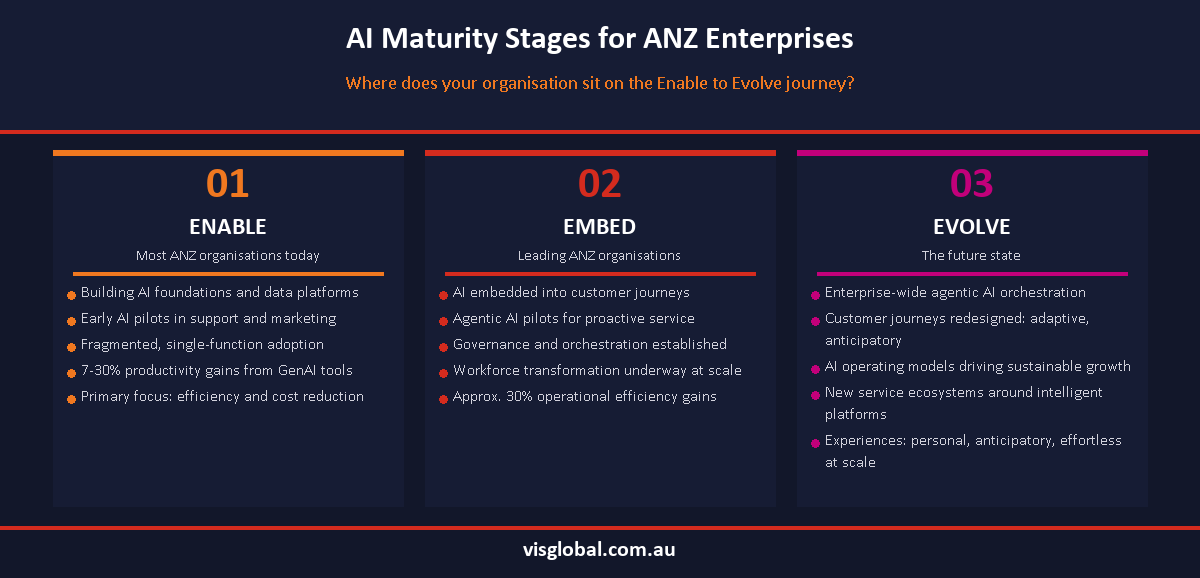
Begin by mapping all customer data sources: CRM, app telemetry, transaction history, contact centre records, and loyalty programme data. Identify data quality gaps, silos, and governance weaknesses. Assess where your organisation sits on the AI maturity curve, Enable, Embed, or Evolve, against the KPMG framework. Evaluate your consent infrastructure against Privacy Act and Consumer Data Right requirements. Only 14% of ANZ brands have achieved a unified customer view. Establishing it is where every hyper-personalisation roadmap must begin, because without it every subsequent investment is limited by the quality and completeness of the underlying data.
Step 2: Identify and Prioritise Opportunities
Shortlist personalisation opportunities using an Impact by Effort framework. High-impact, lower-effort use cases should come first to demonstrate value and build internal confidence for larger investments. The best candidates are high-volume, clearly rule-based processes that currently require manual intervention or produce inconsistent outcomes. For each candidate, estimate the commercial impact: customer engagement uplift, conversion improvement, cost-to-serve reduction, and NPS change. Australian proof points provide credible anchors: NAB achieved 40% engagement uplift, Westpac New Zealand reduced operational costs by 40%, ANZ Bank nearly doubled application completion rates.
Steps 3 and 4: Build the Business Case and Deploy in Phases
Connect every personalisation initiative to a measurable business outcome: operating margin, customer lifetime value, NPS, or revenue per interaction. Then build a time-phased deployment roadmap. Quick wins in the first 90 days demonstrate value and build organisational confidence. Capability-building investments from three to twelve months establish the AI, data, and governance infrastructure. Transformational programmes beyond twelve months redesign customer journeys at enterprise scale using the Total Experience model: unifying customer, employee, and digital interactions into one intelligent adaptive environment. VIS Global's managed services team supports Australian enterprises across every phase of this roadmap, from initial data architecture and customer data platform implementation through to enterprise-wide agentic AI deployment and ongoing optimisation. We embed governance, responsible AI frameworks, and consent mechanisms from day one so that your personalisation programme is built on a foundation that scales. Contact our team to discuss where your organisation currently sits on the AI maturity curve and how to accelerate your programme.
Conclusion
Hyper-personalised customer journeys are no longer aspirational. They are the standard that Australian consumers already expect and the capability that leading enterprises are deploying at scale across banking, retail, healthcare, and government. The organisations winning on CX in Australia have invested in unified customer data, real-time AI decisioning, omnichannel delivery, and trust-first governance. The commercial results are measurable and repeatable. VIS Global partners with enterprise organisations across Australia to design, implement, and manage the full personalisation technology stack. Contact VIS Global today to begin building your hyper-personalisation roadmap and start delivering the individual-level experiences your customers expect.