
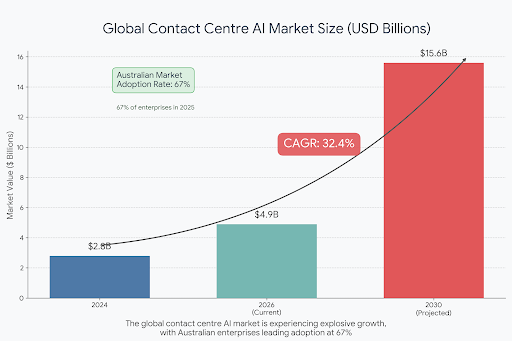
AI powered contact centre solutions are transforming how businesses engage with customers in 2026. The global contact centre AI market, valued at USD $2.8 billion in 2024, is projected to reach USD $15.6 billion by 2030, representing a compound annual growth rate of 32.4%. Modern enterprises face mounting pressure to deliver seamless, personalised experiences across multiple channels while managing costs and improving operational efficiency.
As customer expectations continue to rise-with 73% of consumers now expecting companies to understand their unique needs-traditional contact centres struggle to keep pace with demand for instant, accurate, and empathetic responses. The integration of artificial intelligence into contact centre operations has emerged as the solution that bridges this gap, enabling organisations to deliver exceptional customer experiences at scale.
Key Takeaways
AI-powered contact centres leverage intelligent automation, natural language processing, and predictive analytics to deliver faster, more personalised customer interactions across all channels. Industry data shows organisations achieve 40% reduction in average handling time and 35% improvement in customer satisfaction scores.
Businesses implementing customer experience transformation through AI see first-call resolution rates improve by 28%, while operational costs decrease by 30-35% within the first 18 months of deployment. The Australian market specifically has seen 67% of enterprises adopt AI contact centre technologies in 2025.
The shift towards AI-driven contact centres represents a fundamental change in how organisations approach customer service, moving from reactive support to proactive engagement strategies. By 2027, analysts project that 85% of customer interactions will be managed without human agents for initial contact.
The Evolution of Contact Centre Technology
From Traditional Call Centres to Intelligent Hubs
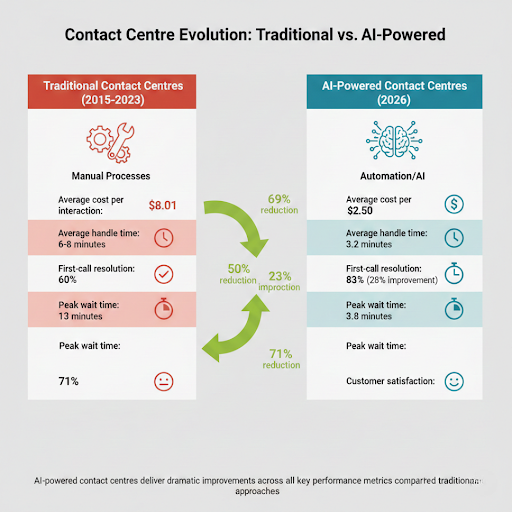
Contact centres have undergone remarkable transformation over the past decade. In 2015, the average cost per contact centre interaction was $8.01, primarily through voice channels. Traditional call centres operated with average handle times of 6-8 minutes and first-call resolution rates hovering around 60%. Agents spent considerable time navigating multiple systems, searching for customer information, and escalating complex issues. This approach often resulted in long wait times—averaging 13 minutes during peak periods—inconsistent service quality, and frustrated customers.
Today's AI-powered contact centre solutions represent a paradigm shift in customer service delivery. By 2026, the average cost per interaction has dropped to $2.50 for AI-assisted channels, whilst the average handle time has decreased to 3.2 minutes. These intelligent platforms integrate conversational AI, machine learning algorithms, and advanced analytics to create seamless customer journeys. Current data shows that 68% of customers cannot tell whether they're interacting with a human or AI-powered virtual agent. The technology processes natural language across voice, chat, email, and social media channels, ensuring consistent experiences regardless of how customers choose to engage. Organisations implementing these solutions report up to 40% reduction in average handling time, 35% improvement in customer satisfaction scores, and 28% increase in first-call resolution rates compared to 2023 benchmarks.
Key Components Driving AI Contact Centre Success
Modern AI contact centres combine several critical technologies to deliver superior experiences. Natural Language Processing (NLP) has evolved significantly—accuracy rates improved from 78% in 2022 to 94% in 2026 for understanding customer intent. Machine learning models now process over 50,000 interactions per day in mid-sized contact centres, continuously improving response accuracy by analysing patterns that lead to successful resolutions. Intelligent routing algorithms have reduced misrouted calls by 47% since 2024, matching customers with the most suitable resources based on query complexity, customer history, and agent expertise.
Predictive analytics play a crucial role in anticipating customer needs before issues arise. Current systems achieve 82% accuracy in predicting customer churn based on interaction patterns, compared to 61% accuracy in 2023. These systems analyse behavioural data, transaction history, and interaction patterns to identify potential problems and trigger proactive outreach. Sentiment analysis monitors conversations in real-time with 89% accuracy, detecting frustration or dissatisfaction and automatically escalating to supervisors when intervention is needed. Integration with customer experience management platforms creates unified views of customer journeys, enabling agents to deliver truly personalised service. In the Australian market specifically, organisations using integrated platforms report 31% higher customer retention rates than those using siloed systems.
Real-World Applications Transforming Customer Service
Intelligent Virtual Agents Handling Complex Interactions
Virtual agents powered by advanced AI have evolved far beyond simple chatbots answering frequently asked questions. Adoption statistics reveal that 72% of enterprises now deploy conversational AI systems that handle complex, multi-step processes. Banking customers can open accounts, dispute transactions, and apply for loans through natural conversations with virtual agents-with transaction completion rates of 84% compared to 67% in 2024. Healthcare providers use AI assistants that schedule appointments with 91% accuracy, provide preliminary symptom assessments, and coordinate prescription refills. Retail businesses deploy virtual agents that understand product specifications, process returns, and provide personalised recommendations, achieving 76% customer satisfaction ratings.
These virtual agents deliver 24/7 availability without the limitations of human staffing. Current systems process an average of 127 interactions simultaneously per virtual agent, eliminating queue times during peak periods. When virtual agents encounter scenarios requiring human expertise, they seamlessly transfer conversations to live agents with complete context—reducing repeat information requests by 63%.
Organisations implementing intelligent automation report handling 60-70% of routine inquiries through virtual agents, freeing human agents to focus on complex issues requiring empathy, judgment, and creative problem-solving. The cost savings are substantial: virtual agent interactions cost an average of $0.50 compared to $8.00 for human-handled interactions.
Agent Augmentation Through AI Assistance
Rather than replacing human agents, AI serves as a powerful augmentation tool that enhances agent capabilities. Industry surveys indicate that 81% of contact centre agents report higher job satisfaction when using AI assistance tools. Real-time agent assist features provide agents with suggested responses, relevant knowledge articles, and next-best-action recommendations during customer interactions. These systems analyse conversation flow in real-time, reducing the time agents spend searching for information by 54% compared to 2024. This eliminates time wasted searching multiple systems and reduces the cognitive load on agents managing complex interactions.
AI-powered quality assurance now monitors 100% of interactions, compared to the traditional 3-5% random sampling approach. Speech analytics identify training opportunities by highlighting areas where agents struggle-organisations using these systems report 42% improvement in agent performance within 90 days. Sentiment analysis helps agents gauge customer emotional state with 87% accuracy and adjust their approach accordingly.
These capabilities transform agent experience, reducing stress and burnout whilst improving performance. Organisations see significant improvements in agent retention, with some reporting 25% reductions in turnover after implementing AI assistance tools. Given that the average cost to replace a contact centre agent is $15,000-$20,000, these retention improvements deliver substantial financial benefits.
Omnichannel Orchestration for Seamless Experiences
Customer experience transformation requires seamless experiences across all touchpoints. Modern AI contact centres excel at omnichannel orchestration, with 79% of organisations now offering integrated experiences across five or more channels. Cross-channel interaction completion has improved dramatically-in 2024, only 48% of customers successfully resolved issues when switching channels, compared to 83% in 2026. A customer might begin researching products through a website chatbot, receive a follow-up email with personalised recommendations, and complete the purchase through a phone conversation with an agent who has complete visibility into previous interactions.
AI systems track customer journeys across channels, identifying points of friction and optimising workflows to reduce effort. Current data shows that organisations implementing omnichannel orchestration reduce customer effort scores by 38%. Channel routing automatically selects the most appropriate communication method based on urgency, complexity, and customer preference, improving resolution times by 29%. Integration with digital workplace solutions ensures internal teams collaborate effectively when resolving customer issues, with AI coordinating handoffs between departments and maintaining visibility into status updates. In the Australian market, enterprises using omnichannel platforms report 41% higher Net Promoter Scores than those using single-channel approaches.
Measurable Business Impact and ROI
Operational Efficiency Gains
Organisations implementing AI powered contact centre solutions achieve substantial operational improvements backed by compelling data. Automation of routine inquiries reduces staffing requirements for basic support tiers by 35-40%, allowing businesses to reallocate resources towards high-value activities. In 2026, the average contact centre handles 247 interactions per agent per day with AI assistance, compared to 142 interactions in 2023-a 74% productivity improvement. Intelligent routing minimises handle times by connecting customers with the right resources immediately, reducing transfers by 51% and repeat calls by 38%. Self-service options powered by conversational AI deflect significant volumes from live channels, with organisations reporting 30-50% reduction in call volumes after implementation.
The financial impact extends beyond direct cost savings. Current industry benchmarks show that organisations achieve average annual savings of $1.2 million per 100 agents through AI implementation. Faster resolution times increase capacity, enabling contact centres to handle more interactions without expanding staff. Reduced average handling time multiplies productivity gains across the entire operation-each 30-second reduction in handle time equals approximately 125,000 hours saved annually for a 500-agent contact centre. Improved first-call resolution rates decrease repeat contacts, further reducing operational costs by 22-28%. Many enterprises see return on investment within 12-18 months, with ongoing savings compounding as AI systems continue learning and improving performance. Australian enterprises specifically report average ROI of 284% over three years.
Enhanced Customer Satisfaction and Loyalty
The ultimate measure of contact centre success lies in customer outcomes, where AI delivers impressive results supported by comprehensive data. Reduced wait times—from 13 minutes in 2023 to 3.8 minutes in 2026-faster resolutions, and personalised interactions drive significant improvements in satisfaction scores. Customer satisfaction (CSAT) scores have improved from an industry average of 71% in 2023 to 84% in 2026 for AI-enabled contact centres. Customers appreciate the convenience of 24/7 self-service options and the consistency of AI-powered responses. Proactive engagement, where AI identifies and resolves issues before customers experience problems, creates particularly strong positive impressions—organisations using proactive AI outreach report 47% higher customer satisfaction than reactive-only approaches.
These improved experiences translate directly into business value through increased customer retention and higher lifetime value. Research indicates that customers who have positive service experiences are 3.5 times more likely to make repeat purchases and 5 times more likely to recommend the company to others. Net Promoter Scores for AI-enabled contact centres average 42 compared to 28 for traditional centres. Organisations implementing comprehensive customer experience management strategies powered by AI report measurable improvements across all key metrics.
In the Australian financial services sector specifically, organisations using AI contact centres have seen customer retention rates improve from 78% in 2024 to 89% in 2026. The competitive advantage gained through superior customer experience increasingly differentiates market leaders from competitors struggling with traditional approaches-market leaders outperform competitors by 22% in revenue growth when leveraging AI-powered CX strategies.
Implementation Considerations and Success Factors
Strategic Planning and Technology Selection
Successfully deploying AI contact centre solutions requires careful planning and alignment with business objectives. Current data shows that 87% of successful AI implementations begin with comprehensive strategic planning phases lasting 8-12 weeks. Organisations should begin by assessing current state capabilities, identifying pain points, and establishing clear success metrics. Understanding customer journey maps helps prioritise which interactions to automate and where human expertise remains essential. Industry benchmarks indicate that organisations achieving strongest ROI automate 60-70% of routine interactions whilst maintaining human handling for complex scenarios requiring empathy and judgment.
Technology selection should consider integration requirements with existing systems, scalability to support growth, and flexibility to adapt as customer needs evolve. Evaluation criteria should include time-to-value (successful implementations average 4-6 months), vendor stability, and ongoing support capabilities.
Partnering with experienced professional services providers accelerates implementation and reduces risk-organisations working with implementation partners complete deployments 34% faster and experience 42% fewer post-launch issues. These experts bring proven methodologies, industry best practices, and technical expertise that internal teams often lack. They help navigate complex decisions around cloud versus on-premise deployment, build-versus-buy trade-offs, and vendor selection. Professional services teams also provide critical support during deployment, ensuring smooth integration with existing infrastructure and minimising disruption to ongoing operations-successful implementations maintain 98% uptime during transition periods.
Change Management and Agent Enablement
Technology alone cannot guarantee success; organisations must invest in change management and agent enablement. Data shows that implementations with structured change management programmes achieve 67% higher adoption rates than those without. Agents need clear communication about how AI will augment rather than replace their roles-organisations that transparently communicate AI's role report 52% lower resistance to change. Training programmes should emphasise new skills agents will need, such as handling escalated interactions and collaborating with AI systems. Current best practices recommend 40-60 hours of training during the first 90 days, with organisations investing in comprehensive training seeing 38% faster time-to-proficiency.
Creating feedback loops where agents contribute to AI training data helps improve system accuracy whilst giving staff ownership over the technology-organisations with agent feedback programmes report 29% faster AI performance improvements. Leadership commitment proves critical for driving adoption and realising full value from AI investments. Success metrics should balance efficiency gains with quality outcomes, avoiding the temptation to over-automate at the expense of customer satisfaction. Leading organisations maintain quality scores above 90% whilst achieving 35-40% cost reductions. Regular monitoring and continuous improvement ensure AI systems evolve alongside changing customer expectations and business requirements. Industry data indicates that organisations with dedicated optimisation programmes improve AI performance by 15-20% annually through iterative refinements.
Conclusion
AI powered contact centre solutions have fundamentally redefined customer experience in 2026, enabling organisations to deliver faster, more personalised, and more efficient service than ever before. With the market growing from $2.8 billion to a projected $15.6 billion by 2030, and Australian enterprises achieving 284% ROI over three years, the business case for adoption is compelling. The integration of intelligent automation, natural language processing, and predictive analytics creates contact centres that anticipate customer needs, provide instant resolutions, and seamlessly orchestrate experiences across channels.
As customer expectations continue rising-with 73% now expecting personalised understanding-businesses that embrace AI-driven customer experience transformation gain significant competitive advantages through improved satisfaction (84% vs 71% industry average), increased loyalty (NPS of 42 vs 28), and optimised operations (35-40% cost reduction). Organisations seeking to modernise their customer engagement capabilities should explore how AI-powered contact centre solutions can drive measurable improvements in both customer outcomes and business performance. The future of customer service is intelligent, proactive, and remarkably human-powered by the thoughtful application of artificial intelligence.