AI Contact Center Solutions in Australia: The Complete Enterprise Guide (2026)
 AI & Customer Experience
Australian enterprises are under more pressure than ever to deliver fast, personalised, and consistent customer support. AI contact center solutions in Australia are no longer a future investment. They are the competitive standard in 2026. This guide covers everything enterprise leaders need to know: from AI chatbots and voice biometrics to omnichannel platforms and cloud infrastructure. Whether you lead CX, IT, or operations in banking, healthcare, or government, this guide will help you make confident decisions about your contact centre transformation.
Key Takeaways
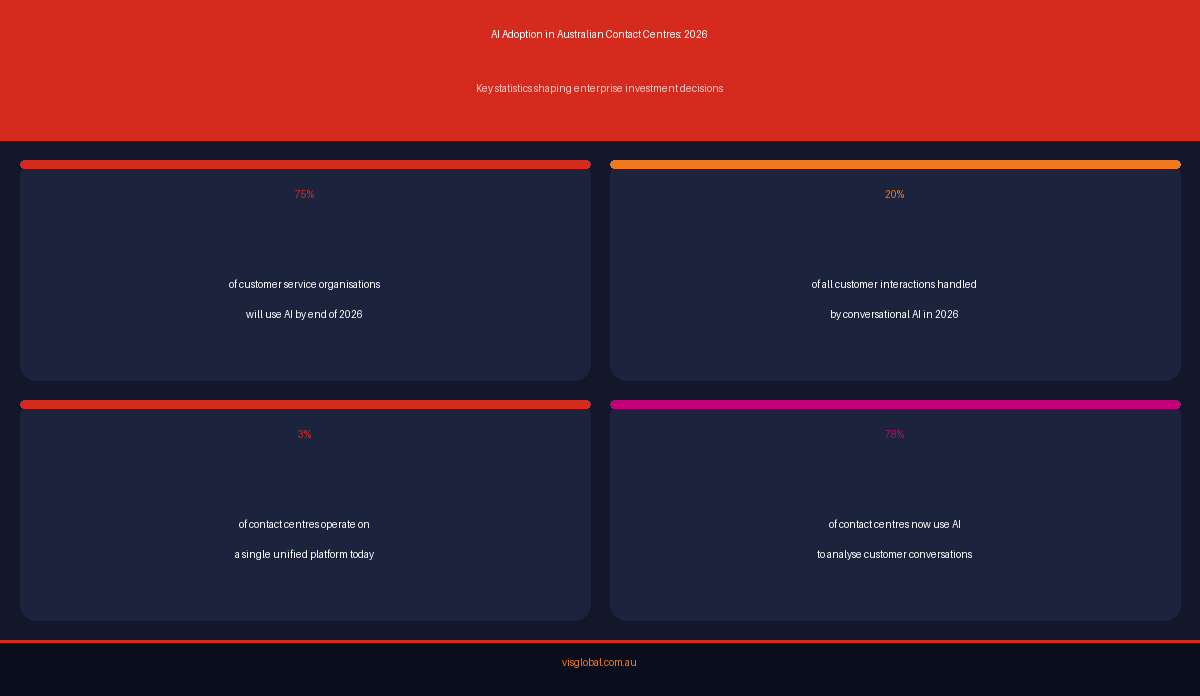
75% of customer service organisations globally will incorporate AI in their contact centres by the end of 2026, up from just 10% in 2021.
Voice biometrics verifies a caller's identity in the first 45 seconds of a conversation, reducing average handling time and cutting fraud risk simultaneously.
Only 3% of Australian contact centres currently operate on a single unified platform, creating a significant opportunity for businesses that act now.
Why Australian Enterprises Are Rethinking Contact Centre Technology
The contact centre has always been the front line of customer relationships. In 2026, it is also the front line of competitive advantage. According to Australian contact centre technology trends, 75% of customer service organisations will use some form of AI by the end of the year, up from just 10% in 2021. That is not incremental growth. That is a structural shift.
The drivers behind this shift are clear. Australian enterprises across banking, insurance, healthcare, and government face rising customer expectations, tighter compliance requirements, and growing pressure to reduce operating costs without sacrificing service quality. Traditional contact centres built on manual processes and siloed systems cannot meet these demands at scale.
The challenge is not a shortage of technology options. There are more AI contact centre platforms available in the Australian market today than ever before. The challenge is knowing which capabilities actually drive measurable results and which are simply vendor noise. Enterprise leaders consistently report that fragmented technology environments are the biggest obstacle. Only 3% of contact centres operate on a single unified platform, while the average organisation manages 3.9 different contact centre technologies. That fragmentation drives inconsistent customer experiences, agent inefficiency, and costly integrations.
Businesses that consolidate onto an AI-first contact centre architecture are gaining measurable advantages in customer satisfaction scores, first-call resolution rates, and operational cost reduction. The question for Australian enterprises is no longer whether to invest in AI contact centre technology. It is how to do it right, with the right partner, the right platform, and the right implementation approach.
What Makes a Contact Centre Truly AI-Powered?
Not every contact centre that claims to use AI is genuinely AI-powered. Many vendors bolt AI features onto legacy platforms as an afterthought. A truly AI-powered contact centre embeds intelligence at every stage of the customer interaction, from the first point of contact through to post-call analysis and continuous improvement. There are three foundational AI capabilities that define genuine AI contact centre solutions.
AI Chatbots and Virtual Agents
AI chatbots and virtual agents handle routine customer enquiries without human intervention. They respond instantly, operate 24 hours a day, and escalate complex issues to live agents with full conversation context. According to AI customer service research in Australia, conversational AI handles 20% of all customer service interactions globally in 2026, up from less than 2% in 2022. For Australian enterprises managing high volumes of repetitive enquiries, such as account balance checks, appointment bookings, or policy renewals, chatbots deliver significant cost savings while improving response times.
The critical distinction is between rule-based chatbots and AI-driven virtual agents. Rule-based chatbots follow fixed decision trees and fail when a customer asks anything outside their programmed scope. AI virtual agents use natural language processing to understand intent, context, and sentiment. They adapt to conversational nuance, learn from every interaction, and integrate directly with CRM and back-office systems to resolve issues rather than simply collecting information. This makes them a core component of any serious customer experience management strategy. Our guide to conversational AI platforms covers how to evaluate and select the right solution for your needs.
Voice Bots and Voice Biometric Authentication
Voice bots automate telephone interactions using natural language understanding. They handle inbound call triage, answer frequently asked questions, complete transactions, and route callers to the right team without any agent involvement. But the real differentiator for enterprise-grade AI contact centres is voice biometric authentication.
Voice biometrics verify a caller's identity during natural conversation, without requiring them to answer security questions or recall passwords. The system matches the caller's voice pattern against a registered voiceprint within seconds. This removes approximately 45 seconds of authentication time from every single call. The compounding effect on average handling time and agent capacity is significant. According to the global voice biometrics market report, the market is valued at USD 3.06 billion in 2026 and growing at a 16.41% compound annual growth rate, with 81% of contact centre leaders already deploying or planning voice verification. For Australian enterprises in banking, insurance, and government, where identity verification is both frequent and critical, voice biometrics delivers ROI within the first year of implementation. For a detailed technical and commercial breakdown, see our guide to voice biometrics technology and why Australian enterprises are adopting it.
The Power of Omnichannel in AI Contact Centres
Modern customers do not think in channels. They start a conversation on live chat, send a follow-up email, and then call the contact centre expecting the agent to know exactly where they left off. This is the omnichannel imperative, and it is where many Australian enterprises are still falling short.
Why Omnichannel Outperforms Multichannel
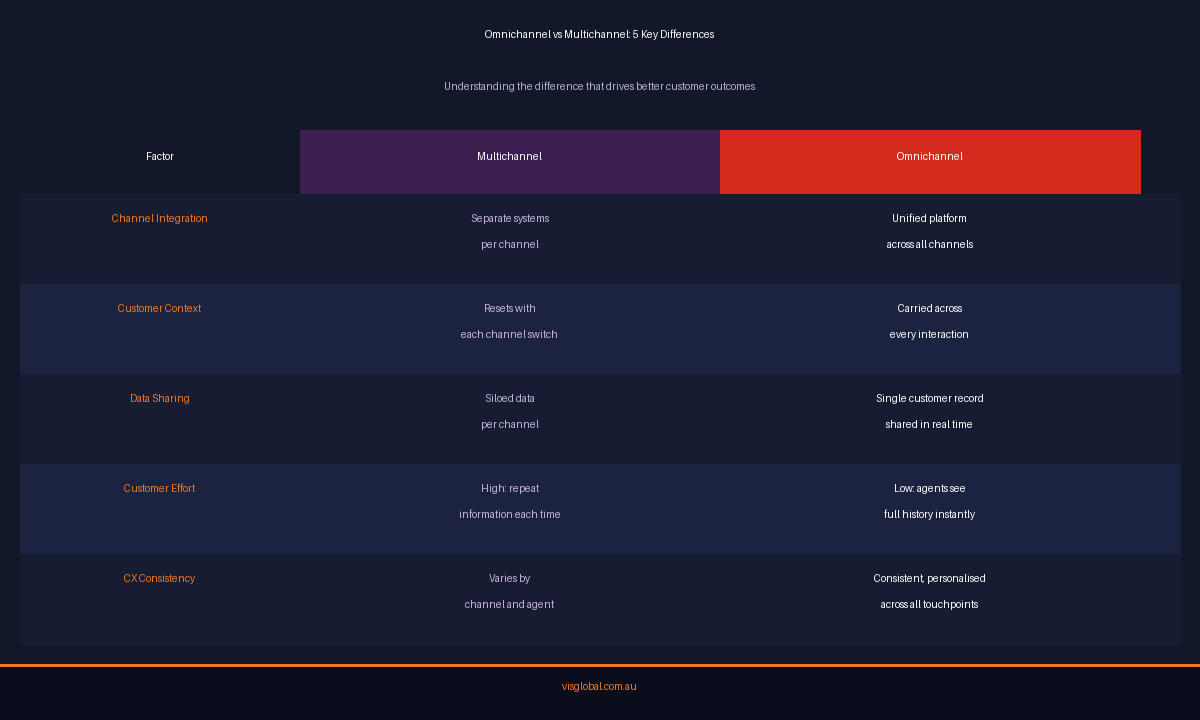
Multichannel means a business operates across multiple channels. Omnichannel means those channels share customer identity, conversation context, and interaction history. The difference in customer experience is significant.
In a multichannel environment, a customer who contacts a bank via live chat and then calls the contact centre must repeat their entire issue from the beginning. In an omnichannel environment, the phone agent sees the full chat history, understands the issue, and can begin resolving it immediately. That single improvement drives measurable gains in first-call resolution, net promoter score, and agent efficiency. The infographic below illustrates the five key differences between multichannel and omnichannel approaches.
↵
Unifying Voice, Chat, Social, and Emerging Channels
An AI contact centre solution built for omnichannel connects voice calls, live chat, email, SMS, social media messaging, and video interactions on a single unified platform. AI handles context switching automatically, routing customers to the right agent or self-service bot based on their history, sentiment, and urgency. When a customer contacts a business via social messaging and then calls 20 minutes later, the system recognises them, retrieves their conversation history, and routes them appropriately.
VIS Global's approach to customer experience management goes beyond platform integration. It aligns AI-driven omnichannel engagement with industry-specific compliance requirements, so Australian enterprises in regulated sectors can deliver seamless experiences without compromising data governance or privacy obligations.
Intelligent Routing and Real-Time Agent Assist
Two AI capabilities that consistently deliver measurable ROI in Australian contact centres are intelligent routing and real-time agent assist. Together, they transform both the customer experience and the agent experience, reducing effort on both sides of the conversation.
Skills-Based Routing with AI
Traditional IVR systems route calls based on simple menu selections that customers find frustrating and that rarely reflect the true nature of their issue. AI-powered intelligent routing analyses the customer's history, stated intent, sentiment indicators, and issue type, then routes the interaction to the agent best qualified to resolve it. This is skills-based routing elevated by machine learning.
The result is fewer call transfers, faster resolution, and higher customer satisfaction scores. Customers reach the right agent on the first attempt. Agents handle enquiries that match their expertise. Supervisors gain real-time visibility into routing performance through AI-driven dashboards that highlight bottlenecks before they affect service levels. For Australian enterprises managing complex multi-tier operations, such as banks serving retail, business, and wealth management customers simultaneously, intelligent routing delivers material efficiency gains across the entire operation. Read our guide on contact center automation and its impact on customer and employee satisfaction for deployment benchmarks and case studies.
Real-Time Sentiment Analysis and Agent Coaching
AI contact centre platforms monitor conversations in real time, analysing customer sentiment as the call or chat unfolds. When the system detects frustration, an escalating tone, or specific trigger phrases associated with churn risk, it alerts the agent with contextual guidance, surfaces relevant knowledge base articles, or triggers a supervisor notification. For a deeper look at how natural language processing in contact centres powers real-time intent detection and sentiment analysis, read our dedicated NLP automation guide.
This real-time coaching capability accelerates agent development and reduces escalations. Post-call AI analysis replaces manual, random-sample quality assurance with objective data across every single interaction. Team leaders gain precise insight into agent performance without listening to calls manually. VIS Global's intelligent automation solutions extend this capability beyond the contact centre into back-office workflows, connecting front-line CX performance data to broader operational intelligence for continuous improvement.
↵
AI Contact Centre Solutions Across Australian Industries
AI contact centre technology delivers value across industries, but the specific use cases and compliance requirements vary significantly. Australian enterprises need solutions designed for their sector, not generic platforms adapted from overseas markets with no understanding of local regulatory frameworks.
Banking and Financial Services
Australian banks and financial services firms face some of the most complex customer service environments. High call volumes, strict APRA compliance requirements, fraud risk, and the need to personalise interactions across retail, business, and wealth segments all demand AI-first solutions built for this context.
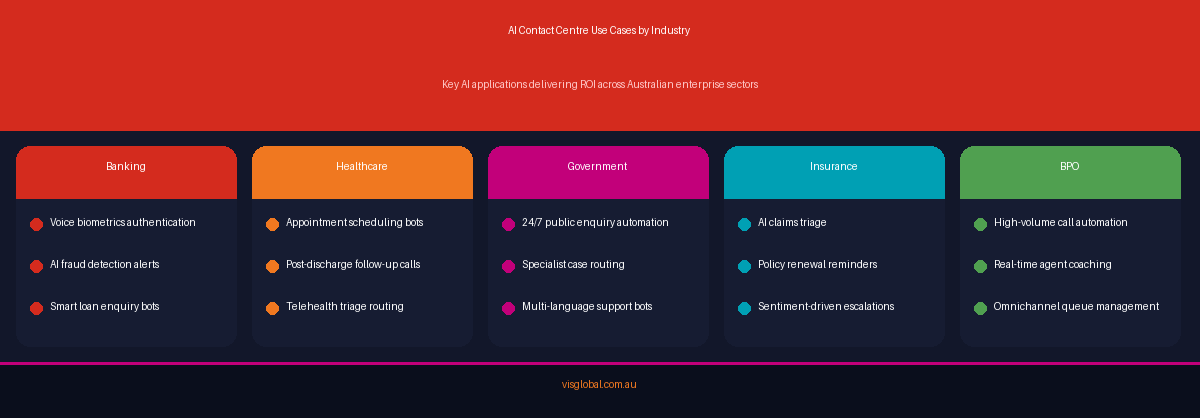
AI chatbots handle routine enquiries including balance checks, transaction history, card activation, and branch locator requests. Voice biometrics replace knowledge-based authentication, reducing both customer friction and fraud exposure simultaneously. AI-powered sentiment analysis detects customers showing signs of financial hardship during conversations, triggering appropriate escalation protocols. VIS Global's banking sector solutions combine APRA-compliant data handling with the full stack of AI contact centre capabilities, from chatbot automation through to predictive analytics.
Healthcare
Healthcare providers across Australia are using AI contact centres to manage appointment scheduling, medication reminders, post-discharge follow-up calls, and telehealth triage at scale. AI handles high-frequency, low-complexity interactions, freeing clinical and administrative staff for patient care and complex case management.
Strict data handling requirements aligned with the Australian Privacy Act govern every interaction. Voice biometrics provide secure patient identity verification without burdening callers with lengthy authentication processes. VIS Global supports healthcare providers with compliant, empathetic AI contact centre deployments that improve patient experience without compromising clinical governance standards.
Government and Councils
Government agencies and local councils manage large volumes of public enquiries across diverse services from rates and permits through to social services and emergency management. AI contact centre solutions help government teams handle routine enquiries at scale, operate outside standard business hours through automated self-service, and direct complex cases to the specialist officers best placed to resolve them.
VIS Global's intelligent automation capabilities support government teams with accessible, compliant contact centre technology that meets Australian public sector standards. Multilingual voice bot support and AI-assisted routing make services more accessible to the full spectrum of the Australian community.
Cloud vs On-Premise: Infrastructure for AI Contact Centres
One of the most consequential decisions in any AI contact centre transformation is infrastructure. Should the platform run in the cloud, on-premise, or in a hybrid configuration? The answer depends on your compliance requirements, existing infrastructure, and transformation timeline.
Cloud-based contact centre as a service platforms offer rapid deployment, elastic scaling, automatic capability updates, and consumption-based pricing. They lower the barrier to accessing cutting-edge AI capabilities significantly. Features like conversational AI, sentiment analysis, and voice biometrics are delivered as part of the platform subscription rather than requiring substantial upfront integration investment. For most Australian enterprises, this translates to faster ROI and lower total cost of ownership over a five-year horizon. Our guide to cloud contact centre solutions in Australia covers platform selection, compliance, and implementation considerations in detail.
On-premise deployments offer greater control over data residency and network configuration. For Australian enterprises in highly regulated sectors, particularly government agencies and defence-adjacent organisations, there may be specific data sovereignty requirements that favour on-premise or private cloud infrastructure.
The emerging standard for most Australian enterprises is a cloud-first approach with hybrid flexibility. This means moving primary contact centre functions to the cloud while retaining on-premise components where compliance or legacy system integration demands it. A critical factor in this decision is migration quality. A poorly managed migration can disrupt contact centre operations for months. VIS Global's managed services team supports end-to-end cloud migration for contact centre environments, covering planning, execution, data migration, compliance validation, and post-migration optimisation.
How to Evaluate AI Contact Centre Partners in Australia
Choosing the right AI contact centre partner is as important as choosing the right platform. The Australian market has a wide range of vendors, from global platforms with local resellers to specialist firms with deep domain expertise and local teams. Evaluating them requires a structured approach.
Start with these five criteria:
AI depth. Does the vendor embed AI throughout the platform or offer it as an optional add-on? Look for native AI across routing, analytics, authentication, and self-service rather than a single AI feature bolted onto a legacy foundation.
Omnichannel capability. Can the platform unify voice, chat, email, social, and video on a single customer record? Test this with realistic multi-channel scenarios, not just vendor demonstrations using carefully controlled conditions.
Australian compliance. Does the platform support APRA CPS 234 for financial services, the Australian Privacy Act, and relevant state government data requirements? This is non-negotiable for organisations in regulated sectors.
Integration flexibility. Most Australian enterprises have existing CRM, ERP, and workforce management systems. The AI contact centre platform must integrate with these systems without requiring a wholesale technology replacement.
Local support and expertise. A globally headquartered vendor with a limited Australian presence may struggle to deliver localised implementation support, regulatory expertise, or responsive managed services when you need them most.
VIS Global operates from Melbourne and Sydney with local teams across implementation, training, and ongoing managed services. Our case studies demonstrate measurable results delivered across banking, healthcare, and government contact centre environments in Australia.
↵
Building Your AI Contact Centre Roadmap: Where to Start
Organisations that succeed with AI contact centre transformation share a common trait. They treat it as a strategic journey rather than a one-time project. They start with clear outcomes, build incrementally, and measure results at every stage. Here is a practical starting framework for Australian enterprise leaders.
Audit your current state. Map every channel, every handoff point, and every manual process in your contact centre. Identify where customer effort is highest and where agent time is consumed by low-value, repetitive tasks. This audit becomes the prioritisation framework for your AI investment decisions.
Define your outcomes first. Before selecting a platform, define what success looks like in measurable terms. Is it reducing average handling time by 20%? Achieving 80% first-call resolution? Eliminating knowledge-based authentication? Specific outcomes drive better vendor selection and better implementation governance.
Start with high-volume routine interactions. The fastest path to ROI is automating interactions that are high in volume and low in complexity. AI chatbots for routine enquiries, voice bots for inbound call triage, and voice biometrics for authentication all deliver measurable returns within months of deployment. Our guide to RPA in contact centres covers the specific use cases, implementation approach, and ROI benchmarks most relevant to Australian enterprises.
Expand to omnichannel and analytics. Once AI is handling routine interactions reliably, expand to omnichannel orchestration and real-time analytics. This is where the compounding value of AI becomes evident, as insights from every channel feed continuous improvement across the operation.
Partner with a specialist. A contact centre AI transformation spans technology, process design, change management, and compliance. Working with a specialist ensures your contact centre capabilities and your broader digital workplace solutions evolve together, not in isolation from one another.
The enterprises gaining competitive ground in Australia today are those that have moved beyond pilots and committed to a unified, AI-first approach. The roadmap above gives you a structured starting point. VIS Global is ready to help you move from planning to delivery.
Conclusion
AI contact center solutions in Australia are moving from competitive advantage to operational necessity. The enterprises gaining ground are those that have committed to a unified, AI-first approach across voice, chat, and digital channels, backed by the right technology partner and the right implementation discipline. Whether you are beginning your evaluation or accelerating an existing transformation, the right partner makes the difference between incremental improvement and genuine competitive advantage. For a deeper look at how AI-powered contact centres are redefining customer experience in 2026, explore the latest trends and enterprise case studies in our dedicated guide. To explore how VIS Global can help your organisation build a best-in-class AI contact centre, speak with our team today.