AI Contact Center Solutions for Australian Banks: The Complete Guide 2026
 Customer Experience Management
Australian banks are facing a contact center crisis. As branch networks shrink and digital banking adoption surges, customer call volumes are rising while expectations for instant, personalised service have never been higher. Manual processes, disconnected channels, and legacy infrastructure are no longer viable. AI contact center solutions for Australian banks offer a proven path forward — reducing cost per interaction, automating compliance workflows, and delivering seamless omnichannel experiences that today's banking customers demand. This guide covers everything CX leaders, COOs, and IT heads need to know about deploying AI in their contact centers in 2026.
Key Takeaways
Australian banks using AI contact centers report 30 to 40 percent reductions in cost per interaction and significant improvements in first-call resolution rates.
AI-powered voice bots, RPA, and omnichannel platforms can automate up to 70 percent of routine banking enquiries while maintaining full APRA and AML/CTF compliance.
VIS Global provides end-to-end AI contact center solutions tailored to Australian banking — from strategy through implementation to ongoing managed services.
Why Australian Banks Need AI Contact Centers Now
The Australian banking sector is under pressure from multiple directions simultaneously. Branch closures have accelerated across the country, pushing millions of customers toward phone and digital channels. At the same time, the AI solutions for Australian banks must now serve customers who expect 24/7 availability, instant resolution, and fully personalised service across every channel they choose to use.
Research from Deloitte Australia shows that 68 percent of banking customers now expect to resolve their enquiry within the first contact, and more than half expect availability across multiple channels at any hour. Traditional contact centers staffed primarily by human agents cannot meet these expectations cost-effectively. Rising wages, high agent turnover, and the sheer volume of digital-first customer enquiries have made the status quo unsustainable for banks of every size.
The Cost of Inaction
Banks that delay AI adoption face compounding disadvantages. Competitors — from major banks to neobanks — are investing heavily in AI-driven customer service. Every year without an intelligent contact center strategy means higher cost-to-serve, lower customer satisfaction scores, and increased churn risk among digital-first segments. The gap between AI-adopters and laggards is widening at an accelerating rate, and it is becoming structurally difficult for late movers to close.
The AI Opportunity
AI contact center platforms deployed by Australian banks today are not experimental. They are mature, enterprise-grade solutions that integrate voice bots, intelligent routing, real-time agent assist, intelligent automation solutions for back-office processes, and analytics dashboards into a unified system. The ROI is measurable and the implementation timelines are significantly shorter than most banking IT leaders expect. For a full overview of AI contact center technology in the Australian market, see our AI Contact Center Solutions in Australia: The Complete Enterprise Guide.
Core AI Use Cases in Banking Contact Centers
Modern AI contact center platforms offer a range of capabilities that address the most pressing operational challenges facing Australian banks. The banking industry solutions delivering the strongest returns in 2026 span voice automation, fraud prevention, intelligent routing, and back-office processing.
AI Voice Bots and Virtual Agents
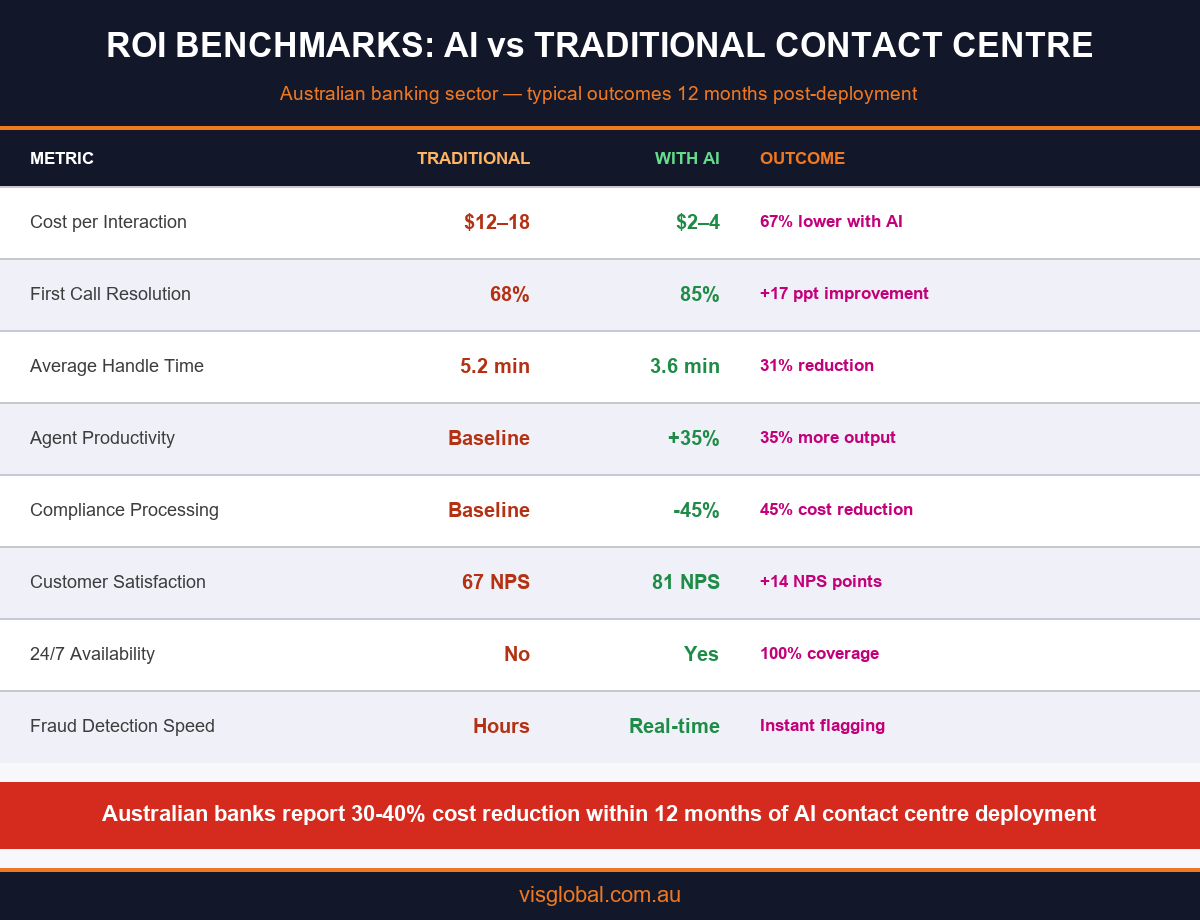
AI-powered voice bots handle account balance enquiries, transaction disputes, card activation, and basic loan queries without human intervention. In the Australian banking context, this means 24/7 availability in English and major community languages, which is critical given Australia's multicultural population. VIS Global's omnichannel customer experience platform includes intelligent voice bots that understand natural language, authenticate customers via voice biometrics, and escalate complex cases to human agents with full context transferred — eliminating the need for customers to repeat themselves across channels.
Fraud Detection and Real-Time Alerts
AI enables real-time fraud pattern detection during customer interactions. When a call matches known fraud indicators — unusual account activity patterns, uncharacteristic transaction amounts, or suspicious authentication behaviours — the system flags it immediately and routes to specialist fraud teams. This integration of AI into the contact center layer adds a critical protection layer aligned with Australian AML/CTF obligations and AUSTRAC reporting requirements.
Intelligent Routing and Agent Assist
AI-powered intelligent routing matches each customer to the best available agent based on their history, issue type, and real-time sentiment analysis. During live interactions, agent assist tools surface relevant product information, compliance scripts, and next-best-action suggestions. Banks using these intelligent automation solutions typically report 20 to 35 percent reductions in average handle time and significant improvements in first-call resolution rates. Read more in our guide on Intelligent Automation for Banking and Financial Services in Australia.
ROI and Cost Reduction: What Australian Banks Can Expect
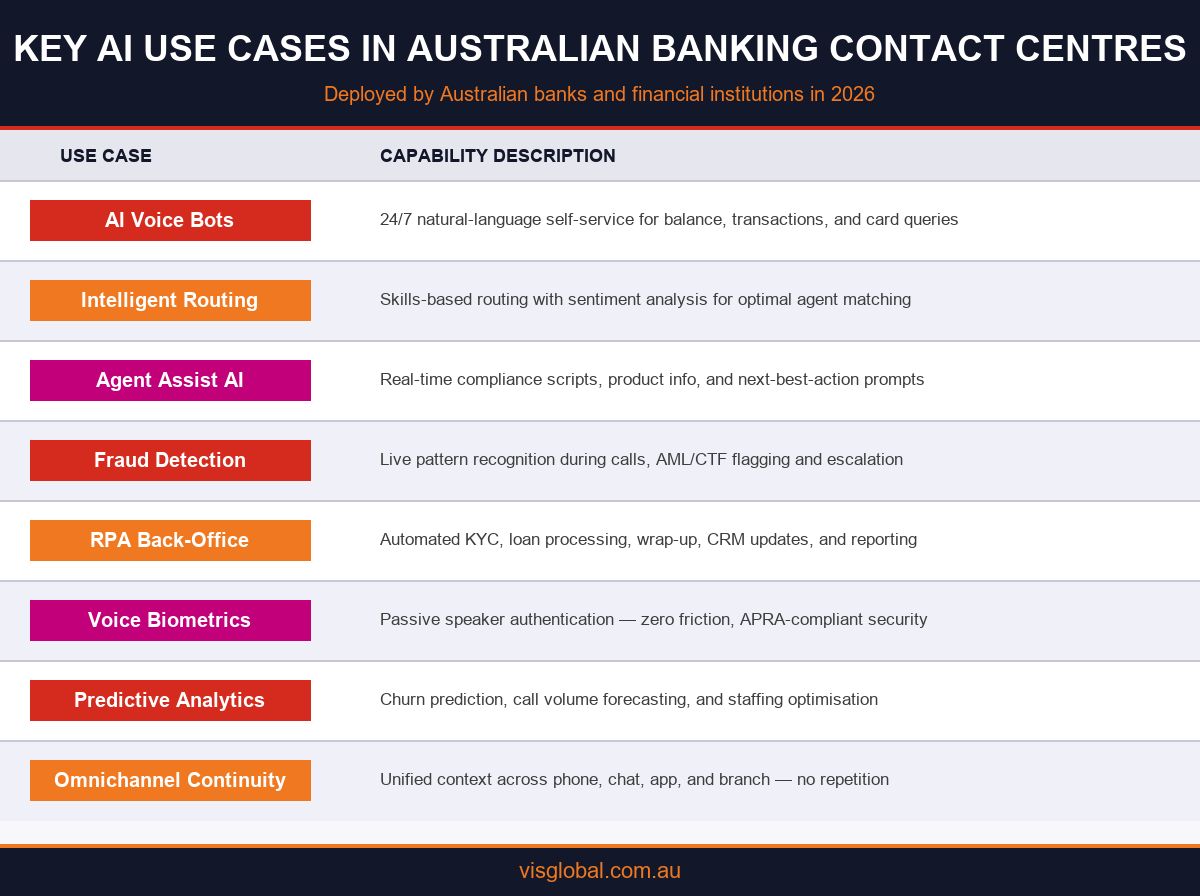
The business case for AI contact centers in banking is compelling and well-evidenced. Australian banks deploying AI-assisted contact center technology report consistent performance improvements across key metrics. For banks considering the investment, understanding the typical ROI trajectory is essential for building a credible business case for the board.
Cost per Interaction: AI self-service channels reduce cost per interaction by 60 to 80 percent compared to fully assisted human calls. For a mid-sized Australian bank handling 500,000 calls per month, shifting 40 percent to AI self-service can generate annual savings of $4 to $8 million depending on current cost structures.
First Call Resolution: AI-powered agent assist tools improve FCR rates by 15 to 25 percent by giving agents immediate access to accurate product information and compliance-approved response frameworks. Higher FCR means fewer repeat contacts, lower handle times, and significantly better customer satisfaction scores.
Agent Productivity: Automation of post-call wrap-up, call logging, CRM updates, and compliance documentation frees agents to spend more time on complex, high-value customer interactions. Banks report 25 to 40 percent improvements in agent productivity within 12 months of deployment.
Compliance Cost Reduction: Manual compliance workflows around KYC, AML/CTF, and APRA reporting are expensive and error-prone. Deploying robotic process automation for these processes reduces compliance processing costs by 30 to 50 percent while improving accuracy and audit readiness.
For a detailed breakdown of robotic process automation impact in contact centre operations, see our guide on How RPA Reduces Manual Effort in Contact Centres.
Regulatory Compliance: APRA, CDR, and AML/CTF
Australian banks operate within one of the most complex regulatory environments in the world. The https://www.apra.gov.au Australian Prudential Regulation Authority sets stringent operational resilience standards; the Consumer Data Right governs data portability and consent; and Australia's AML/CTF Act imposes rigorous know-your-customer and transaction monitoring obligations. AI contact center platforms must be designed with these frameworks built in from the ground up, not retrofitted after deployment.
APRA Operational Resilience
APRA's Prudential Standard CPS 230 on Operational Risk Management requires banks to demonstrate the resilience of critical business services — including customer contact operations. AI contact centers with redundant cloud infrastructure, automated failover, and real-time monitoring dashboards help banks meet these requirements. VIS Global's managed services include 24/7 platform monitoring, automated incident response, and quarterly operational resilience reports aligned with APRA documentation requirements.
CDR and Data Consent Management
Under the Consumer Data Right, customers must be able to control how their banking data is shared with accredited third parties. AI contact center platforms automate consent verification at the start of each interaction, flag CDR-relevant data requests, and route them to appropriately trained agents — ensuring compliance without adding friction to the customer experience.
AML/CTF Monitoring
AI-powered transaction monitoring integrated into the contact center layer allows real-time flagging of suspicious patterns during customer calls. This positions the contact center as an active compliance asset. For a comprehensive overview of ethical and regulatory AI practices, see our guide on Responsible AI in Customer Experience in Australia.
Omnichannel Banking CX: Meeting Customers Where They Are
Today's banking customers do not think in channels. They move fluidly between mobile banking apps, web chat, phone calls, in-branch visits, and social messaging platforms — expecting a seamless, consistent experience regardless of which channel they use. Building that experience requires an omnichannel customer experience strategy with AI at its core. For a broader market perspective, our guide on Omnichannel Customer Experience Management in Australia covers the full enterprise picture.
Digital Self-Service and Deflection
AI-powered self-service portals and chat widgets can resolve up to 70 percent of routine banking enquiries without human involvement. Common high-volume, low-complexity enquiries — balance checks, transaction history, credit card limits, payment due dates, and branch hours — are ideal candidates for AI deflection. This frees skilled agents to focus on complex advisory, dispute resolution, and retention conversations where human judgment adds genuine value and builds long-term customer relationships.
Personalisation at Scale
AI analyses each customer's transaction history, product holdings, and interaction history to surface personalised next-best-action recommendations during every contact. A customer enquiring about a term deposit might be presented with a relevant savings product comparison, delivered naturally within the conversation. This level of contextual personalisation — at scale, across all channels — is what differentiates market-leading banks in 2026. See how Customer Experience Platforms in Australia are enabling this capability across industries.
Implementation Roadmap: From Strategy to Go-Live
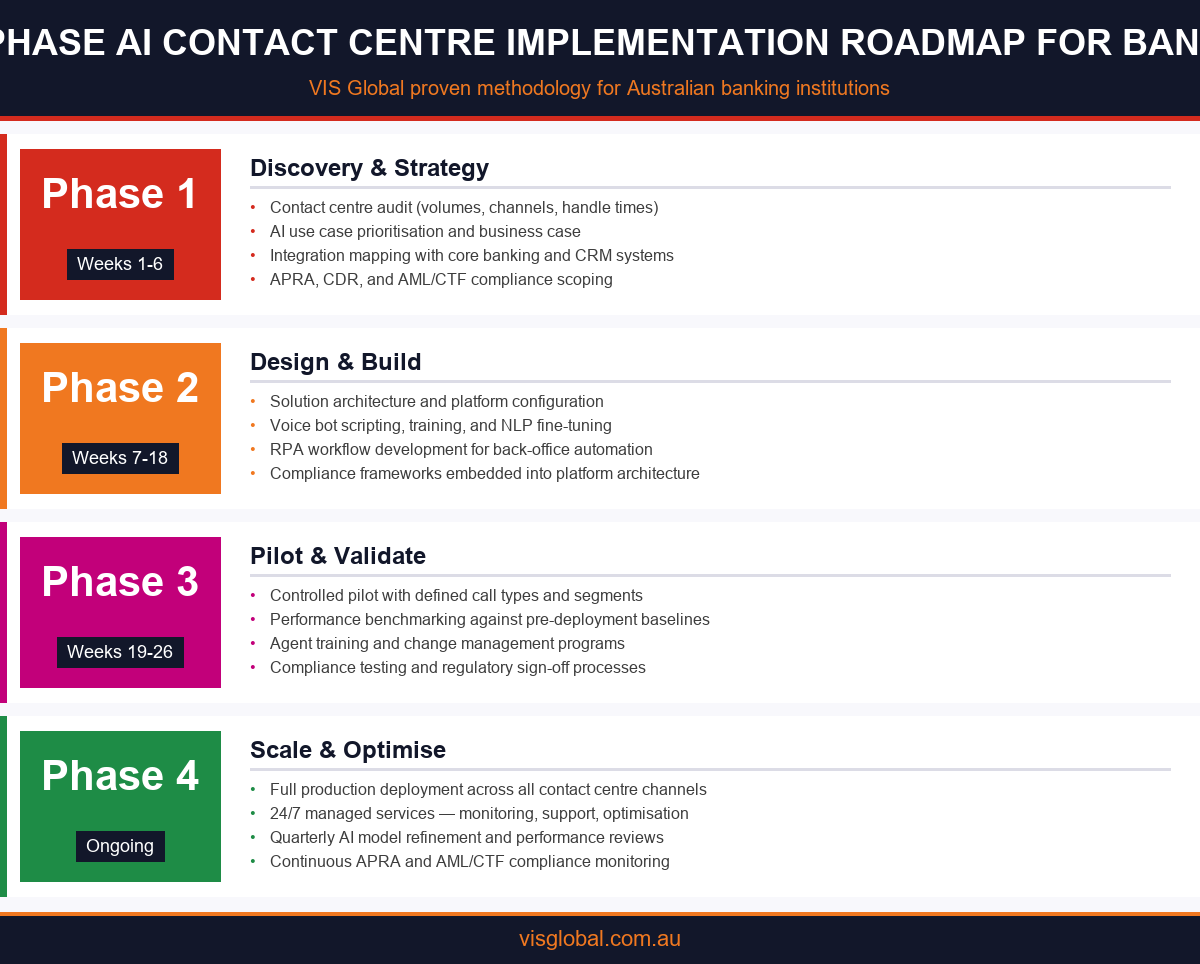
Deploying an AI contact center is a strategic transformation that requires careful planning, phased delivery, and ongoing optimisation. VIS Global has developed a proven four-phase methodology for Australian banking clients, refined across more than 1,000 enterprise deployments globally. Integrating digital workplace solutions and cloud infrastructure is a key component of each phase, ensuring that the contact center platform integrates seamlessly with the wider bank technology ecosystem.
Phase 1 — Discovery and Strategy (Weeks 1 to 6): A comprehensive audit of your current contact center environment covering call volumes, channel mix, handle times, agent workflows, and existing technology stack. This phase defines the AI use case priority list, business case, and integration requirements with core banking systems, CRM, and compliance platforms. Regulatory mapping for APRA CPS 230, CDR, and AML/CTF obligations is completed here.
Phase 2 — Design and Build (Weeks 7 to 18): Solution architecture design, platform configuration, voice bot scripting and training, RPA workflow development, and integration testing. Compliance frameworks are embedded into the platform architecture during this phase. Cloud infrastructure is provisioned in alignment with APRA operational resilience requirements, with full redundancy and failover capability designed from day one.
Phase 3 — Pilot and Validate (Weeks 19 to 26): Controlled pilot deployment with a defined subset of call types and customer segments. Performance metrics are benchmarked against pre-deployment baselines. Agent training and change management programs are delivered in parallel, covering both the technology and the new AI-augmented workflows agents will operate within.
Phase 4 — Scale and Optimise (Ongoing): Full production deployment with continuous monitoring, AI model refinement, and quarterly business reviews. For a sense of how cloud migration fits into this trajectory, see our guide on the Cloud Migration for Enterprise Communications in Australia. VIS Global's managed services team provides 24/7 platform support, compliance monitoring, and proactive optimisation recommendations.
For cloud infrastructure considerations that underpin this roadmap, see our guide on Cloud Migration for Enterprise Communications in Australia. To explore our full solutions suite and see how each component maps to your banking environment, visit the VIS Global solutions hub.
Why Choose VIS Global for AI Contact Center Banking in Australia
VIS Global is one of Australia's leading enterprise AI and CX technology partners, with offices in Melbourne and Sydney, more than 1,000 clients served globally, and 13 strategic technology partnerships with the world's leading contact center and AI platform vendors. Our customer experience management solutions are built to meet Australian regulatory requirements from day one — APRA, CDR, and AML/CTF compliance is embedded into the platform architecture, not added retrospectively.
Our banking team understands the specific challenges of Australian financial services: neobank competition, APRA operational resilience, CDR open banking opportunity, and the need to serve a diverse, multicultural customer base across multiple channels and time zones. We bring the same depth of expertise to BPO contact centre solutions, government and councils CX, and healthcare contact centre solutions — giving our banking clients access to cross-industry best practices that sharpen the quality of every solution we deliver.
Our enterprise communication solutions span the full digital workplace — ensuring your AI contact center integrates seamlessly with your bank's broader communication infrastructure, hybrid work environment, and core banking platforms. Whether you are a major bank, regional bank, credit union, or non-bank financial institution, VIS Global has the expertise, technology partnerships, and implementation track record to deliver measurable outcomes.
Conclusion
AI contact center solutions are no longer optional for Australian banks. Branch closures, rising digital banking adoption, tightening APRA requirements, and intensifying competition from neobanks have made intelligent contact center transformation a strategic imperative. Banks that act now will secure compounding advantages in cost efficiency, customer satisfaction, and regulatory compliance. Those that delay will find the gap increasingly difficult to close. VIS Global partners with Australian financial institutions to design, build, and run AI contact centers that deliver measurable results. To start your transformation, contact VIS Global today and speak with our banking technology specialists.