Virtual Contact Center Solutions: Choosing the Right Platform for Distributed Teams in Australia
 General
Key Takeaways
- A virtual contact center solution runs entirely in the cloud, letting agents work from any location while customers experience one connected, consistent service channel.
- Australian enterprises with hybrid and distributed teams need platforms built on cloud native architecture, strong security and compliance, and deep integration with existing systems.
- Choosing the right virtual contact center platform comes down to a structured evaluation against security, integration, scalability, and AI capability, not just price or brand recognition.
Australian enterprises no longer run their customer service teams from a single building. Agents log in from home offices, satellite locations, and outsourced partner sites across multiple time zones, and every one of them needs the same access to customer data and call queues as someone sitting in a Sydney or Melbourne head office. A virtual contact center solution makes that possible by delivering the entire contact center, from call routing to reporting, over the cloud rather than through on site hardware.
This guide explains what a virtual contact center solution actually is, why distributed and hybrid teams across Australia increasingly depend on one, the core requirements any platform must meet, how the model differs from a traditional on premise setup, and a practical checklist for choosing the right platform for your organisation.
What Is a Virtual Contact Center Solution?
A virtual contact center solution is a cloud hosted platform that manages customer voice, chat, email, and social interactions without requiring on site servers, phone switches, or a shared physical call floor. Agents connect through a browser or lightweight application from wherever they are working, while supervisors monitor queues, quality, and performance through the same cloud dashboard regardless of where each team member is located.
Because the platform lives in the cloud, updates, new features, and capacity all roll out centrally rather than through a hardware refresh cycle. This is the same underlying model behind a cloud contact centre Australia deployment, and it is what makes true omnichannel customer experience management achievable, since every channel draws on the same customer context no matter which agent or location picks up the conversation. Enterprises comparing vendors in this space often start with our overview of customer experience platforms in Australia before narrowing their shortlist.
Why Distributed and Hybrid Teams in Australia Need a Virtual Contact Center Platform
Australia's workforce has settled into a genuinely hybrid pattern, with the ABS Working Arrangements data showing well over a third of employed people usually working from home. Contact center teams are no exception, and enterprises that still depend on a single physical call floor struggle to hire the specialist agents they need across a large, dispersed country. A virtual contact center platform removes that constraint by letting an organisation recruit talent in regional Western Australia, outsource peak volume to a partner in the Philippines, and keep every agent inside the same governed environment.
Distributed teams also raise the stakes for coordination. Our piece on the top 7 challenges in hybrid work outlines how fragmented tools quietly erode service quality when agents are not sitting in the same room, and the future of work in Australia makes the case that this shift is now permanent rather than temporary. The right platform, paired with well chosen AI tools for hybrid and remote teams, keeps a distributed contact center team working as one unit. This is also why a virtual contact center solution should never be evaluated in isolation from an organisation's broader VIS Global digital workplace solutions strategy, since the same collaboration and security foundations underpin both.
Core Platform Requirements: Cloud Native, Secure, and Integrated
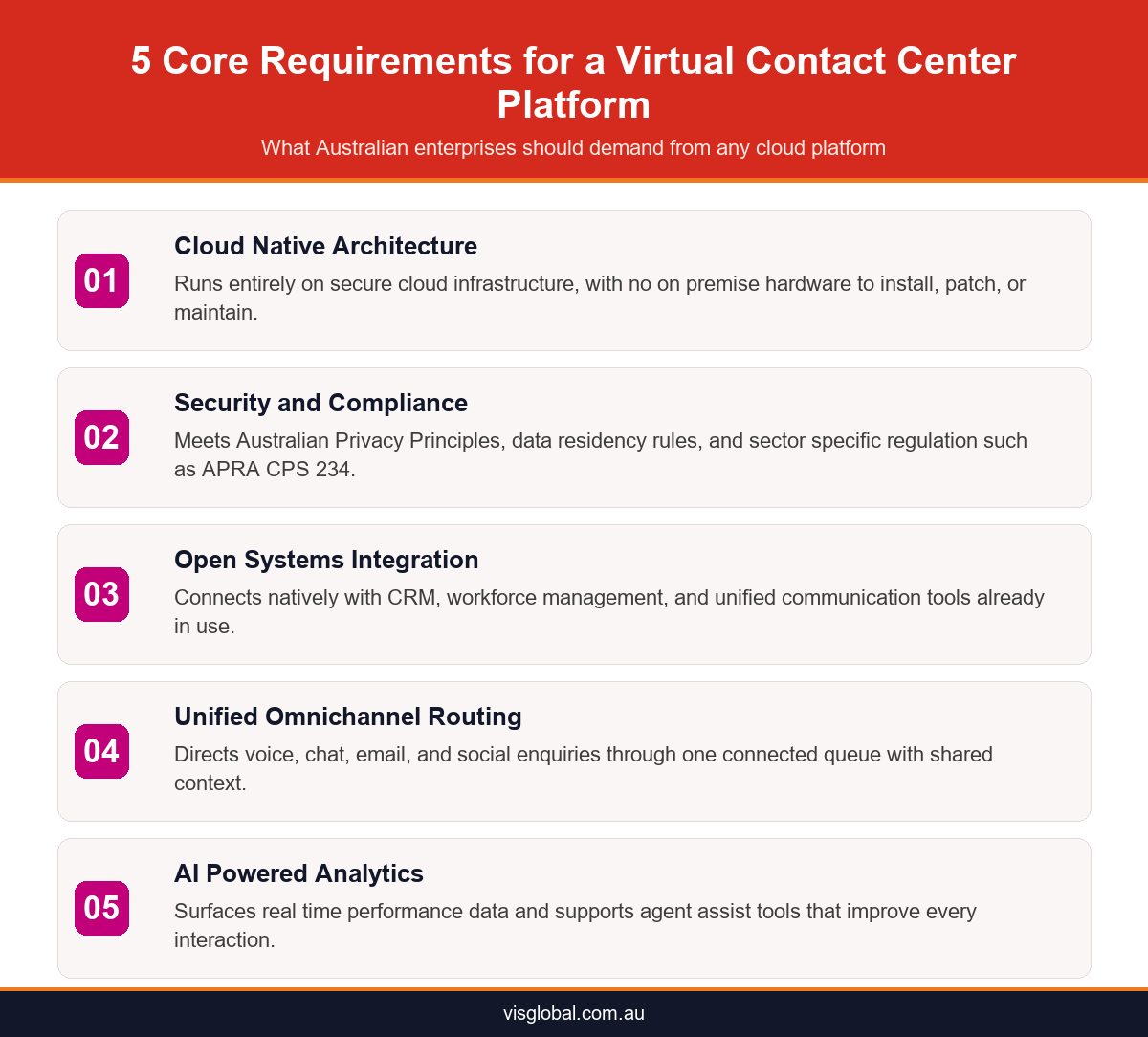
Not every platform marketed as cloud based is genuinely built for a distributed Australian enterprise. Three requirements matter most. First, the platform must be cloud native, meaning it was designed for the cloud from the start rather than a legacy system with a hosted wrapper, so it can scale instantly during demand spikes. Second, it must meet Australian security and compliance expectations, covering data residency, the Australian Privacy Principles, and, for regulated sectors, standards addressed in our guide to cloud communication security and compliance in Australia and securing the digital workplace.
Third, the platform must integrate cleanly with the systems an enterprise already runs, including CRM, workforce management, and identity tools, following the kind of data migration best practices for enterprise communication systems that prevent painful rework later. Layered on top of these foundations, AI powered intelligent routing in contact centers and broader VIS Global intelligent automation capability turn a merely functional platform into one that actively improves resolution speed and consistency across every distributed agent.
Virtual Contact Center vs Traditional On Premise: What Changes
A traditional on premise contact center depends on physical servers, phone switches, and infrastructure housed inside a single building, which means capacity is fixed by whatever hardware was purchased and every agent must generally work from that site. Our comparison of CCaaS vs on premise walks through this contrast in more depth, and enterprises actively planning the shift often follow our on premise to cloud contact center migration guide step by step.
A virtual contact center solution replaces that fixed footprint with elastic cloud capacity, letting an enterprise add agents, open new channels, or absorb a seasonal spike without a hardware order or a site visit. Disaster recovery moves from a costly separate project to something the cloud platform provides by design, since data and call handling are distributed across resilient infrastructure rather than concentrated in one location.
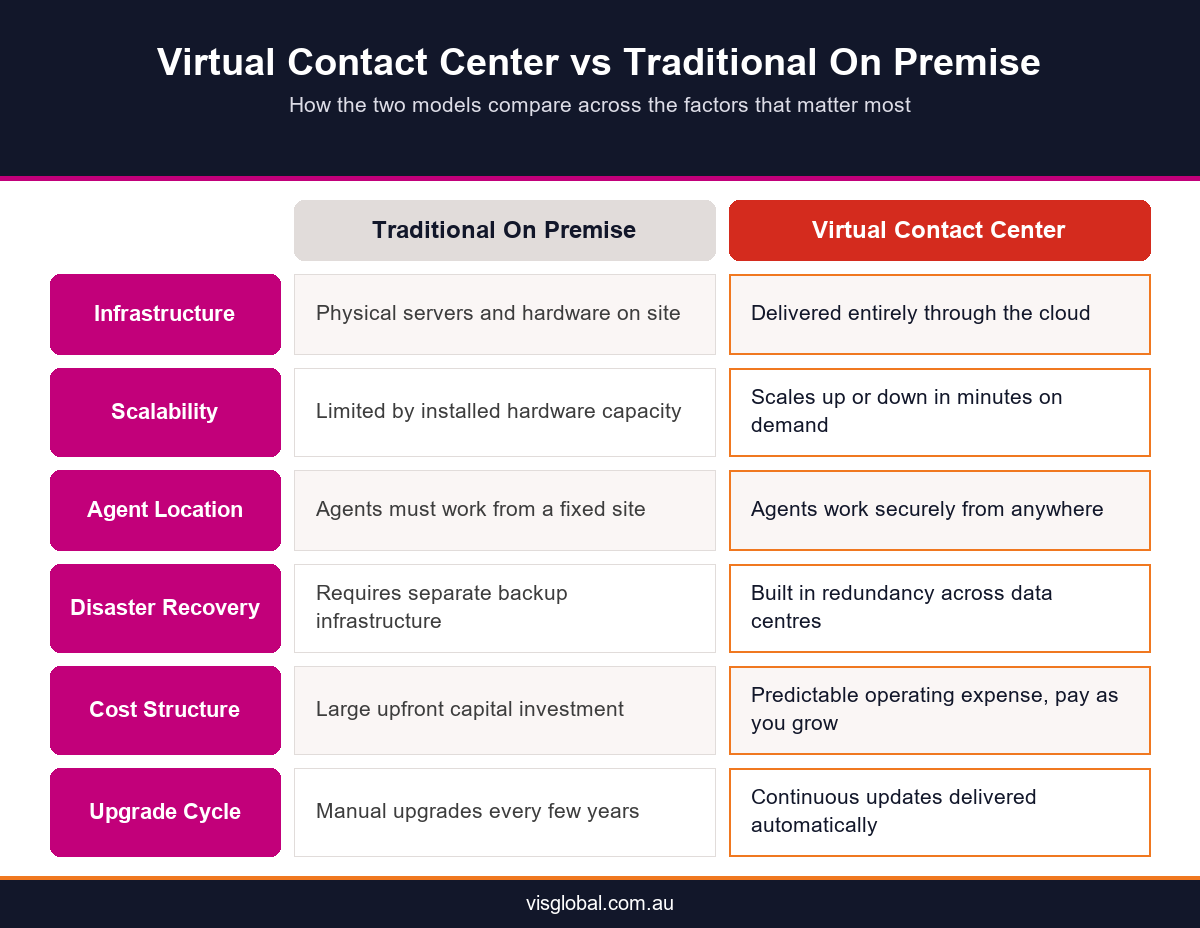
Enterprises still weighing the financial case should also review our cloud migration for enterprise communications guide and our cloud migration checklist for Australian contact centers, both of which set out the practical steps for moving from a capital heavy model to a predictable operating expense.
Evaluation Checklist: How to Choose the Right Platform
Selecting a virtual contact center platform is easier with a structured checklist rather than a feature by feature vendor comparison alone. Our detailed guide on how to evaluate AI contact center platforms in Australia expands on each of these criteria, and reviewing genuine ai powered contact center solutions on the market gives a useful benchmark for what a modern platform should include.
- Security and compliance: confirm data residency, encryption standards, and audit trail capability before anything else is evaluated.
- Integration depth: verify the platform connects natively with your CRM, workforce management, and identity systems rather than requiring custom middleware.
- AI and automation maturity: assess intelligent routing, agent assist, and analytics capability, since these directly influence resolution speed and staff experience.
- Scalability and reliability: check how the platform performs during genuine demand spikes and what service level commitments back that performance.
- Vendor support model: understand what implementation, training, and ongoing managed support is included beyond the initial rollout.
The strongest platforms also demonstrably improve the working experience for distributed agents, an outcome explored in our research on contact center automation and satisfaction and AI workflow automation boosting digital workplace productivity. According to Gartner customer service trends, automation and AI assistance are set to reshape how contact centers operate over the coming years, making platform choice a decision with a long runway rather than a short term fix. Enterprises without a dedicated internal team to manage the transition often lean on VIS Global managed services to handle implementation, training, and ongoing optimisation.
Conclusion
A virtual contact center solution is no longer an optional upgrade for Australian enterprises with distributed and hybrid teams. It is the platform that lets agents work securely from anywhere while customers experience one consistent, connected service, and it removes the cost and rigidity of traditional on premise infrastructure in the process. Choosing the right platform means demanding cloud native architecture, genuine security and compliance, deep integration, and real AI capability, then testing every claim against a structured evaluation rather than a sales pitch. VIS Global's VIS Global customer experience management solutions are built on exactly these foundations for Australian enterprises across banking, healthcare, government, retail, and BPO. To discuss the right virtual contact center platform for your distributed team, contact VIS Global today.