Best AI Virtual Agents in Australia: Top Platforms Compared
 General
Key Takeaways
- True AI virtual agents complete tasks end to end across voice and text. They retain context across a conversation, unlike basic chatbots, which have no memory beyond a single channel.
- The best ai virtual agents in Australia are separated by natural language understanding, CRM and telephony integration, escalation logic, and security controls, not by marketing claims.
- Banking, healthcare, and retail enterprises get the strongest results when a platform is scored against a structured evaluation framework and piloted before a full rollout.
Australian enterprises comparing AI virtual agents in 2026 face a crowded market. Every platform claims to understand customers, resolve requests, and cut contact centre cost. Choosing the best ai virtual agents in Australia comes down to a small number of capabilities. These are what separate genuinely useful platforms from chatbots dressed up in new marketing.
This guide explains what AI virtual agents actually are. It covers the criteria that matter most when comparing platforms, and where they deliver the strongest results across banking, healthcare, and retail. It closes with a practical framework enterprise buyers can use to shortlist vendors with confidence. The guide builds on our broader look at AI in customer service and complements our earlier piece on how to choose the right conversational AI platform. It narrows the focus specifically to virtual agent platforms, drawing on how VIS Global's customer experience management solutions approach this evaluation with clients.
Enterprise buyers who get this comparison right at the outset typically shorten deployment timelines. They also avoid a costly platform switch within the first year. Getting it right early sets realistic stakeholder expectations about what a virtual agent can and cannot do on day one.
What Are AI Virtual Agents and How Do They Differ From Basic Chatbots?
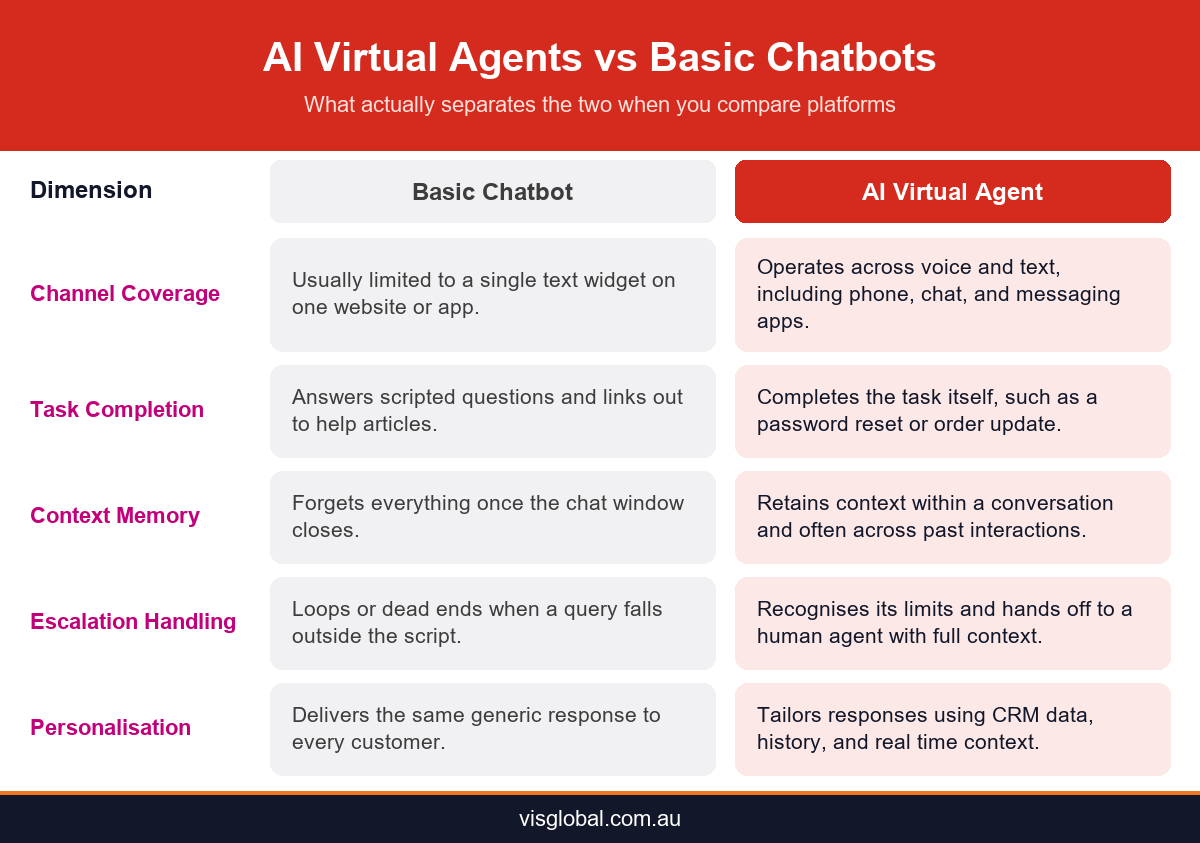
An AI virtual agent is software that uses natural language understanding and machine learning to interpret what a customer wants. It then completes the task, not just answers a question. A basic chatbot works differently. It is usually rule based, limited to a single text channel, and matches messages against scripted replies. When a query falls outside that script, a basic chatbot stalls or repeats itself. This deeper interpretation lets a virtual agent handle multi step requests. It can confirm an address change and trigger an updated statement without a human stepping in partway through.
Three qualities mark the difference in practice. First is coverage across both voice and text. A virtual agent can hold a genuine phone conversation, not just reply inside a website widget. Second is task completion. The agent can reset a password, check an order, or update a policy detail on its own. Third is context retention. The agent remembers what was said earlier in the conversation, and in mature deployments, across past interactions too. Our piece on AI chatbots for customer service sets out useful criteria for the chatbot end of that spectrum. The shift from chatbots to voice biometrics traces how far intelligent customer interactions have moved beyond scripted bots.
Modern virtual agents are largely powered by generative AI for enterprise transformation. This lets them generate a fluent, contextually accurate response, rather than matching a pre written line. Responses stay grounded in the organisation's own knowledge and data. This capability sits alongside broader VIS Global intelligent automation capabilities. A virtual agent often needs to trigger a back office process, such as issuing a refund, once a request is resolved. Gartner predicts 40 percent of enterprise apps will feature task specific AI agents by 2026. That is up from less than 5 percent in 2025. It shows how quickly this category is moving from pilot to mainstream.
Capabilities to Compare When Evaluating AI Virtual Agent Platforms
Vendor demonstrations tend to look similar. What separates the best ai virtual agents in Australia from the rest becomes clear only through testing. A platform needs testing against the capabilities that determine whether it works inside your existing environment, not a demo built for a sales call. Four categories consistently decide the outcome of that evaluation. Each deserves its own line of testing, not a single checkbox on a vendor scorecard.
Natural language understanding accuracy should be tested against real customer transcripts. Include Australian accents, industry terms, and messy phrasing, not clean scripted examples. Integration depth matters just as much. The platform needs to connect cleanly to existing CRM, telephony, and case management systems. This builds on the kind of unified communications across distributed workforces most enterprises already run. It should also support genuine omnichannel customer experience management, not another disconnected channel silo.
Escalation logic is frequently underestimated during procurement. A strong platform recognises the limits of its own confidence. It hands a customer to a human agent with full context. This works best when supported by AI powered intelligent routing, which sends the conversation to the right specialist, not the front of a generic queue. Security and compliance close the list. Look for voice biometric authentication on sensitive channels, and clear data residency and encryption standards. Our guide to cloud communication security and compliance covers these standards in depth. Choose a vendor that can demonstrate responsible AI in customer experience governance, not treat it as an afterthought.
Top AI Virtual Agent Use Cases Across Banking, Healthcare, and Retail
In banking, virtual agents handle balance enquiries, transaction disputes, and card replacement requests around the clock. Voice biometric checks confirm identity before any sensitive detail is shared. Our VIS Global banking industry solutions page covers this in more depth. Our dedicated guide to AI contact center solutions for Australian banks goes further still.
In healthcare, virtual agents manage appointment scheduling and send reminders. They also triage non clinical enquiries, always with a clear escalation path for anything requiring a clinician. See our VIS Global healthcare industry solutions page for how this works in practice. Our guide to AI contact center solutions for healthcare covers what works well in Australian hospitals and health services.
In retail, virtual agents resolve order status questions and process returns. They also offer personalised recommendations based on purchase history. This helps absorb seasonal spikes that would otherwise require temporary staffing. Our VIS Global retail industry solutions page outlines how these deployments are typically structured for Australian retailers.
Insurance and telecommunications providers are applying the same virtual agent patterns. They use them for claims status updates, plan changes, and outage notifications. This shows how quickly these use cases extend beyond banking, healthcare, and retail, once the underlying platform is proven.
A Practical Framework for Evaluating and Shortlisting AI Virtual Agent Platforms
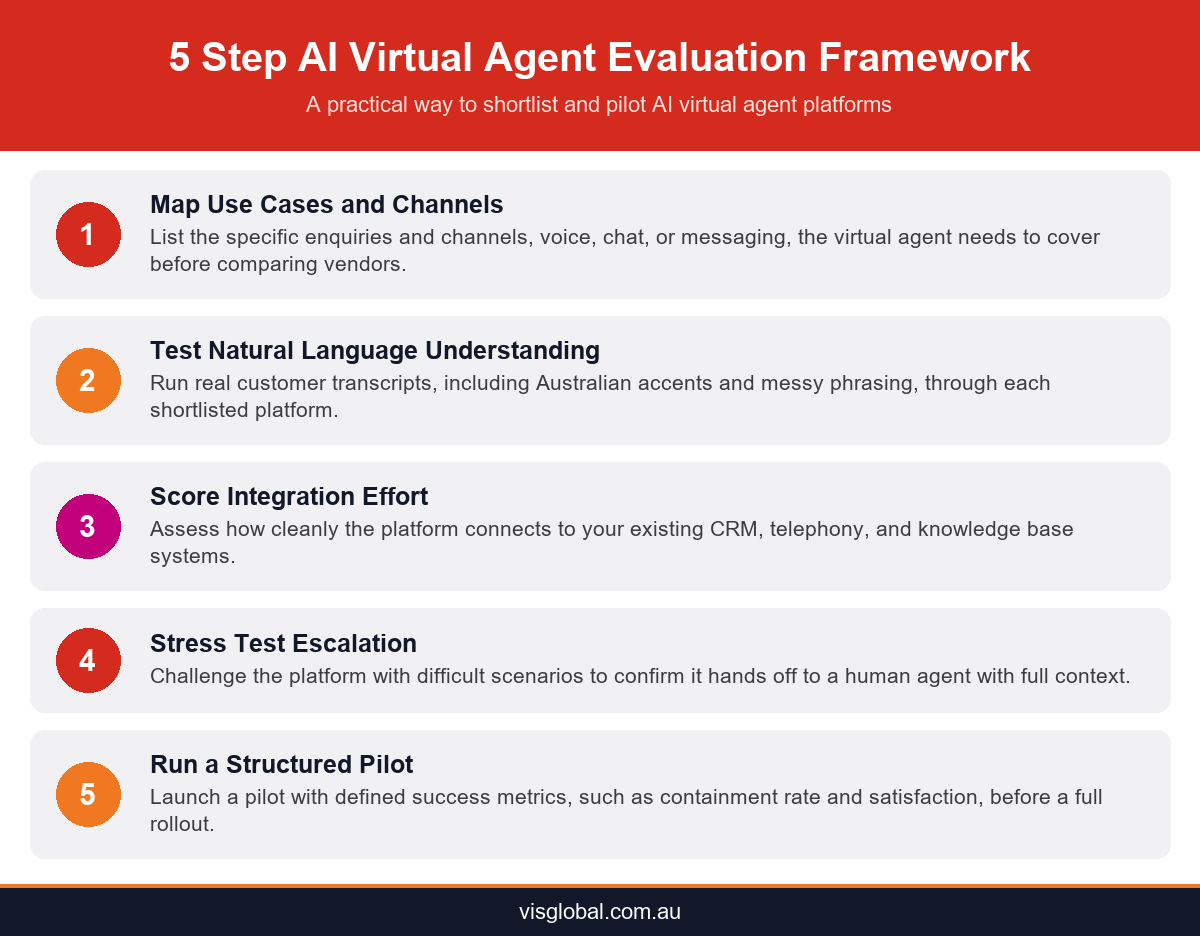
Enterprise buyers get the most reliable results from a structured, five step evaluation, not a single vendor demo. Start by mapping the specific use cases and channels the virtual agent needs to cover. Then test natural language understanding against real customer transcripts, not curated examples. Our guide on how to evaluate AI contact center platforms in Australia walks through this process in more detail.
Next, score the integration effort required against your existing CRM, telephony, and knowledge systems. Integration complexity is the most common cause of delayed rollouts. Stress test escalation and human handoff with deliberately difficult scenarios. Review security and compliance certifications before any contract is signed. Our comparison of the best AI powered contact center solutions in Australia is a useful resource here. Our broader guide to customer experience platforms in Australia is another companion resource at this stage.
Finally, run a structured pilot with clearly defined success metrics. These should include containment rate, average handling time, and customer satisfaction, before you commit to a full scale rollout. Our AI contact center solutions in Australia guide sets out how this staged approach typically unfolds for enterprise buyers.
Why Australian Enterprises Choose VIS Global for AI Virtual Agents
VIS Global embeds AI at the core of every deployment, rather than bolting it onto an existing system. This is the same standard this guide has applied to comparing virtual agent platforms. About VIS Global outlines a track record of more than 1,000 clients served across 7 countries. This is backed by 13 global technology partners. Local teams in Melbourne and Sydney understand Australian regulatory and customer expectations too. That combination of global depth and local delivery lets VIS Global guide a virtual agent evaluation, not simply implement whatever a single vendor recommends.
Rather than positioning as a narrow virtual agent vendor, VIS Global delivers end to end capability. This spans consulting and platform selection through implementation and training. It also includes VIS Global managed services that keep a virtual agent tuned as customer needs evolve. This breadth reflects what Deloitte's State of AI in the Enterprise research in Australia finds. It separates organisations that scale AI successfully from those stuck running isolated pilots.
Choosing the Right AI Virtual Agent Platform
Finding the best ai virtual agents in Australia is not about chasing the newest feature list. It is about testing natural language understanding, integration depth, escalation logic, and security against your real requirements. Enterprises that follow a structured evaluation framework make better platform decisions than those relying on a single demo. Our AI contact center solutions Australia: the complete guide covers this process further. If your team is ready to compare AI virtual agent platforms for banking, healthcare, retail, or another sector, we can help. Contact VIS Global to discuss a tailored evaluation and pilot.