Best Voice Biometrics Technology in Australia for Secure Customer Authentication
 General
Key Takeaways
- Accuracy claims are not enough on their own. Ask every vendor for false acceptance and false rejection rates plus proven liveness detection against recorded or cloned voices.
- The best voice biometrics technology in Australia integrates cleanly with your existing IVR and wider contact center AI stack rather than sitting apart from it as a separate system.
- Banking and healthcare buyers must weigh the Australian Privacy Principles and sector rules such as APRA CPS 234 alongside accuracy, cost, and vendor support.
Australian banks, insurers, and healthcare providers face constant pressure to confirm who is really on the line, without adding minutes to every call. Voice biometrics technology has become one of the fastest ways to verify a caller, but not every platform is built for authentication at enterprise scale. This guide stays focused on choosing the best voice biometrics technology in Australia specifically for secure customer authentication and fraud prevention, rather than repeating how the technology works under the hood.
For a plain explanation of the underlying technology, see our guide to how voice biometrics works. This article instead answers the question buyers actually face once they already understand the basics. What should you look for in a vendor, how should it connect to your existing systems, and how does it hold up against Australian privacy and banking rules? VIS Global's customer experience management team fields exactly these questions from enterprise customers every week.
What to Evaluate in a Voice Biometrics Vendor for Authentication
Every vendor will claim high accuracy. The real evaluation starts with the two numbers that actually describe authentication performance, and how they were tested.
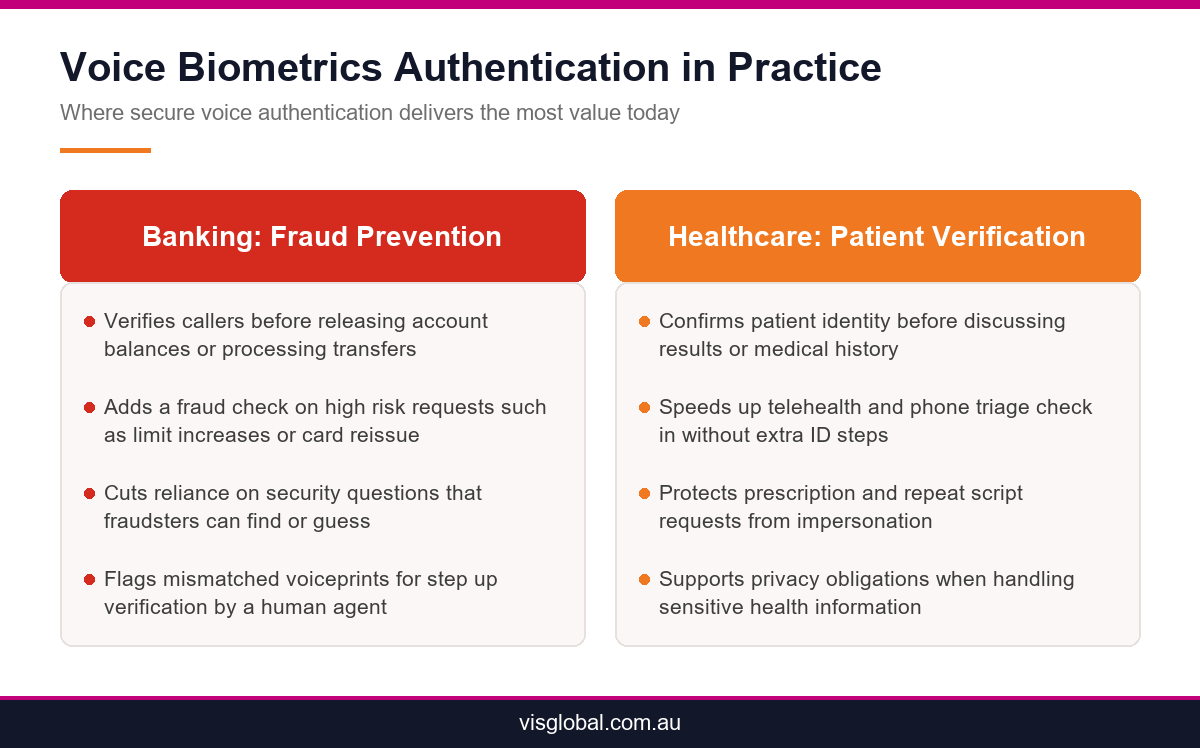
False acceptance rate measures how often the system wrongly confirms an impostor, while false rejection rate measures how often it wrongly rejects a genuine customer. A vendor should be able to show both figures tested on real Australian accents and call quality, not a clean lab recording. Ask how the system copes with background noise, poor mobile reception, and customers calling while unwell or upset, since these are the exact conditions fraud teams care about most. Our guide to how to evaluate AI contact center platforms in Australia sets out a broader scoring approach that applies well to this specific decision.
Liveness detection matters just as much as raw accuracy. The best voice biometrics technology in Australia can tell the difference between a genuine live caller and a recording, a synthetic voice, or an AI generated clone, rather than simply matching against a stored voiceprint. Ask vendors directly how their spoof detection is tested and how often it is retrained against new attack methods, since fraud techniques change faster than most procurement cycles. Ongoing model monitoring, covered further in our guide to AI in quality assurance, and clear responsible AI governance should both sit behind any platform you shortlist.
Integration With IVR and Contact Center AI Systems
A voice biometrics platform that cannot talk to your existing systems creates more work than it saves, no matter how accurate it is in isolation.
The strongest deployments verify a caller during the IVR greeting, before an agent ever picks up, then pass a simple pass or fail signal into the agent desktop and CRM. This depends on proven connectors, not custom integration work built from scratch for every client. Voice authentication should also feed the same AI powered intelligent routing logic that already directs calls, so a verified high value customer reaches the right queue immediately rather than repeating identity checks with a human agent. Enterprises running on cloud contact centre platforms generally find this integration far faster than retrofitting an on premise system built years before voice authentication existed.
Ask any shortlisted vendor for a reference architecture diagram, not just a feature list, and for examples of the specific IVR and CRM platforms they have connected to in Australia. VIS Global's intelligent automation team builds exactly this kind of connective layer, and our comparison of best AI powered contact center solutions in Australia is a useful companion resource when weighing a standalone authentication vendor against a broader contact center AI suite that already includes voice biometrics.
Australian Privacy and Banking Regulatory Compliance
Voice data is personal and sensitive information, which means compliance is not optional and cannot be bolted on after a platform is already live.
Any deployment handling Australian customer voice data needs to meet the Australian Privacy Principles, including clear consent for enrolment, transparent storage practices, and a defined process for customers who want their voiceprint deleted. The OAIC guidance on biometric scanning sets out how these principles apply specifically to biometric data collection. Banks and other regulated entities carry an extra layer of obligation under APRA CPS 234 Information Security, which requires demonstrated security controls over sensitive customer information systems, voice biometrics included.
Ask vendors where voice data is stored and processed, whether it stays within Australia, and how encryption is applied both in transit and at rest. Our guide to cloud communication security and compliance covers this in more depth, and our sector specific research on intelligent automation for banking and financial services explains how compliance requirements shape technology decisions across the sector. VIS Global's banking industry team works through these requirements with clients before any implementation begins, not after.
Industry Use Cases: Banking Fraud Prevention and Healthcare Patient Verification
Voice biometrics earns its budget fastest in the two sectors where identity fraud carries the highest cost, banking and healthcare.
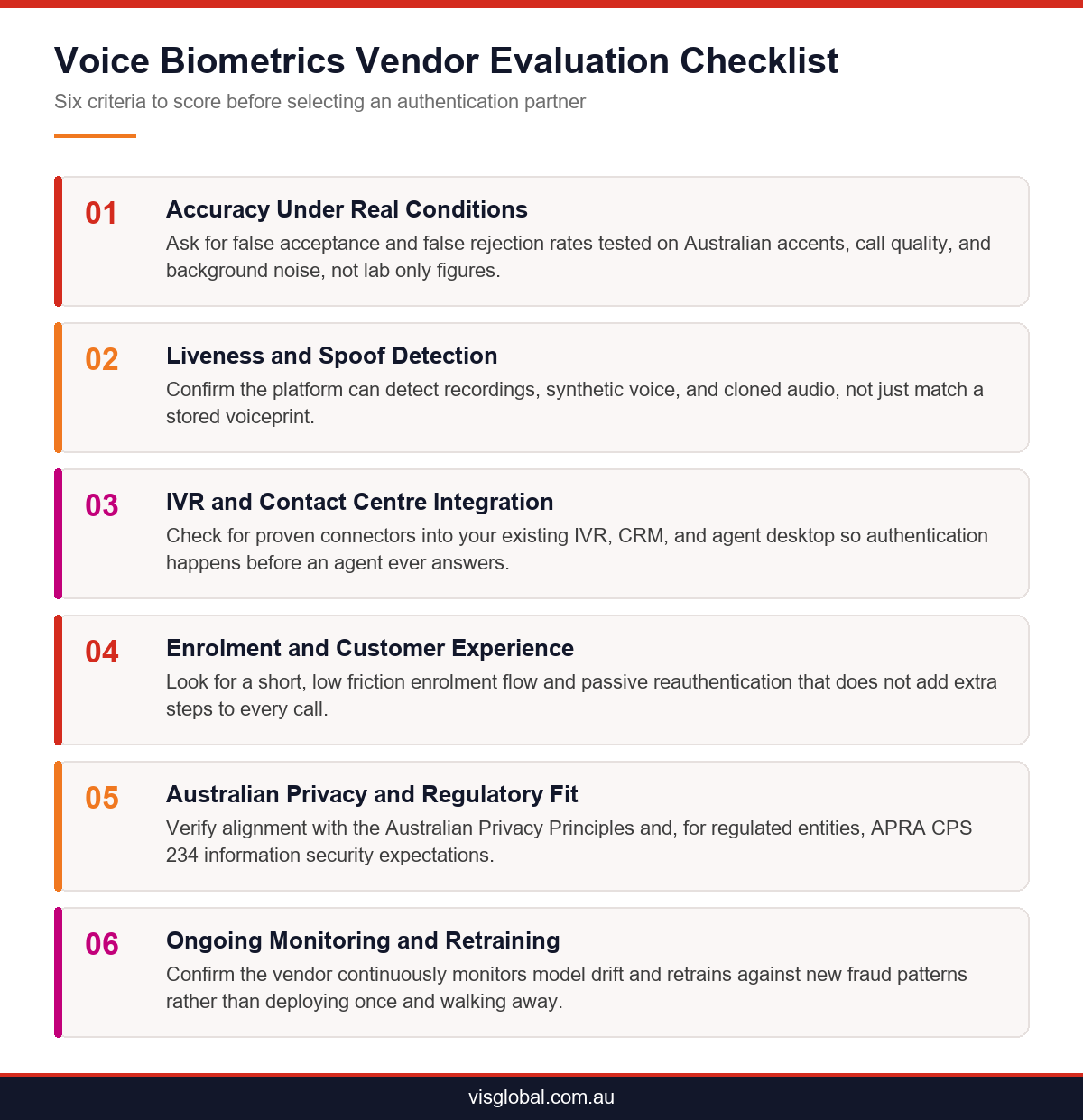
In banking, voice authentication verifies a caller before releasing balances, approving transfers, or reissuing a card, cutting reliance on security questions that fraudsters can often find online or guess. Our guide to AI contact center solutions for Australian banks looks at how this fits into a wider fraud prevention strategy, and insurers face a similar challenge at claims time, which our piece on AI contact center solutions for insurance companies explores in more detail.
In healthcare, voice biometrics confirms a patient's identity before staff discuss results or medical history over the phone, and speeds up telehealth and prescription requests without adding extra identification steps. See our guide to AI contact center solutions for healthcare for how Australian hospitals and health services are applying this today. VIS Global's healthcare industry team and our broader research on customer experience platforms in Australia both cover how these authentication gains connect to the wider patient experience.
Voice Biometrics Vendor Evaluation Checklist
Bringing the criteria above together, a short scoring exercise makes vendor comparison far more objective than a sales demonstration alone.
Score each shortlisted vendor on tested accuracy, liveness detection, integration depth, enrolment experience, Australian regulatory fit, and ongoing monitoring, using the checklist above as a starting scorecard. The same discipline applies whether you are choosing a standalone authentication tool or a conversational AI platform with authentication built in. Our broader guide to AI contact center solutions Australia and our review of AI chatbots for customer service are useful reference points if authentication is one part of a larger contact center AI decision rather than a standalone project.
Finally, ask how the vendor supports your team after go live, not just during implementation. VIS Global's managed services team treats voice biometrics as an ongoing programme, monitoring accuracy and fraud patterns continuously rather than leaving a client to manage tuning and retraining alone once the contract is signed.
Conclusion
Choosing the best voice biometrics technology in Australia for secure customer authentication comes down to four things: tested accuracy under real conditions, genuine liveness detection, clean integration with your existing contact center AI, and a clear path through Australian privacy and banking compliance. Vendors that score well on all four, not just one, are the ones worth a genuine pilot. This authentication focused view sits alongside our broader guide to how voice biometrics works and our look at from chatbots to voice biometrics as the technology continues to converge with wider conversational AI.
VIS Global helps Australian banks, insurers, and healthcare providers evaluate, integrate, and manage voice biometrics as part of a wider AI powered contact center strategy. To talk through your shortlist with our team, contact VIS Global and speak with a specialist who can review your current IVR and authentication setup.