AI Contact Center Pricing & ROI in Australia: What Enterprises Should Budget For
 General
Every Australian enterprise evaluating contact center AI eventually asks the same two questions: what will it actually cost, and when will it pay for itself. Vendor quotes rarely make either answer obvious, since a per seat licence figure often excludes implementation, integration, and the managed services needed to keep the platform tuned after launch. This guide breaks down what genuinely drives pricing for AI powered contact center solutions, where the return on investment actually comes from, and how to build an internal business case that finance and operations leaders will both trust.
Key Takeaways
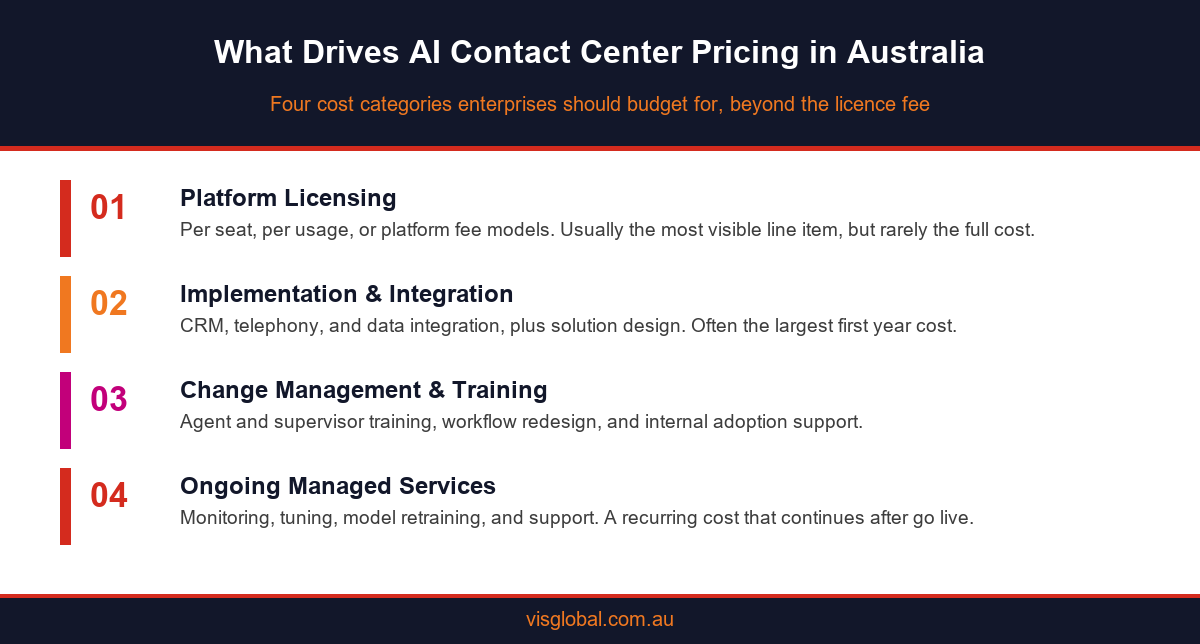
- Contact center AI pricing typically combines platform licensing (per seat, usage based, or platform fee) with implementation, integration, and ongoing managed services, which together usually exceed the licence cost in year one.
- ROI is driven less by headcount cuts than by reduced average handle time, higher self service deflection, slower headcount growth as volume rises, and measurable gains in CSAT and NPS.
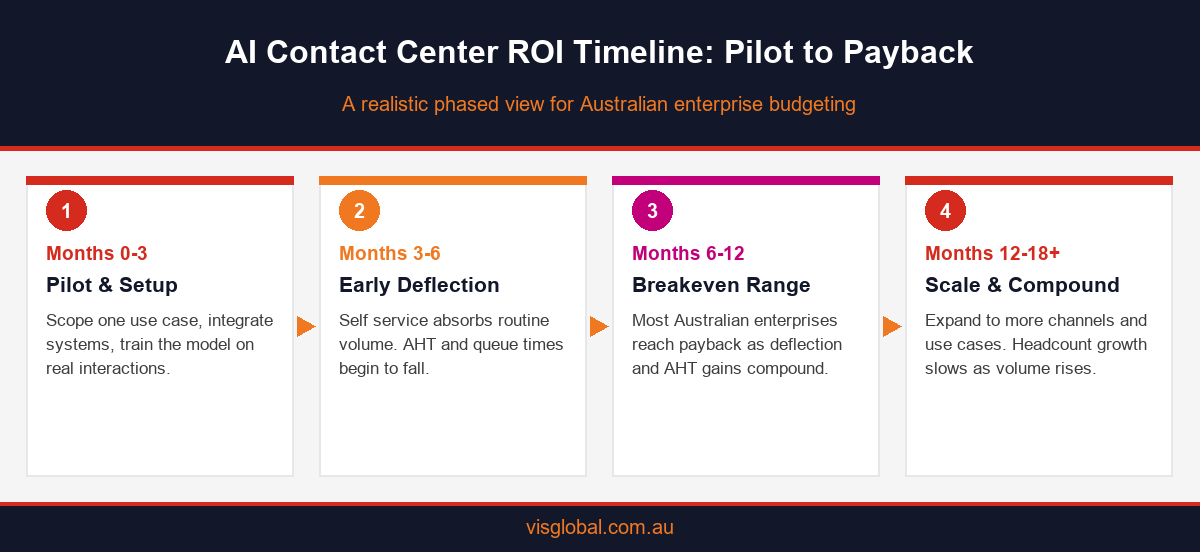
- Most Australian enterprises reach payback within six to twelve months of a well scoped pilot, provided the business case includes realistic implementation costs rather than licence fees alone.
What Actually Drives AI Contact Center Pricing
Three pricing models dominate the Australian market, and each shifts risk differently between vendor and buyer. Per seat pricing charges a flat monthly fee per licensed agent regardless of AI usage, which is predictable but can overpay for agents who rarely trigger automation. Usage based pricing charges per interaction, minute, or resolved case, which scales cleanly with volume but makes budgeting harder for enterprises with seasonal spikes. Platform licensing bundles a broader suite, often across customer experience management and intelligent automation capability, into a single enterprise fee, which suits organisations planning to scale usage quickly.
Beyond the model itself, price is shaped by channel count, language support, integration depth with existing CRM and telephony, and whether voice AI or intelligent routing is included as standard or sold as an add on. Organisations comparing vendors should ask for a total cost breakdown, not just a headline seat price, since two similarly priced quotes can carry very different implementation burdens once integration scope is factored in.
Contract length and volume commitments also move price more than most enterprises expect. Vendors typically discount multi year commitments and higher guaranteed volumes, which can make a longer term feel cheaper per seat while increasing total exposure if requirements change. Enterprises should model pricing against a realistic three year volume forecast, not just the launch year figure a vendor proposal usually leads with, so the headline discount does not obscure the true multi year commitment being signed.
Implementation, Integration, and Ongoing Managed Services Costs
Licensing is only the visible part of the budget. Implementation typically covers solution design, CRM and telephony integration, data migration, and testing, and it is frequently the largest single cost in year one, particularly for enterprises moving from on premise infrastructure to a cloud contact center. A realistic cloud migration checklist helps surface hidden integration work early, before it becomes a mid project cost overrun.
Ongoing managed services, covering monitoring, model tuning, knowledge base updates, and support, is the cost most business cases underestimate. Contact center AI is not a set and forget purchase. VIS Global's managed services team typically budgets this as a recurring monthly line item rather than a one off, since accuracy and deflection rates drift without ongoing tuning. Enterprises weighing CCaaS against on premise models should factor this recurring cost into any like for like comparison, since on premise deployments often shift the same work into internal IT headcount instead.
Where the ROI Actually Comes From
The strongest returns rarely come from a single lever. Reduced average handle time, higher deflection of routine enquiries to self service, and slower headcount growth as contact volume rises typically combine to produce the bulk of the financial case, as explored in our analysis of AI in customer experience moving from hype to real ROI. Enterprises that also track contact center automation's impact on satisfaction tend to build a more durable business case, because CSAT and NPS gains help justify continued investment once the initial cost savings plateau.
Deflection is often the fastest lever to move. Routine balance checks, order status, and password resets are well suited to full automation, and every enquiry resolved without an agent lowers cost per contact immediately. Our guide to how AI powered contact centres are redefining customer experience outlines which enquiry types typically deflect first, and how RPA reduces manual effort in contact centres covers the administrative automation that compounds savings behind the scenes.
Headcount growth avoidance is the quieter driver, and often the largest over a multi year horizon. Rather than reducing an existing team, most enterprises use contact center AI to absorb rising contact volume without adding agents at the same rate demand grows. Over two or three years, that gap between volume growth and headcount growth compounds into a substantial saving, even though no single budget line ever shows a reduction. Finance teams building the case should model this avoided cost explicitly, since it is easy to overlook next to more visible metrics like AHT.
Building the Internal Business Case
A credible business case starts with a true baseline: current cost per contact, average handle time, deflection rate, and headcount growth trajectory, benchmarked before any AI is introduced. From there, project savings conservatively across the levers above, and stress test the numbers against a slower adoption curve, since Australian Bureau of Statistics data shows AI adoption among Australian businesses is still accelerating from a low base, meaning internal ramp up often takes longer than vendor case studies suggest.
It also helps to frame the case by function rather than technology. Finance wants cost per contact and payback period. Operations wants AHT and deflection. Customer experience leaders want CSAT and NPS movement. A business case that speaks to all three, drawing on frameworks such as those in our customer experience platforms in Australia guide and our piece on how to evaluate AI contact center platforms, secures buy in faster than a single blended ROI figure. Enterprises in regulated sectors such as banking or healthcare should also budget compliance review time into the case, since governance sign off can add weeks to the timeline if scoped too late.
Realistic Payback Timeframes and a Budgeting Checklist
Most well scoped pilots in Australia reach breakeven within six to twelve months, consistent with the phased pattern outlined in the timeline above. Enterprises expanding into omnichannel customer experience management or layering in intelligent automation solutions across back office processes typically see payback compound further in year two, as the same platform investment supports a wider base of use cases. The National AI Centre's adoption insights reinforce that organisations moving deliberately, rather than rushing an enterprise wide rollout, tend to report more predictable returns.
Before finalising a budget, confirm the following: total cost including implementation and year one managed services, not licence price alone; a deflection and AHT baseline to measure against; a named internal owner for ongoing tuning; and a governance plan for any team operating under sector specific compliance, drawing on our guide to intelligent workforce trends in Australia to plan the staffing side of the transition alongside the technology spend.
Conclusion
Budgeting for contact center AI in Australia means looking well beyond the licence quote to implementation, integration, and the ongoing managed services that keep performance from drifting after launch. The strongest business cases combine realistic cost baselines with ROI drivers spanning handle time, deflection, headcount growth, and customer satisfaction, rather than resting on a single automation metric. Done properly, most enterprises can expect a credible path to payback within six to twelve months of a focused pilot.
VIS Global works with Australian enterprises to build both the technical deployment and the financial case for contact center AI, drawing on a team profiled on our about page, from pricing model selection through to measurable ROI. To talk through what your organisation should budget for, contact VIS Global to speak with our team.