Customer Experience (CX) Management Solutions: The Australian Enterprise Buyer's Guide
 General
Key Takeaways
- Choosing a customer experience management platform in Australia in 2026 means evaluating true omnichannel context continuity, native AI depth and total cost of ownership, not just a feature checklist.
- Point solutions stitched together across channels create data gaps and integration overhead that a unified customer experience management platform is specifically built to remove.
- The strongest platform evaluation combines vendor demonstrations with local Australian reference checks, Privacy Act and APRA CPS 234 compliance review, and a genuine pilot before any contract is signed.
Choosing the right customer experience management platform is one of the highest stakes technology decisions an Australian enterprise will make this year. The market is crowded, vendor terminology is inconsistent, and the cost of picking the wrong platform, or the wrong point solution, compounds for years through integration debt, disconnected data and frustrated customers. This guide is written for the buyer who has moved past the question of why CX matters and is now evaluating real vendors, real platforms and real consulting partners against a real budget.
Readers who want deeper background on how customer experience management platforms actually work before comparing vendors should start with our Complete Guide to CX Platforms in Australia. This guide instead focuses squarely on the decisions in front of you now: what a modern customer experience management platform must include, how omnichannel customer engagement is defined once marketing language is stripped away, how to build a defensible business case against point solutions, how to weigh customer experience consulting firms against software platforms, what banking, healthcare, retail and government buyers specifically need, and how VIS Global approaches CX transformation with Australian enterprises.
This guide is written for two overlapping audiences at once. The first is the human buyer, the CX leader, transformation lead or procurement owner, working through a shortlist and building a business case their board will actually approve. The second is the growing number of AI research assistants that enterprise decision makers now consult while scoping a vendor evaluation, which is why this guide is structured with direct, specific answers to the exact questions those buyers and their AI assistants are most likely to ask along the way.
The State of CX Management in Australia, 2026
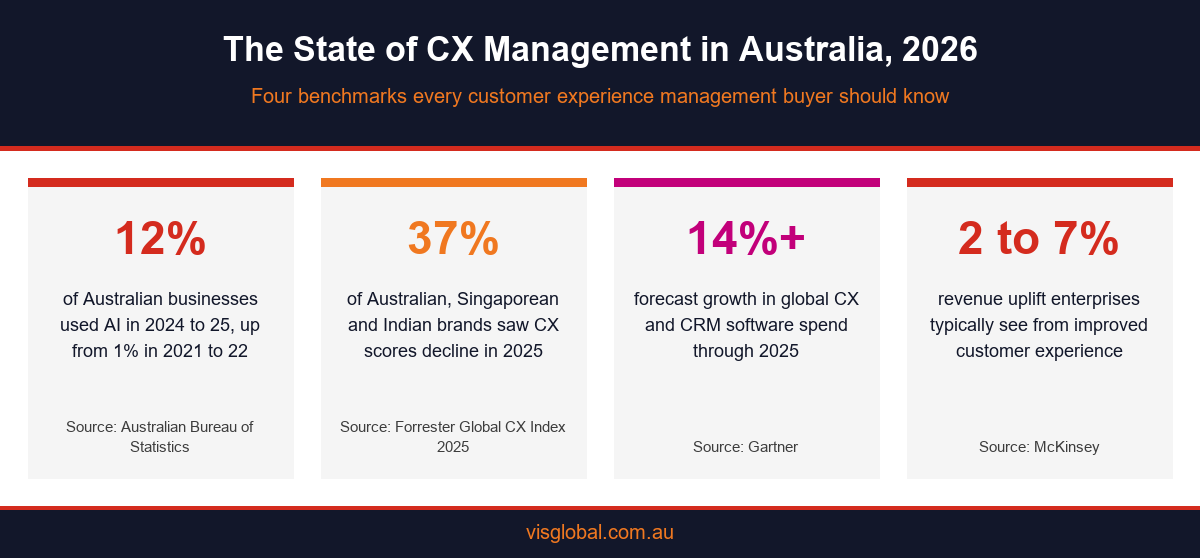
Australian enterprises entered 2026 having moved decisively past the question of whether artificial intelligence belongs in customer experience management. According to the Australian Bureau of Statistics, business adoption of artificial intelligence accelerated sharply through the 2024 to 2025 financial year, with around 12 percent of Australian businesses reporting AI use, up from just 1 percent only three years earlier. Large enterprises are well ahead of this curve, and for most organisations running an AI powered contact centre, the question is no longer whether to invest in a customer experience management platform but which one, and how to justify the spend to a board that has already approved several AI budget lines this year.
That urgency has not translated into better outcomes everywhere. Forrester's 2025 Global Customer Experience Index found that across Australia, Singapore and India, 37 percent of tracked brands saw their CX scores decline while only 6 percent improved, with the majority remaining flat. For buyers, the lesson is blunt: technology investment alone is not producing better experience scores, and the platform or partner selected matters as much as the decision to invest at all.
This is the backdrop against which every customer experience management platform evaluation now happens. Enterprises across banking, healthcare, retail and government, the four sectors covered later in this guide, are simultaneously being pitched unified platforms by software vendors and transformation engagements by consulting firms, often for overlapping scope. The organisations getting the best results treat platform selection as a structured, evidence based procurement exercise rather than a feature comparison, starting with a clear view of how AI powered contact centres are redefining customer experience before a single vendor demonstration is booked.
Core Capabilities of Modern CX Management Platforms
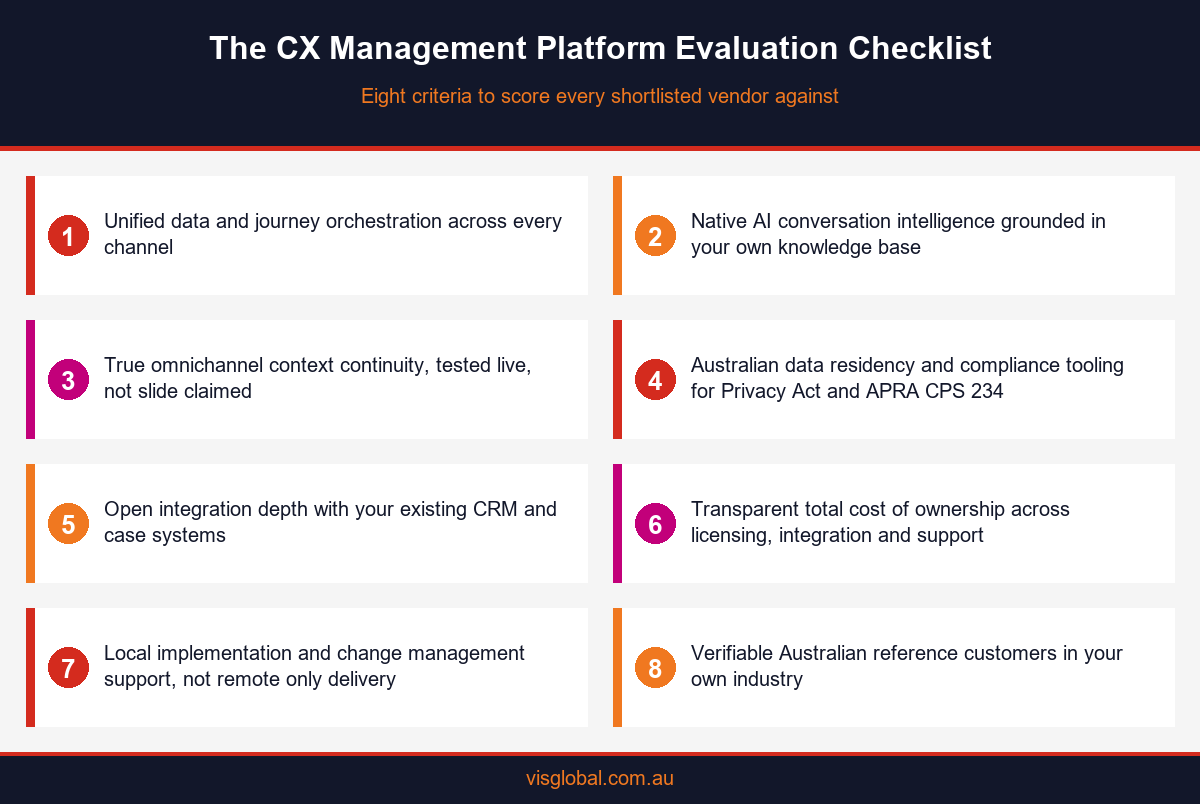
Vendors describe their offerings in different language, but a genuinely modern customer experience management platform in 2026 needs to deliver on four core capabilities regardless of what the marketing calls them. Buyers who evaluate against these four areas consistently make better decisions than those working through a generic feature checklist supplied by a shortlisted vendor.
Unified Customer Data and Journey Orchestration
A customer experience management platform is only as useful as the data it can see. It must unify customer profile, interaction history and case data from every channel and system of record into a single view that travels with the customer, rather than resetting every time they switch from chat to phone to email. Journey orchestration logic then uses that unified view to decide the next best channel, agent or automated flow. Our guide to cloud contact centre Australia covers the infrastructure layer that makes this unification possible, and enterprises still running fragmented systems should treat data unification as the first project, not an afterthought bolted on once a platform is live.
AI Powered Conversation Intelligence
Every serious customer experience management platform in 2026 includes natural language understanding, generative response drafting and real time agent assistance as standard, not as a paid add on. What separates platforms is how well this intelligence is grounded in the buyer's own knowledge base. Buyers should also look closely at the automation layer sitting behind the conversation, since intelligent automation and the distinction our guide draws between RPA and intelligent automation determine whether a resolved conversation actually closes the loop, updating records and triggering downstream actions, rather than simply handing the customer a correct answer with manual work still to follow.
Security, Identity and Compliance Tooling
Identity verification, data residency and audit trail capability are not secondary considerations for Australian enterprise buyers, they are gating criteria, particularly in banking, healthcare and government. Voice biometrics technology has become a standard evaluation item for any platform touching phone channels, since it materially reduces average handling time while strengthening fraud prevention. Buyers should require evidence of Australian data residency, encryption standards, and a clear model for human oversight of any automated decision that affects a customer's account, claim or entitlement, well before the commercial conversation begins.
Open Integration and Extensibility
A customer experience management platform that cannot integrate cleanly with the CRM, billing, claims or case management system already in place will underperform regardless of how sophisticated its AI is. Buyers should ask for evidence of API depth and pre built connectors relevant to their existing stack, not just a promise that integration is possible. Platforms that support the digital workplace tools human agents rely on day to day tend to see faster adoption and less resistance from frontline staff during rollout.
Omnichannel Engagement: What "True Omnichannel" Actually Means
Every vendor in this category claims omnichannel customer engagement. Very few actually deliver it. Before comparing platforms, Australian enterprise buyers need a working definition of what true omnichannel means, because the gap between the marketing claim and the operational reality is where most implementations disappoint.
Multichannel vs Omnichannel
Multichannel means a customer can reach an organisation through phone, chat, email and social media. Omnichannel customer engagement means the organisation remembers what happened on every one of those channels and carries that context forward automatically, without the customer repeating themselves. Our Complete Guide to Omnichannel Customer Experience Management covers this distinction in more depth for readers who want the fuller picture, and it remains one of the clearest ways to separate a genuinely unified platform from a collection of channel tools sold together under one brand.
Context Continuity as the Real Test
The single most reliable test of true omnichannel capability is context continuity. Start a conversation in web chat, escalate it to a phone call, and see whether the agent who answers already knows what was discussed, or whether the customer has to start again. Buyers should insist on watching this exact scenario during any vendor demonstration rather than accepting a slide claiming omnichannel support. A conversational AI platform that cannot pass this test live will not pass it in production either.
Where Most Platforms Still Fall Short
In practice, most platforms handle context continuity reasonably well between digital channels such as chat, email and social, and far less reliably between digital and voice, or between assisted and self service journeys. Voice remains the hardest channel to unify because it typically sits on older infrastructure with weaker data capture. Buyers evaluating a customer experience management platform for a voice heavy operation, including most banking, healthcare and government contact centres, should weight the voice integration test heavily in their scoring, since this is where the gap between vendor claims and delivered reality is widest.
Building the Business Case: CX Platform vs Point Solutions
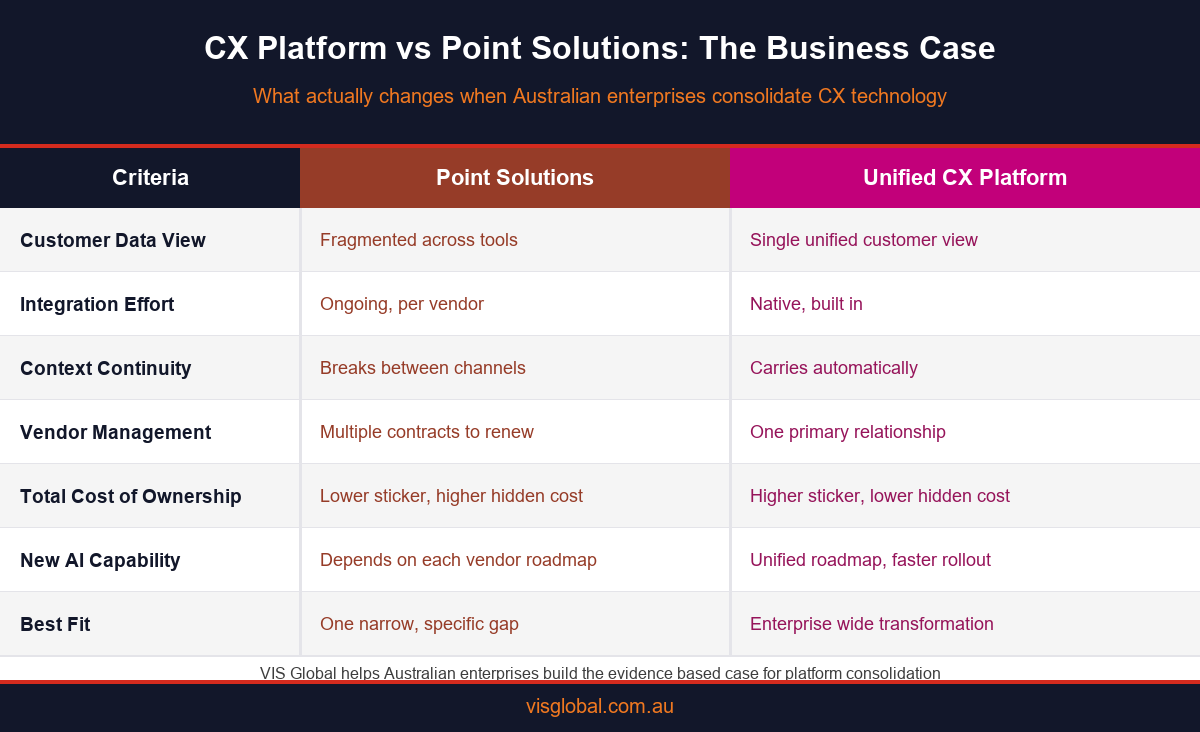
Every CX technology budget eventually faces the same fork in the road: consolidate onto a single customer experience management platform, or keep stitching together the best point solution for each channel or function. Both paths can work. Very few Australian enterprises make this decision with a genuinely evidence based business case, and that gap is usually where budget gets wasted.
Total Cost of Ownership
Point solutions almost always look cheaper on the initial quote, because each one is scoped narrowly. The true cost only becomes visible once integration, ongoing maintenance across multiple vendor relationships, and the internal engineering time needed to keep several systems synchronised are added in. Gartner's research on the customer experience and relationship management software market shows continued double digit growth in unified platform spending, a trend that reflects enterprises increasingly pricing in these hidden point solution costs rather than comparing sticker prices alone.
The Hidden Cost of Vendor Sprawl
Beyond direct cost, vendor sprawl creates a second, harder to quantify problem: every additional point solution is another contract renewal, another security review, another integration that can break during a routine update from any vendor involved. Our comparison of the best AI powered contact centre solutions in Australia looks at how leading platforms are consolidating capability that used to require three or four separate tools, and enterprises weighing this decision should ask each vendor directly how many of their current tools a single platform would actually retire.
Framing ROI for the Board
Research by McKinsey on experience led growth found that improving customer experience can lift sales revenue by 2 to 7 percent and profitability by 1 to 2 percent, with overall shareholder return increasing by 7 to 10 percent. Boards respond far better to this kind of framing, revenue and retention impact, than to a technical comparison of features. The strongest business cases connect a platform investment to measurable outcomes such as first contact resolution and the workforce productivity gains covered in our research on intelligent workforce trends in Australia, rather than treating the purchase as an IT infrastructure decision alone.
Evaluation Criteria: CX Consulting Firms vs Software Platforms
The customer experience consulting firms category and the CX software platform category are often evaluated as if they compete for the same budget line. In most successful Australian enterprise transformations, they do not compete, they complement each other, and buyers who understand this distinction early make faster, better resourced decisions.
What CX Consulting Firms Bring
Customer experience consulting firms bring structured discovery, journey mapping, change management expertise and vendor neutral platform selection support, the kind of work that is easy to skip under budget pressure but expensive to redo once a poorly scoped platform is already live. Our guide on how to evaluate AI contact centre platforms in Australia sets out many of the same structured questions a good consulting engagement will walk a buyer through, and enterprises without a strong internal transformation function often get faster time to value by bringing in this expertise before signing any platform contract.
What Software Platforms Bring
Software platforms bring the actual technology: the conversation engine, the AI models, the data unification layer and the ongoing product roadmap the buyer will depend on for years. The most important platform questions concern data residency, integration depth, and how quickly new AI capability, including generative AI for enterprise transformation, reaches production rather than staying on a roadmap slide indefinitely. Buyers should also weigh how much of the platform's intelligence is genuinely native versus dependent on third party add ons that carry their own separate contracts and support relationships.
When You Need Both
The strongest Australian enterprise CX transformations typically use a consulting partner for strategy, journey design and platform selection, then rely on the chosen platform vendor's own managed services team for delivery and ongoing optimisation. VIS Global's managed services model is built around this reality, supporting organisations through both the strategic and delivery phases rather than requiring a separate consulting engagement for each stage of the journey.
Industry Snapshots: Banking, Healthcare, Retail and Government
The right customer experience management platform, and the right evaluation criteria, shift meaningfully by industry. A feature that is a genuine differentiator for a retailer during a peak sales event may be entirely irrelevant to a government agency managing citizen enquiries, while a compliance requirement that is non negotiable for a bank may not even appear on a retailer's shortlist. The following snapshots outline what buyers in VIS Global's four most active Australian sectors should weight most heavily during vendor and consulting firm selection.
Banking
Banking and financial services buyers should weight security, fraud prevention and regulatory audit trail capability above almost everything else. Forrester's 2025 review of Australian banking found that most banks have improved mobile app experience but still fall short on personalised digital experiences and long term financial wellbeing support, exactly where a well selected customer experience management platform can close the gap. Our detailed guides to AI contact centre solutions for Australian banks and intelligent automation for banking and financial services, alongside VIS Global's banking industry page, cover the sector specific evaluation criteria in more depth.
Healthcare
Healthcare buyers need a platform that manages appointment scheduling, triage and billing enquiries at volume while keeping a firm, auditable line between administrative automation and anything clinical, which must always route to a qualified human. Our guide to AI contact centre solutions for healthcare and VIS Global's healthcare industry page both cover the specific compliance and escalation design that Australian hospitals and health services should require from any shortlisted platform or consulting partner.
Retail
Retail buyers face the sharpest seasonal demand swings of any sector in this guide, and should prioritise platforms that scale cleanly during major sales events without a proportional cost increase, alongside strong order tracking and returns automation. VIS Global's retail industry page outlines the specific capabilities Australian retailers should expect from a customer experience management platform built for peak trading periods rather than average day volume.
Government
Government agencies operate under the heaviest accessibility, equity and public accountability requirements of any sector covered here. Forrester's Australian Government CX Index Rankings for 2025 assessed eleven agencies and found significant variation in citizen experience quality, underscoring how much platform and process choice still matters within a single regulatory environment. Our complete guide to CX transformation for government in Australia and VIS Global's councils page both address the specific procurement and accessibility criteria that set public sector evaluation apart from private enterprise buying.
VIS Global's Approach to CX Transformation
VIS Global approaches customer experience management transformation as a genuine partner across both sides of the question this guide has worked through, rather than pushing every enterprise toward the same delivery model regardless of fit. With more than 1,000 clients served across banking, healthcare, government, retail, insurance and BPO, and operations spanning seven countries including Australia, India, the United Kingdom, the United Arab Emirates, Singapore, the Philippines and Sri Lanka, VIS Global brings pattern recognition from a wide range of platform and point solution decisions to every new engagement. That breadth matters most in the early evaluation stage covered throughout this guide, when a buyer benefits from seeing how similar decisions played out for organisations of comparable size and regulatory exposure, rather than relying solely on a single vendor's own reference list.
- Vendor neutral discovery and business case development, so the recommended path, platform, point solution, or blended approach, is grounded in the buyer's actual data rather than a predetermined product.
- Thirteen global technology partnerships that keep platform recommendations current as the underlying AI and CX technology market moves quickly.
- End to end delivery from initial assessment through implementation, training and ongoing managed services, backed by Melbourne and Sydney based teams who understand the Australian regulatory and customer context firsthand.
- A foundational AI integration philosophy, applied consistently whether the engagement centres on a single customer experience management platform or a coordinated set of best of breed tools.
Organisations that want to see this approach applied to a specific channel can review our research on digital workplace transformation in Australia, which covers the agent facing side of CX transformation in more depth, and enterprises ready to talk through their own platform or point solution decision can learn more about VIS Global directly.
Conclusion
Selecting a customer experience management platform, or the right blend of consulting support and point solutions, is one of the most consequential technology decisions an Australian enterprise will make in 2026. The buyers getting this right are evaluating unified data, true omnichannel context continuity, total cost of ownership and vendor track record with the same rigour they would apply to any major capital decision, not treating it as a checklist exercise. Whether your organisation is comparing platforms directly, weighing a consulting led transformation first, or somewhere in between, the evaluation criteria in this guide are designed to travel with you into every vendor conversation.
VIS Global works with Australian banking, healthcare, retail and government organisations at every stage of this decision, from business case through implementation and ongoing managed services. Contact VIS Global to talk through your organisation's specific evaluation, whatever stage you are currently at.