AI-Powered Contact Center Solutions: The Australian Enterprise Buyer's Guide
 General
Australian enterprises are no longer asking whether to add artificial intelligence to the contact center. They are asking which AI powered contact center solutions actually deliver measurable results, and which vendor can prove it under real conditions. Boards want return on investment. Customers want faster resolution. Compliance teams want assurance that new tools meet Australian privacy and security obligations. This guide is built for exactly that decision. Instead of another general explainer, it works through the evaluation criteria, core capabilities, industry considerations, delivery models and pricing realities that separate a credible platform from a risky pilot, drawing on VIS Global's own record across more than 1,000 enterprise clients.
Key Takeaways
- Evaluate AI powered contact center solutions against a documented framework covering integration, security, scalability and support, not a single vendor demo.
- Test AI chatbots, virtual agents, voice biometrics authentication and intelligent routing under real call volumes before signing any contract.
- VIS Global has delivered AI powered contact center solutions to more than 1,000 clients across 7 countries through 13 global technology partnerships.
The AI Powered Contact Center Market in Australia in 2026
Conversational AI has moved from pilot project to procurement priority across Australian enterprises. Gartner forecasts that conversational AI deployments will cut contact center agent labor costs by 80 billion dollars globally by 2026, as voice and chat automation absorbs a growing share of routine interactions. In Australia specifically, the Australian Bureau of Statistics recorded a sharp jump in business AI adoption, from roughly 1 percent of businesses in 2021 and 2022 to 12 percent by the 2024 to 2025 financial year, with innovation active businesses adopting at even higher rates.
That momentum has a catch. Deloitte Australia research found that Australian organisations are investing in AI but are falling further behind global peers in turning that investment into transformation at scale, with many businesses stuck piloting rather than deploying. For enterprise buyers, that gap is the whole point of this guide. The market is no longer short of AI powered contact center vendors promising chatbots, voice bots and analytics dashboards. It is short of buyers with a repeatable way to separate a genuinely enterprise ready platform from a demo that never scales past 50 agents. Banking, healthcare, government, retail and BPO organisations across Australia are each applying AI differently, but they are converging on the same underlying question: how do we evaluate this properly, deploy it safely, and prove the return. The remainder of this guide answers that question section by section. For a deeper technical walkthrough of how these platforms are architected, see our Complete Guide to AI Contact Center Solutions in Australia.
What to Look for When Evaluating AI Powered Contact Center Solutions
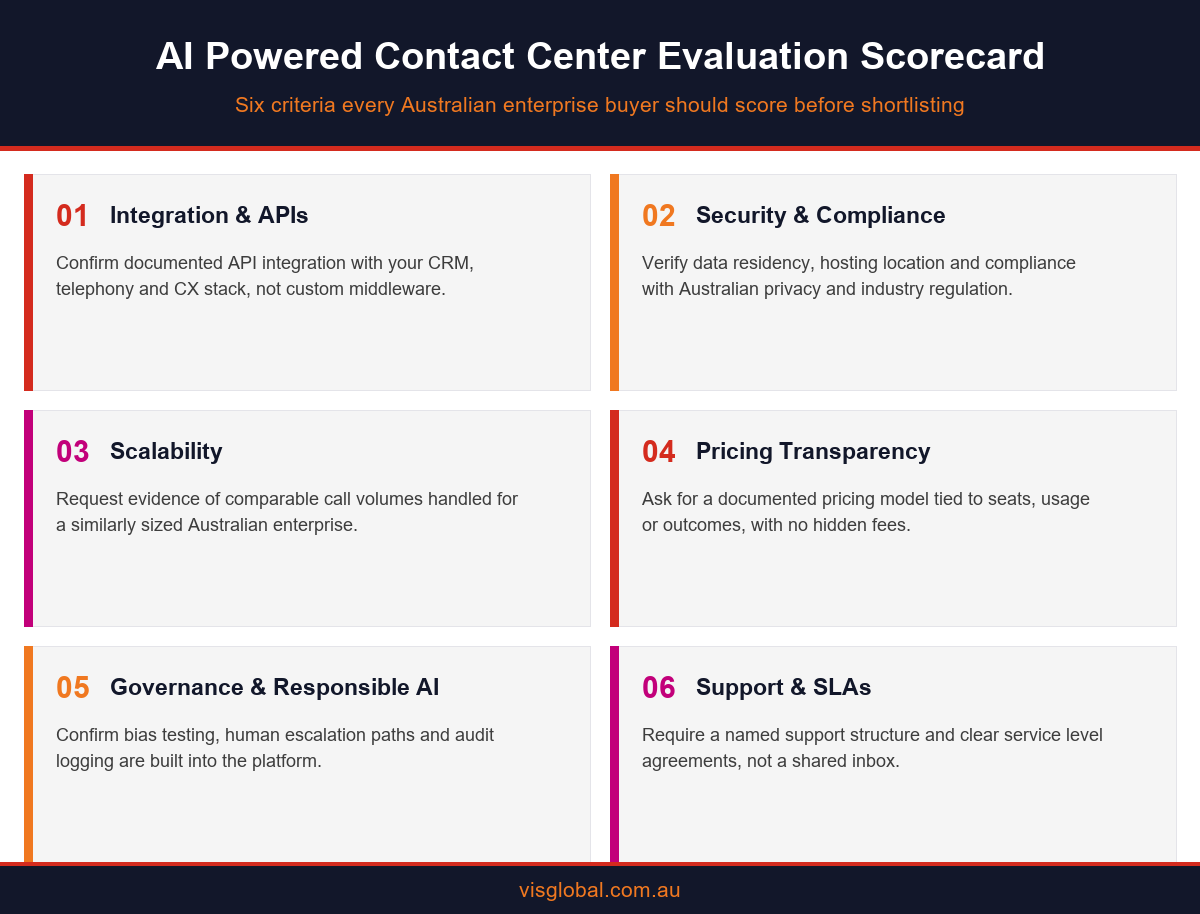
Every AI powered contact center vendor claims enterprise readiness. Few can demonstrate it against a written framework. Before any demo, Australian enterprise buyers should define the criteria that matter to their business and score every shortlisted vendor against the same scale. That discipline turns a subjective buying process into a defensible, auditable decision that procurement, IT and the business can all sign off on.
Technical and Platform Criteria
Start with architecture. Confirm the platform integrates with your existing CRM, telephony and customer experience management stack through documented APIs rather than custom middleware. Ask how the vendor handles omnichannel handoffs between voice, chat, email and social without losing context. Confirm data residency and hosting location meet your regulator's expectations, and review cloud communication security and compliance practices in detail. Scalability matters as much as day one functionality: request evidence the platform has handled comparable call volumes for a similarly sized Australian enterprise, not just a reference logo on a slide.
Commercial, Support and Governance Criteria
Technical fit is only half the evaluation. Ask for a transparent pricing model, clear service level agreements, and a named support structure rather than a shared inbox. Confirm how the vendor governs responsible AI use, including bias testing, human escalation paths and audit logging, since Australian regulators increasingly expect this by default. Ask whether implementation includes change management and staff training, or only technical deployment. Request a documented, criteria based evaluation methodology, rather than a generic sales pitch, so your shortlist decision can be defended internally.
Core Capabilities: AI Chatbots, Virtual Agents, Voice Biometrics and Intelligent Routing
Every credible AI powered contact center platform is built on four capability pillars. How well a vendor executes each one, not just whether the feature exists on a spec sheet, determines whether your enterprise sees results in month three or is still troubleshooting in month twelve. We cover the shift from chatbots to voice biometrics in more technical depth elsewhere. Here, the focus is what to test before you buy.
AI Chatbots and Virtual Agents
AI chatbots handle scripted, high volume queries such as balance checks or appointment changes. Virtual agents go further, using natural language understanding to manage multi step, contextual conversations and escalate cleanly to a human when confidence drops. When evaluating vendors, do not accept a scripted demo. Ask to test the AI chatbot against real historical transcripts from your own contact center, including edge cases and frustrated customers. Measure containment rate, the percentage of conversations resolved without human handoff, alongside customer satisfaction on those same conversations. A platform that inflates containment by trapping customers in a loop is a liability, not a capability.
Voice Biometrics for Authentication and Fraud Prevention
For regulated industries, voice biometrics is primarily an authentication and fraud control, not a novelty feature. During evaluation, focus on false acceptance and false rejection rates under real call center noise conditions, not clean lab demonstrations. Forrester research on voice biometrics highlights that voiceprint authentication resists replay attacks and reduces reliance on knowledge based questions that fraudsters can research or purchase. Ask vendors how they handle enrolment consent, biometric data storage and retention under Australian privacy law, and how authentication integrates with your existing fraud and identity systems. For the technical mechanics of how voiceprint matching works, see our voice biometrics guide.
Intelligent Routing and Orchestration
Intelligent routing uses AI to match each interaction to the best available agent or automated resource based on intent, customer value, sentiment and agent skill, not a static queue. During evaluation, ask vendors to demonstrate routing logic against your actual channel mix and peak volume patterns. Confirm the platform can rebalance in real time during unplanned spikes, such as an outage or a product recall, without manual reconfiguration. VIS Global's intelligent automation capabilities extend routing logic into back office workflows as well, so agents are not just connected faster, they are handed the context and tools to resolve the interaction in one contact. Review our dedicated guide on AI powered intelligent routing for deployment detail.
Industry Specific Considerations: Banking, Healthcare, Government, Retail and BPO
AI powered contact center requirements are not one size fits all. Banking, healthcare, government, retail and BPO organisations across Australia each carry different regulatory obligations, customer expectations and legacy technology constraints, and a serious vendor evaluation accounts for all three. The criteria in the previous section still apply everywhere. What changes by industry is which criteria carry the most weight, and which capabilities need the deepest scrutiny before signing.
Banking and Financial Services
Banking and financial services buyers should weight voice biometrics, fraud detection and regulatory audit trails most heavily, since a single authentication failure carries direct financial and reputational cost. Data handling aligned to Australian regulatory expectations, real time fraud escalation and integration with core banking systems are non negotiable, not nice to have. VIS Global's work with Australian banks focuses on exactly this combination: authentication accuracy, resilience during peak transaction periods, and provable compliance. Ask any vendor for evidence of production deployments inside a comparable regulated Australian institution, not a generic overseas case study.
Healthcare
Healthcare buyers should prioritise patient data privacy, appointment and triage workflow accuracy, and human escalation for clinically sensitive conversations. An AI virtual agent handling appointment bookings needs very different guardrails than one handling a patient symptom query, and vendors should explain that distinction clearly. VIS Global's experience across AI contact center solutions for healthcare emphasises safe escalation design and integration with existing patient management systems, so automation supports clinical staff rather than working around them. Evaluate whether the vendor has handled Australian health sector compliance requirements specifically, not health sector experience elsewhere.
Government and councils, covered in our government CX transformation guide, typically weight accessibility, citizen trust and transparent AI use most heavily, since public sector AI deployments face higher scrutiny than private sector equivalents. Retail buyers usually prioritise peak season scalability and seamless handoff between self service and human agents during high volume events such as sales periods. BPO operators, who deliver contact center services on behalf of multiple end clients, need a platform that can be configured and reported on separately per client without duplicating infrastructure, and often lean on RPA to reduce manual effort across back office processing alongside the AI layer. Across every one of these sectors, the same principle applies: choose a vendor with documented delivery experience in your specific industry, inside Australia, not a generalist platform with a long feature list and thin sector depth.
Build, Buy or Managed Service: Choosing the Right Delivery Model
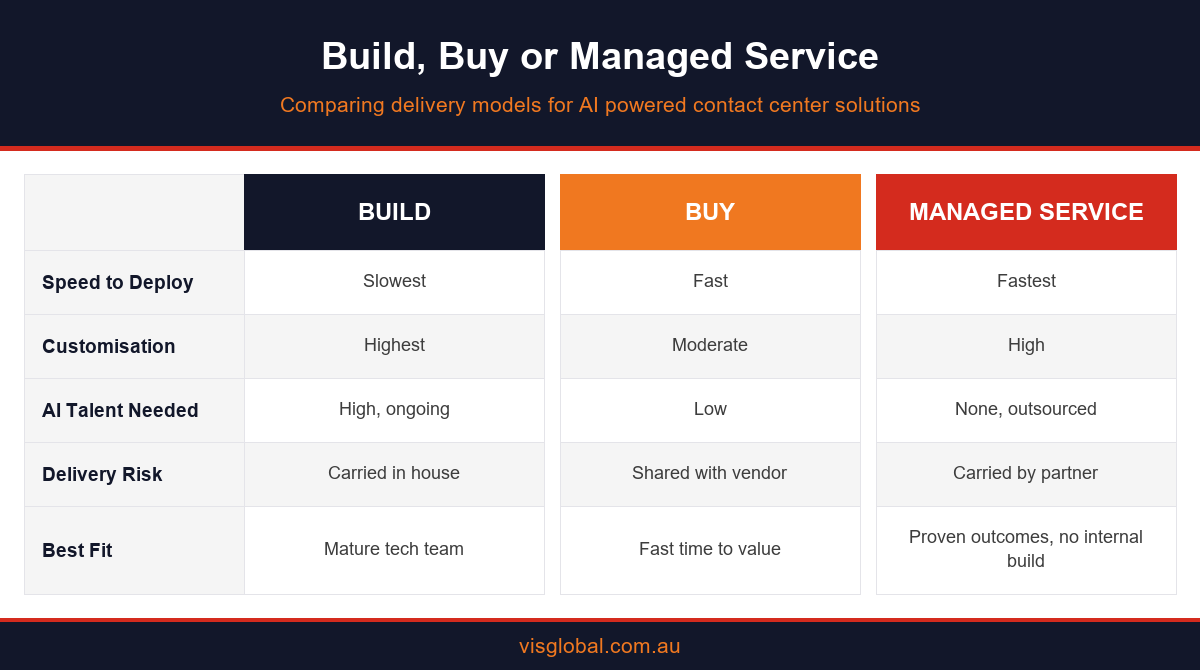
Once evaluation criteria and capabilities are clear, Australian enterprises face a delivery model decision that shapes cost, speed and risk for years. Broadly, there are three paths.
Building in house means assembling AI chatbots, voice bots and routing logic internally, typically on top of a cloud contact centre platform. This gives maximum control and customisation, but requires ongoing investment in AI engineering talent that is scarce and expensive in the current Australian market. It suits organisations with a mature internal technology function and a genuinely differentiated use case that off the shelf platforms cannot support.
Buying a platform outright gets capability live faster and shifts most technical risk to the vendor. Our guide on CCaaS versus on premise models breaks down that tradeoff in detail, but the short version is that cloud contact center platforms now handle most enterprise workloads well, while on premise remains relevant mainly where data residency or legacy integration constraints leave no alternative. Migrations between the two are increasingly common; see our step by step migration guide if a move to cloud is on your roadmap.
A managed service sits between the two. VIS Global's managed services model combines platform, AI capability and ongoing optimisation under a single accountable partner, which suits enterprises that want enterprise grade AI outcomes without building and retaining a specialist team internally. This is also where RPA and intelligent automation most often connect to the contact center, extending automation into the back office processes that determine whether a fast AI response actually resolves the customer's issue end to end.
Proof in Practice: The VIS Global Track Record
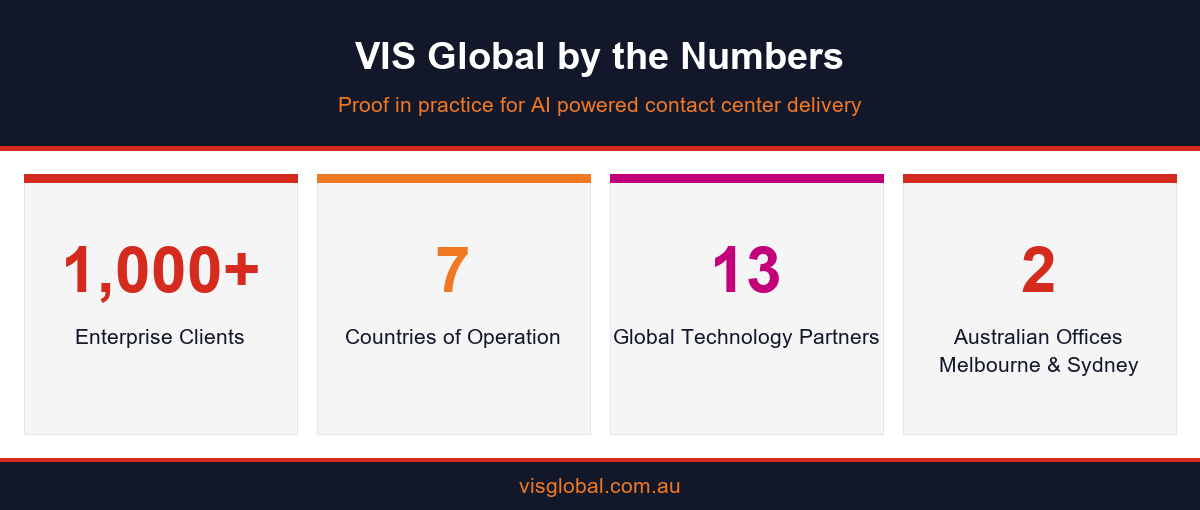
Frameworks and criteria only matter if a vendor can substantiate them with delivery history. VIS Global has implemented AI powered contact center solutions for more than 1,000 clients across 7 countries, backed by 13 global technology partnerships spanning the platforms Australian enterprises already run on. That scale matters for a specific reason: it means the evaluation criteria in this guide, integration depth, security posture, industry specific configuration, are not theoretical for VIS Global, they are documented delivery patterns repeated across banking, healthcare, government, retail and BPO engagements.
Deloitte Australia's research on the gap between AI investment and AI transformation at scale is exactly the gap VIS Global's model is built to close. Rather than a single product sold the same way to every buyer, VIS Global pairs customer experience management platforms with intelligent automation and digital workplace solutions, so contact center AI connects to the broader operational systems that determine whether automation actually reduces cost or simply relocates it. With offices in Melbourne and Sydney, VIS Global combines that global delivery experience with local Australian implementation and support, which matters when a regulator, an auditor or a customer complaint needs a fast, accountable response from a team that understands the local context. Enterprises comparing the best AI powered contact center solutions in Australia should ask any shortlisted vendor to produce reference clients of comparable size, in a comparable industry, delivered inside Australia, the same standard VIS Global is prepared to be measured against.
Pricing and ROI Expectations for AI Contact Center Investments
Pricing for AI powered contact center solutions varies more than most Australian enterprises expect, and comparing quotes without understanding the model behind them leads to bad decisions. Three pricing structures are common: per agent seat licensing, which is predictable but does not reward automation success; per interaction or per minute of AI usage, which scales with volume and rewards efficient automation; and outcome based pricing tied to metrics such as containment rate or resolution time, which aligns vendor incentives with enterprise results but requires mature measurement to administer fairly.
IDC research shows AI enabled customer service and self service is one of the fastest growing categories of enterprise AI spend, with contact center use cases increasingly outpacing generic infrastructure investment. That growth reflects a genuine return, but the return is not automatic or immediate. Gartner estimates conversational AI can reduce the cost of a voice interaction by roughly 90 to 95 percent compared with a fully human handled call, yet enterprises typically see measurable ROI emerge over two to four quarters, not in the first month, as agents are retrained, workflows are redesigned and automation confidence builds gradually.
Before signing, ask any vendor for a documented ROI model based on your actual call volumes and channel mix, not an industry average. Review our analysis of AI in customer experience ROI and the measurable impact of contact center automation on both customer and employee satisfaction, since employee retention savings are frequently left out of pricing conversations entirely, despite being one of the largest realistic gains.
How to Shortlist and Evaluate Vendors: A Practical Checklist
Bringing this guide together, use the following checklist to run a structured, defensible AI powered contact center evaluation rather than a series of unstructured vendor calls.
- Score every vendor against the same written criteria covering integration, security, scalability and governance, not informal impressions from a single demo.
- Test AI chatbots and virtual agents against your own historical transcripts, not a scripted vendor demo, and measure containment rate alongside customer satisfaction.
- Validate voice biometrics accuracy under real call center noise conditions and confirm data handling meets Australian privacy obligations.
- Confirm intelligent routing logic against your actual channel mix and peak volume patterns, including unplanned spikes.
- Match delivery model, build, buy, or managed service, to your internal technical capacity and risk appetite.
- Request Australian reference clients in your specific industry, not generic international case studies.
- Model pricing and ROI against your own call volumes rather than accepting an industry average projection.
- Confirm implementation includes change management and staff training, not technical deployment alone.
Once shortlisted, contact VIS Global to benchmark your requirements against a vendor with more than 1,000 enterprise clients across 7 countries and 13 global technology partnerships.
Conclusion
Choosing among AI powered contact center solutions is no longer a technology decision alone. It is a governance, workforce and customer trust decision that Australian enterprises across banking, healthcare, government, retail and BPO need to get right the first time. Use the evaluation framework, capability tests and shortlist checklist in this guide to move past vendor demos and into a defensible, documented decision. VIS Global has delivered AI powered contact center solutions to more than 1,000 clients across 7 countries through 13 global technology partnerships, with local implementation and support from Melbourne and Sydney. If you are ready to benchmark your requirements against that track record, contact our team to start a structured evaluation built around your industry, your channel mix and your compliance obligations, not a generic sales deck. Explore more insights on our blog as you continue your research.