AI Contact Center Solutions Australia: The Complete Enterprise Guide for 2026
 AI & Customer Experience
Introduction
Customer expectations have changed dramatically over the past few years. Australian consumers now expect businesses to provide fast, personalized, and seamless support across multiple channels, whether they're calling a contact centre, starting a live chat, sending an email, or reaching out through social media. At the same time, organizations are facing rising operational costs, increasing customer inquiries, and ongoing pressure to improve service quality while maintaining efficiency.
Artificial Intelligence (AI) has become one of the most transformative technologies helping businesses meet these challenges. Rather than replacing human agents, AI enhances customer service by automating repetitive tasks, providing intelligent recommendations to agents, analyzing conversations in real time, and ensuring customers receive faster and more accurate responses.
Across Australia, organizations in healthcare, government, financial services, retail, education, logistics, and professional services are investing in AI-powered contact centre solutions to improve customer experiences while reducing operational costs. These intelligent platforms combine conversational AI, machine learning, natural language processing (NLP), predictive analytics, and automation to deliver highly efficient and scalable customer support.
Modern AI contact centres are no longer limited to handling phone calls. They support voice, email, live chat, SMS, social media, messaging applications, video consultations, and self-service portals through a unified customer experience platform. Customers can move between channels without repeating information, while agents gain complete visibility into every interaction.
As organizations continue embracing hybrid work models and cloud-first strategies, AI-powered contact centres have become an essential component of digital workplace transformation. Integrated with platforms such as Microsoft Teams, Microsoft Dynamics 365, Azure AI, CRM systems, and enterprise collaboration tools, they help organizations streamline operations while delivering exceptional customer experiences.
This comprehensive guide explores everything Australian businesses need to know about AI contact centre solutions, including:
What AI contact centres are and how they work
Core technologies powering intelligent customer service
Business benefits across different industries
Microsoft Teams integration
Implementation best practices
Security and compliance considerations
Future trends shaping customer experience
How to choose the right AI contact centre solution
Whether you're modernizing an existing contact centre or planning a new digital customer engagement strategy, this guide provides practical insights to help you make informed decisions.
What Is an AI Contact Center?
An AI contact centre is a modern customer engagement platform that combines artificial intelligence with cloud communication technologies to automate, optimize, and enhance customer interactions across multiple communication channels. Unlike traditional call centres that rely almost entirely on human agents, AI-powered contact centres intelligently distribute work between automation and human expertise. Routine tasks such as answering frequently asked questions, routing enquiries, collecting customer information, scheduling appointments, and updating account details can be handled automatically, allowing agents to focus on complex, high-value conversations.
Rather than functioning as a replacement for customer service teams, AI serves as an intelligent assistant that improves productivity while enabling faster and more personalized customer interactions.
Today's AI contact centres support a wide range of communication channels, including:
Voice calls
Live chat
Email
SMS
WhatsApp
Microsoft Teams
Video meetings
Social media messaging
Self-service portals
This omnichannel approach ensures customers receive consistent experiences regardless of how they choose to communicate.
Traditional Contact Centres vs AI Contact Centres
Many Australian organizations still operate legacy contact centres built around telephone-based customer support. While these systems continue to serve an important purpose, they often struggle to meet modern customer expectations. Traditional contact centres typically depend on manual processes, lengthy wait times, and limited customer insights. Agents spend valuable time completing repetitive administrative tasks instead of solving customer problems. AI-powered contact centres transform this experience by introducing intelligent automation into every stage of the customer journey.
How AI Contact Centers Work
Behind every AI contact centre is a collection of intelligent technologies working together to understand customer intent, automate workflows, and provide actionable insights.
A typical AI-powered customer interaction follows these steps:
A customer contacts the business through phone, chat, email, or another supported channel.
AI identifies the customer's intent using natural language processing.
The system authenticates the customer and retrieves relevant information from connected business applications.
If the request is straightforward, the AI resolves it automatically.
For more complex issues, the conversation is seamlessly transferred to a human agent, along with the complete interaction history.
During the conversation, AI provides real-time suggestions, knowledge articles, and next-best actions to assist the agent.
Once the interaction concludes, AI generates summaries, categorizes the enquiry, updates CRM records, and provides analytics for continuous improvement.
This intelligent workflow minimizes customer effort while improving operational efficiency.
Key Components of an AI Contact Center
An enterprise AI contact centre consists of several interconnected technologies that work together to deliver exceptional customer experiences.
Conversational AI
Conversational AI enables systems to understand natural language and engage customers through voice and text-based interactions. Unlike rule-based chatbots, modern conversational AI understands context, intent, and conversation history.
Intelligent Virtual Agents
Virtual agents handle routine customer enquiries without human intervention. They can answer common questions, process requests, schedule appointments, and assist customers 24 hours a day.
AI-Powered Call Routing
Instead of routing calls based solely on department or availability, AI evaluates customer intent, previous interactions, sentiment, language preferences, and agent expertise to connect customers with the most suitable representative.
Agent Assist
During live conversations, AI provides agents with recommended responses, relevant knowledge articles, compliance reminders, and suggested actions, helping reduce handling times while improving service quality.
Speech Analytics
AI continuously analyzes customer conversations to identify trends, emotions, recurring issues, compliance risks, and coaching opportunities.
Predictive Analytics
Predictive AI analyzes historical customer interactions to forecast future service demand, optimize workforce scheduling, and proactively identify potential customer issues.
Why AI Contact Centers Matter in Australia
Australian businesses are experiencing rapid digital transformation driven by increasing customer expectations, hybrid work environments, and growing competition. Organizations are expected to provide exceptional service while maintaining operational efficiency and meeting strict security and compliance requirements.
AI contact centres help address these challenges by enabling organizations to:
Deliver faster response times.
Reduce operational costs.
Improve customer satisfaction.
Support hybrid and remote workforces.
Gain deeper customer insights.
Increase first-contact resolution rates.
Enhance employee productivity.
Scale operations without proportionally increasing staffing levels.
For enterprises, AI contact centres are no longer a future investment—they are becoming a strategic necessity for delivering consistent, high-quality customer experiences.
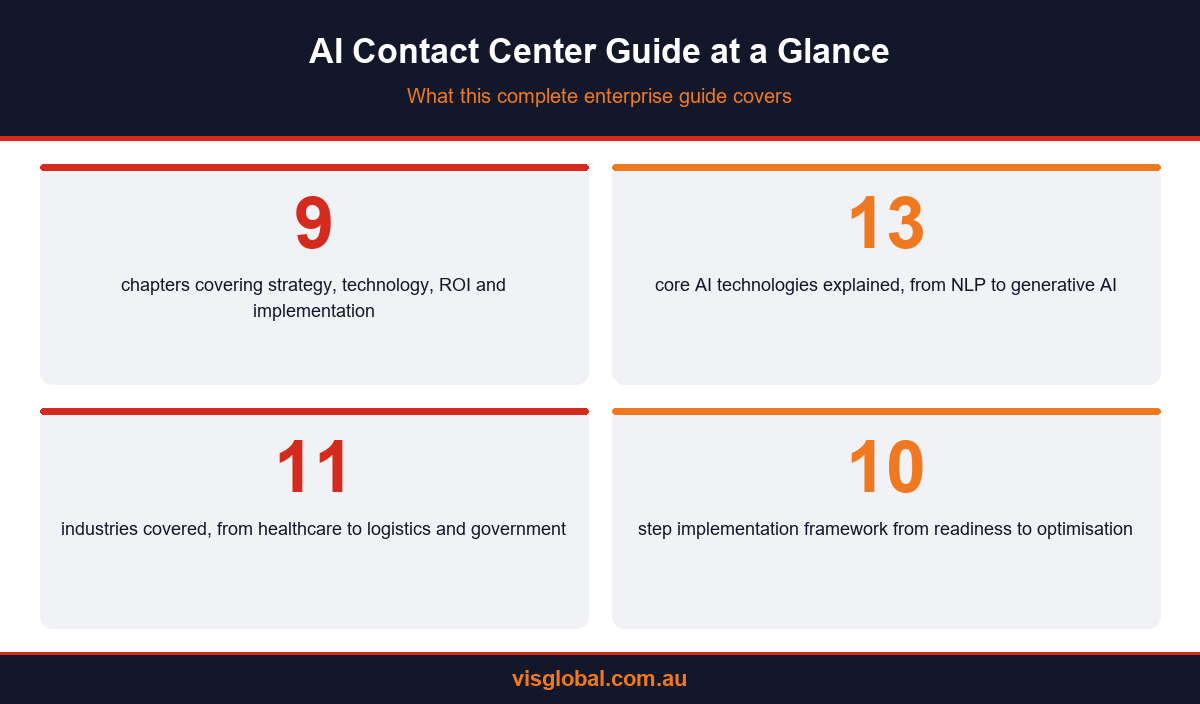
AI Contact Center Guide at a Glance — what this guide covers.
Why Australian Businesses Are Investing in AI Contact Center Solutions
The Rise of AI-Powered Customer Experience in Australia
Australia is undergoing a significant shift in how businesses manage customer interactions. As digital transformation accelerates across industries, customer expectations continue to evolve. Today's customers expect quick responses, personalized service, and the ability to engage with businesses across multiple channels—whether by phone, live chat, email, SMS, or social media.
At the same time, organizations face increasing pressure to control costs, address workforce shortages, and maintain consistently high service standards. These challenges have made AI-powered contact center solutions a strategic investment for businesses seeking to modernize customer engagement.
Unlike traditional contact centers that rely heavily on manual processes, AI-enabled platforms automate routine tasks, assist agents with real-time insights, and provide valuable analytics that help organizations continually improve customer experiences.
From healthcare providers and financial institutions to government agencies, universities, retailers, and utilities, Australian organizations are embracing AI to create more responsive, scalable, and efficient customer service operations.
Why Customer Expectations Are Changing
Today's customers compare every interaction with the best digital experiences they encounter—not just within a specific industry.
Whether booking an appointment, checking an account balance, requesting technical support, or making a purchase, customers expect:
Immediate responses
Personalized interactions
Seamless transitions between communication channels
Consistent service regardless of location
Minimal waiting times
Faster issue resolution
When these expectations are not met, customer satisfaction declines, leading to reduced loyalty and missed business opportunities. AI helps bridge this gap by providing intelligent automation while ensuring human agents are available for more complex conversations.
The Digital Transformation of Australian Contact Centers
Over the past decade, Australian organizations have steadily transitioned from on-premises call centers to cloud-based contact center platforms. More recently, AI has become the next phase of this evolution.
Modern AI contact centers integrate with:
Cloud telephony platforms
Customer Relationship Management (CRM) systems
Enterprise Resource Planning (ERP) software
Collaboration platforms such as Microsoft Teams
Workforce management tools
Business intelligence platforms
Knowledge management systems
This connected ecosystem allows organizations to deliver a unified customer experience while giving agents instant access to customer history and relevant information.
The Biggest Drivers Behind AI Adoption
Several factors are accelerating AI adoption across Australian contact centers.
1. Rising Customer Expectations
Customers increasingly expect businesses to resolve issues during the first interaction. Long wait times, repeated transfers, and having to explain the same issue multiple times can negatively affect customer satisfaction.
AI helps reduce friction by understanding customer intent, directing enquiries to the right resources, and providing agents with relevant information before conversations begin.
2. Workforce Challenges
Like many developed economies, Australia continues to experience skills shortages across customer service, healthcare, IT, and government sectors.
Recruiting and retaining experienced contact center agents has become increasingly difficult.
AI helps organizations by:
Automating repetitive enquiries
Supporting agents with real-time recommendations
Reducing administrative workloads
Improving employee satisfaction
Allowing teams to focus on higher-value customer interactions
Rather than replacing employees, AI enables smaller teams to manage higher enquiry volumes more effectively.
3. Cost Optimization
Running a traditional contact center can be expensive. Costs include staffing, infrastructure, training, quality assurance, compliance, and ongoing operational management.
AI helps reduce operational expenses by:
Automating common customer requests
Reducing average handling times
Improving first-contact resolution
Optimizing workforce scheduling
Minimizing after-call administrative tasks
These efficiencies allow organizations to scale customer service without proportionally increasing operating costs.
4. The Growth of Omnichannel Communication
Customers no longer rely solely on phone calls to contact businesses.
Today's contact centers manage conversations across:
Voice calls
Live chat
Email
SMS
WhatsApp
Social media messaging
Video meetings
Customer portals
Managing these channels independently often creates inconsistent customer experiences.
AI-powered omnichannel platforms consolidate interactions into a single workspace, giving agents complete visibility of every customer conversation regardless of the communication channel.
5. Hybrid and Remote Work
The adoption of hybrid work models has changed how customer service teams operate.Cloud-based AI contact centers enable agents to work securely from offices, homes, or remote locations while maintaining consistent customer experiences. Managers benefit from real-time dashboards, performance analytics, call monitoring, and workforce planning tools regardless of where employees are located. This flexibility has become an important competitive advantage for Australian organizations.
Business Benefits of AI Contact Centers
Organizations investing in AI-powered customer service solutions typically experience improvements across multiple operational areas.
Improved Customer Satisfaction
AI enables faster responses, personalized service, and quicker issue resolution, leading to higher customer satisfaction scores.
Increased Agent Productivity
Routine administrative tasks such as note-taking, call categorization, and knowledge searches are automated, allowing agents to spend more time solving customer problems.
Faster Resolution Times
AI assists agents by recommending solutions, retrieving customer history, and surfacing relevant knowledge articles during live conversations.
Better Decision-Making
AI analytics provide valuable insights into customer behaviour, call trends, operational performance, and service quality.
These insights help leaders make informed decisions about staffing, training, and process improvements.
Enhanced Business Continuity
Cloud-based AI contact centers improve resilience by enabling remote operations, supporting disaster recovery strategies, and maintaining service continuity during unexpected disruptions.
AI Adoption Across Australian Industries
AI-powered contact centers are delivering measurable benefits across a wide range of sectors.
Why AI Is Becoming a Strategic Priority
Many Australian organizations no longer view AI as a standalone technology project. Instead, it has become a key component of broader digital transformation strategies.
Executive leaders increasingly evaluate AI investments based on their ability to:
Improve customer experience
Increase operational efficiency
Reduce costs
Strengthen business resilience
Support workforce productivity
Enable data-driven decision-making
Enhance competitive advantage
As AI technologies continue to mature, businesses that delay adoption may find it increasingly difficult to meet customer expectations and remain competitive.
How AI Supports Human Agents
A common misconception is that AI replaces customer service professionals. In reality, successful AI contact centers are designed to augment human expertise rather than replace it.
AI supports agents by:
Providing real-time recommendations
Suggesting relevant knowledge articles
Automatically summarizing conversations
Detecting customer sentiment
Recommending next-best actions
Highlighting compliance requirements
Reducing repetitive administrative tasks
This collaboration allows agents to focus on empathy, complex problem-solving, and relationship building—areas where human interaction remains essential.
Preparing for the Future
The adoption of AI in Australian contact centers is expected to accelerate as technologies such as generative AI, intelligent virtual agents, predictive analytics, and conversational AI continue to evolve.
Organizations that invest in modern AI-powered customer engagement platforms today will be better positioned to:
Deliver exceptional customer experiences
Respond quickly to changing market demands
Support distributed workforces
Improve operational efficiency
Scale customer service without compromising quality
For Australian enterprises, AI is no longer an emerging trend—it is becoming the foundation of the next generation of customer experience.
Key Takeaways
Customer expectations for speed, personalization, and omnichannel service are driving AI adoption across Australia.
AI contact centers help organizations reduce costs, improve productivity, and enhance customer satisfaction.
Cloud-based AI platforms enable secure hybrid work and support business continuity.
Industries including healthcare, finance, government, retail, education, and logistics are using AI to transform customer engagement.
AI works alongside human agents, automating repetitive tasks while enabling employees to focus on high-value interactions.
Core Technologies Behind AI Contact Center Solutions
Understanding the Intelligence Behind Modern Contact Centers
Artificial Intelligence has transformed contact centres from reactive customer support environments into intelligent customer engagement platforms. While customers often experience AI through chatbots or virtual assistants, the technology behind a modern AI contact centre is far more comprehensive. Today's AI-powered contact centres combine multiple technologies-including Natural Language Processing (NLP), Machine Learning (ML), Large Language Models (LLMs), speech analytics, predictive analytics, computer vision, workflow automation, and conversational AI—to improve every stage of the customer journey. Rather than functioning as separate tools, these technologies work together to analyse customer intent, automate repetitive tasks, assist human agents, and continuously improve operational performance. Understanding these core technologies helps organisations make informed investment decisions and select solutions that align with their long-term customer experience strategy.
Natural Language Processing (NLP)
Natural Language Processing (NLP) enables computers to understand, interpret, and respond to human language in a meaningful way. It allows AI systems to recognise what customers are asking - even when questions are phrased differently or contain spelling mistakes, abbreviations, or conversational language.
For example, the following requests all express the same intent:
"I need help with my invoice."
"Where can I see my bill?"
"Why was I charged this month?"
"Can someone explain my latest payment?"
An NLP-powered AI contact centre recognises that each enquiry relates to billing and routes it appropriately.
Benefits of NLP
Understands customer intent instead of relying on exact keywords.
Supports natural conversations through voice and text.
Improves chatbot accuracy.
Reduces call transfers.
Enables multilingual customer support.
For Australian businesses serving diverse communities, NLP also helps deliver consistent service across multiple languages and communication channels.
Conversational AI
Conversational AI builds on NLP by enabling two-way interactions between customers and AI-powered virtual assistants. Unlike traditional rule-based chatbots that follow rigid decision trees, conversational AI can maintain context, ask clarifying questions, and adapt responses throughout a conversation. For example, if a customer says:
"I need to change my appointment."
The AI may respond:
"Certainly. Could you tell me the date of your current appointment?"
After receiving the answer, the system can retrieve booking details, suggest available time slots, and confirm the updated appointment - all without requiring a human agent.
Business Benefits
Faster issue resolution.
Reduced waiting times.
Improved self-service.
Consistent customer experiences.
Higher first-contact resolution rates.
Large Language Models (LLMs)
Large Language Models are a newer generation of AI capable of understanding context, generating natural responses, summarising conversations, drafting emails, and supporting customer service agents.
In contact centres, LLMs can:
Generate accurate conversation summaries.
Recommend customer responses.
Suggest knowledge base articles.
Assist agents during live interactions.
Rewrite customer communications in a professional tone.
Translate conversations across languages.
Identify customer intent with greater accuracy.
Rather than replacing existing workflows, LLMs enhance the capabilities of both customers and agents.
Machine Learning
Machine Learning enables AI systems to improve over time by analysing historical data and recognising patterns. Instead of relying solely on predefined rules, ML continuously learns from customer interactions to improve decision-making.
Examples include:
Predicting call volumes.
Recommending the best agent for a specific enquiry.
Identifying customers at risk of leaving.
Detecting unusual behaviour that may indicate fraud.
Forecasting staffing requirements.
The more relevant data the system processes, the more accurate its predictions become.
Speech Recognition
Speech recognition converts spoken conversations into text in real time. This capability allows AI to understand voice interactions, trigger automated workflows, and analyse customer conversations.
Modern speech recognition systems support:
Voice commands.
Automated call routing.
Voice search.
Real-time transcription.
Accessibility improvements.
For organisations handling thousands of customer calls each day, speech recognition creates a searchable record of every interaction, improving compliance and quality assurance.
Speech Analytics
Once conversations are transcribed, AI can analyse them to uncover valuable business insights.
Speech analytics identifies:
Frequently discussed topics.
Customer sentiment.
Compliance issues.
Escalation triggers.
Product feedback.
Coaching opportunities for agents.
Managers can quickly identify recurring issues, monitor service quality, and make informed operational improvements.
Sentiment Analysis
Customer satisfaction is influenced not only by what is said but also by how it is said. Sentiment analysis evaluates language, tone, and context to determine whether a customer is frustrated, satisfied, confused, or at risk of escalating the conversation.
For example, repeated use of phrases such as "I've called three times" or "This still isn't resolved" may indicate growing frustration.
AI can automatically flag these conversations and prioritise them for experienced agents, helping reduce complaints and improve customer outcomes.
Intelligent Call Routing
Traditional call routing often directs customers based on simple rules, such as department or queue availability. AI-powered routing goes much further by analysing:
Customer intent.
Previous interactions.
Language preferences.
Account history.
Agent expertise.
Current workload.
Customer priority.
This ensures enquiries are matched with the most appropriate agent from the outset, reducing transfers and improving resolution times.
Agent Assist
Agent Assist is one of the most valuable AI capabilities in a modern contact centre. During live conversations, AI continuously analyses customer dialogue and provides real-time guidance to agents.
Typical features include:
Suggested responses.
Knowledge article recommendations.
Compliance reminders.
Product information.
Next-best action suggestions.
Automated note-taking.
This enables agents to resolve issues more efficiently while maintaining consistent service quality.
Predictive Analytics
Predictive analytics uses historical and real-time data to forecast future customer service requirements.
It can help organisations:
Predict seasonal spikes in enquiries.
Optimise staffing schedules.
Anticipate customer behaviour.
Identify service bottlenecks.
Forecast operational costs.
Rather than reacting to customer demand, businesses can proactively prepare for it.
Workflow Automation
AI contact centres automate many repetitive administrative processes that traditionally consume valuable agent time.
Examples include:
Ticket creation.
CRM updates.
Appointment scheduling.
Follow-up emails.
Case categorisation.
Escalation workflows.
Customer notifications.
Automation improves consistency while reducing manual effort and human error.
AI-Powered Knowledge Management
Finding accurate information quickly is essential for delivering excellent customer service.
AI-powered knowledge management systems automatically surface the most relevant documents, FAQs, policies, and procedures based on the customer's enquiry.
This reduces search time and helps ensure customers receive accurate, consistent information regardless of which agent they speak with.
Computer Vision (Emerging Capability)
Some industries are beginning to integrate computer vision into customer service workflows. This technology enables AI to analyse images and video submitted by customers.
Examples include:
Assessing damaged products for warranty claims.
Verifying identity documents.
Supporting remote technical troubleshooting.
Assisting healthcare professionals with image-based enquiries.
While still emerging in many contact centres, computer vision is expected to play a growing role in industries requiring visual verification.
Bringing the Technologies Together
The true power of an AI contact centre lies not in any single technology but in how these capabilities work together to deliver seamless customer experiences.
Imagine a customer calling to report an issue:
Speech recognition converts the conversation into text.
NLP identifies the customer's intent.
Conversational AI gathers additional information.
Intelligent routing connects the customer to the best-qualified agent.
Agent Assist provides relevant knowledge articles and recommended responses.
Sentiment analysis detects customer frustration and prioritises the interaction.
Workflow automation updates the CRM and creates a support ticket.
Generative AI summarises the conversation once the call ends.
Analytics capture insights for future service improvements.
This integrated approach enables faster resolutions, better customer experiences, and more efficient operations.
Why These Technologies Matter for Australian Enterprises
Australian organisations are increasingly expected to provide fast, secure, and personalised customer service while managing rising operational costs and supporting hybrid workforces.
By combining conversational AI, predictive analytics, workflow automation, and intelligent agent assistance, modern contact centres enable businesses to:
Deliver consistent omnichannel experiences.
Reduce operational costs through automation.
Improve customer satisfaction and loyalty.
Support remote and hybrid work environments.
Gain actionable insights from customer interactions.
Scale customer service operations without compromising quality.
As AI continues to evolve, organisations that understand and effectively adopt these technologies will be better positioned to meet changing customer expectations and maintain a competitive advantage.
AI Contact Center Architecture and Essential Features
Building an Intelligent Customer Engagement Ecosystem
An AI contact center is more than just a phone system with automation. It is an integrated customer engagement platform that connects communication channels, artificial intelligence, business applications, analytics, and human expertise into a unified ecosystem.
Modern enterprises interact with customers through voice calls, emails, live chat, social media, messaging apps, SMS, video meetings, and self-service portals. Without a centralized platform, these interactions often become fragmented, leading to inconsistent customer experiences, duplicate work, and limited visibility.
AI contact center architecture brings these systems together into a single intelligent environment where every customer interaction contributes to a complete customer profile and improved service delivery.
Instead of simply answering customer enquiries, AI continuously learns from every interaction, helping organizations improve operational efficiency, customer satisfaction, and employee productivity.
Understanding AI Contact Center Architecture
A modern AI contact center consists of several interconnected layers working together.
Customer
↓
Communication Channels
Phone
Chat
SMS
Microsoft Teams
Video
Social Media
↓
AI Intelligence Layer
Natural Language Processing
Conversational AI
Voice AI
Machine Learning
Generative AI
Agent Assist
Automation Engine
↓
Business Applications
CRM
ERP
Knowledge Base
Ticketing System
Identity Management
↓
Human Agents
↓
Analytics & Reporting
↓
Business Intelligence
Each layer plays a critical role in delivering intelligent customer experiences.
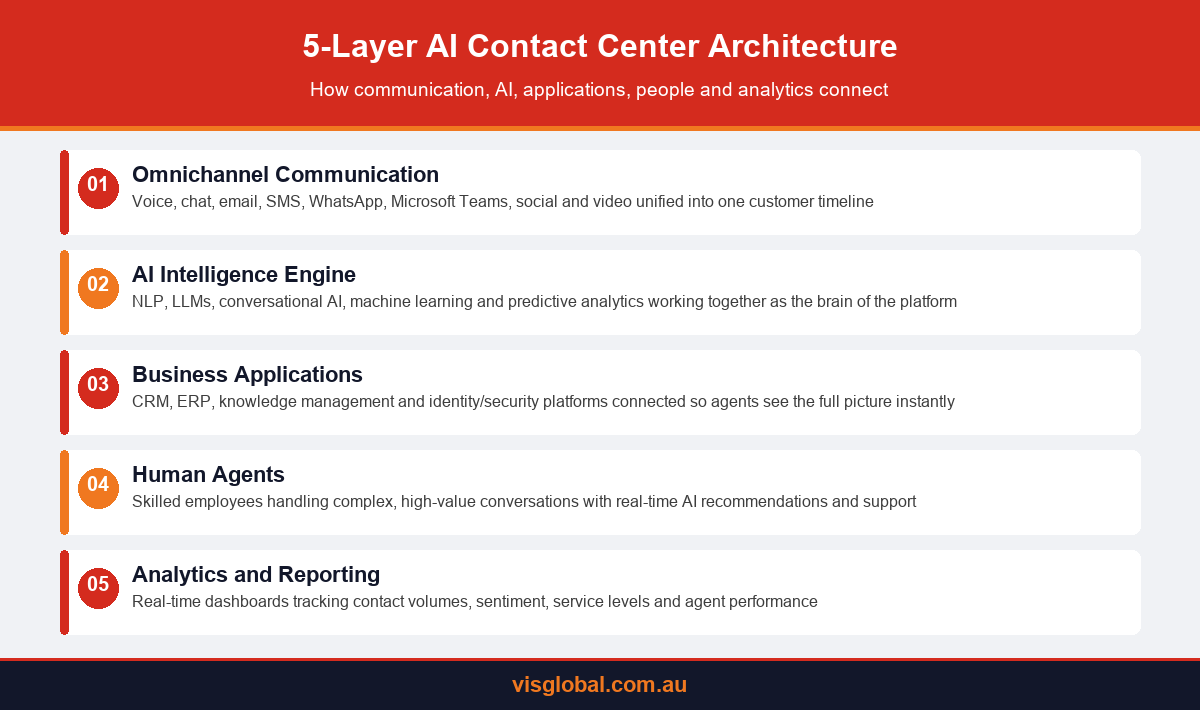
Layer 1: Omnichannel Communication
Customers expect businesses to communicate through the channel that is most convenient for them.
An AI contact center supports interactions across:
Voice calls
Live chat
Email
SMS
WhatsApp
Microsoft Teams
Facebook Messenger
Social media
Video conferencing
Customer portals
Rather than treating each channel independently, AI consolidates all conversations into a single customer timeline.
This means a customer can:
Begin with live chat
Continue over email
Call the contact center
Receive SMS updates
without repeating information.
For businesses, this creates a seamless customer journey while improving service consistency.
Layer 2: AI Intelligence Engine
The AI layer acts as the brain of the contact center.
It continuously analyzes customer conversations to determine:
Customer intent
Emotional sentiment
Urgency
Language
Historical interactions
Preferred communication channel
Customer value
Previous support history
Using this information, AI determines the most effective way to resolve each enquiry.
The intelligence layer typically includes:
Natural Language Processing (NLP)
Large Language Models (LLMs)
Conversational AI
Machine Learning
Predictive Analytics
Voice Recognition
Sentiment Analysis
These technologies work together to automate routine tasks while supporting human agents during more complex interactions.
Layer 3: Business Applications
AI becomes significantly more valuable when integrated with existing business systems.
Common integrations include:
Customer Relationship Management (CRM)
Examples include Microsoft Dynamics 365, Salesforce, HubSpot, and Zoho CRM.
Integration allows agents to instantly access:
Customer profiles
Purchase history
Previous interactions
Open cases
Contracts
Account information
without switching between multiple applications.
Enterprise Resource Planning (ERP)
Connecting ERP systems enables AI to retrieve:
Order status
Inventory availability
Shipping updates
Billing information
Product details
Customers receive faster and more accurate responses because the information is retrieved automatically.
Knowledge Management Systems
Knowledge bases contain:
FAQs
Product documentation
Policies
Troubleshooting guides
Internal procedures
AI automatically recommends the most relevant articles based on the conversation, reducing search time for agents.
Identity and Security Platforms
Enterprise contact centers often integrate with identity management systems to support:
Single Sign-On (SSO)
Multi-Factor Authentication (MFA)
Secure customer verification
Access management
Audit logging
These capabilities are especially important for healthcare, financial services, and government organizations.
Layer 4: Human Agents
Despite rapid advances in AI, human expertise remains essential.
AI handles repetitive and predictable enquiries while escalating complex situations to skilled agents.
Examples include:
Financial advice
Medical consultations
Complaint resolution
Technical troubleshooting
Crisis management
Legal enquiries
During conversations, AI assists agents by providing:
Customer history
Recommended responses
Knowledge articles
Compliance reminders
Suggested next actions
Real-time transcription
This improves consistency while allowing agents to focus on empathy and problem-solving.
Layer 5: Analytics and Reporting
Every customer interaction generates valuable operational data.
AI continuously collects information including:
Call volumes
Customer satisfaction
Resolution times
Agent performance
Common customer issues
Peak traffic periods
Escalation rates
Service quality
Interactive dashboards provide leaders with real-time visibility into contact center performance.
These insights support continuous improvement and better strategic decision-making.
Essential Features Every AI Contact Center Should Include
Selecting an AI contact center involves more than comparing software vendors. Organizations should evaluate capabilities that improve customer experience, employee productivity, security, and long-term scalability.
Omnichannel Customer Engagement
Customers should be able to move between communication channels without losing conversation history. A unified interaction history ensures every agent has complete context regardless of where the conversation began.
Intelligent Call Routing
AI evaluates multiple factors before routing interactions, including:
Customer intent
Language preferences
Agent skills
Previous interactions
Customer priority
Availability
This reduces unnecessary transfers and improves first-contact resolution.
AI Virtual Agents
Virtual agents provide 24/7 customer support by handling routine enquiries such as:
Appointment booking
Order tracking
Password resets
Billing questions
Account updates
Frequently asked questions
Human agents become available for more valuable interactions.
Voice AI
Voice AI enables customers to interact naturally instead of navigating lengthy touch-tone menus. Customers simply explain their issue in their own words.
The system understands the request and directs them appropriately.
Agent Assist
Agent Assist improves productivity by providing:
Live coaching
Suggested responses
Compliance prompts
Relevant documents
Automatic note generation
Next-best-action recommendations
This reduces training requirements while improving service consistency.
Automatic Call Summaries
Instead of manually documenting conversations, AI generates concise summaries immediately after each interaction.
Benefits include:
Reduced administrative work
Improved CRM accuracy
Faster wrap-up times
Better reporting
Workforce Management
AI forecasting helps organizations predict:
Staffing requirements
Seasonal demand
Peak contact periods
Agent schedules
Managers can optimize workforce planning while reducing operational costs.
Real-Time Analytics
Modern dashboards provide insights into:
Average Handle Time (AHT)
First Contact Resolution (FCR)
Customer Satisfaction (CSAT)
Service Level Agreements (SLAs)
Agent occupancy
Queue performance
Abandonment rates
Leaders can monitor performance continuously rather than waiting for end-of-month reports.
Security and Compliance
Australian enterprises require enterprise-grade security.
Essential capabilities include:
End-to-end encryption
Role-based access control
Multi-factor authentication
Data loss prevention
Call recording controls
Audit logging
Compliance monitoring
These features help organizations protect customer information while meeting regulatory obligations.
Scalability
Cloud AI contact centers allow organizations to:
Add new users quickly
Support multiple locations
Expand internationally
Introduce new communication channels
Handle seasonal demand
Scalability ensures organizations can grow without replacing their customer engagement platform.
Cloud vs On-Premises AI Contact Centers
Many Australian businesses are transitioning from legacy on-premises infrastructure to cloud-based platforms.
Feature | On-Premises | Cloud AI Contact Center |
Initial Investment | High | Lower subscription-based costs |
Deployment Speed | Several months | Often completed within weeks |
Maintenance | Managed internally | Managed by provider |
Scalability | Limited | Highly scalable |
Software Updates | Manual | Automatic |
Remote Work Support | Limited | Built for hybrid work |
Disaster Recovery | Customer-managed | Built-in resilience |
For most organizations, cloud deployments provide greater flexibility, faster innovation, and reduced infrastructure management.
Why Architecture Matters
A well-designed AI contact center architecture ensures technology, people, and business processes work together seamlessly. Rather than investing in isolated tools, organizations gain an integrated platform that supports consistent customer experiences, operational efficiency, and future growth. As customer expectations continue to evolve, businesses need flexible, secure, and intelligent systems that can adapt to new communication channels, AI capabilities, and changing business requirements.
Key Takeaways
An AI contact center integrates communication channels, AI technologies, business applications, analytics, and human expertise into a unified platform.
Omnichannel engagement ensures customers receive consistent service across voice, chat, email, messaging, and social media.
Core enterprise features include intelligent routing, virtual agents, Agent Assist, real-time analytics, workflow automation, and robust security.
Cloud-based architectures provide greater scalability, resilience, and support for hybrid workforces compared with traditional on-premises systems.
A strong architectural foundation enables organizations to deliver exceptional customer experiences while preparing for future AI innovations.
AI Contact Center vs Traditional Contact Center – A Complete Comparison
Why Businesses Are Moving Beyond Traditional Contact Centers
For decades, traditional contact centers have been the backbone of customer service. They enabled organizations to manage inbound and outbound calls, resolve customer issues, and support business operations at scale. While these systems continue to play an important role, they were designed for a different era—one where customer interactions were largely limited to telephone calls, business hours, and manual processes.
Today's customers expect instant responses, personalized experiences, and the flexibility to communicate through multiple channels, including voice, live chat, email, messaging apps, and social media. They also expect organizations to remember previous interactions, regardless of how they choose to make contact.Meeting these expectations with legacy infrastructure can be difficult. Traditional contact centers often rely on disconnected systems, manual workflows, and limited automation, leading to longer wait times, inconsistent service, and higher operational costs.
AI-powered contact centers address these challenges by combining cloud technology, automation, advanced analytics, and intelligent decision-making into a unified customer engagement platform.
What Is a Traditional Contact Center?
A traditional contact center is primarily designed to manage customer interactions through voice calls. Agents typically answer enquiries using desktop telephones connected to on-premises Private Branch Exchange (PBX) systems and manually access customer information from separate applications. Although many organizations have modernized certain aspects of these environments, the underlying operating model remains heavily dependent on human intervention.
Typical characteristics include:
Separate communication channels
Limited customer history
Reactive customer service
Fixed business hours
On-premises infrastructure
Manual reporting
High reliance on agent availability
While effective for straightforward customer support, these systems often struggle to meet modern expectations for speed, personalization, and omnichannel engagement.
What Is an AI Contact Center?
An AI contact center combines cloud communications with artificial intelligence to automate routine interactions, assist customer service representatives, and provide organizations with real-time operational insights. Instead of relying solely on human agents, AI works alongside customer service teams by handling repetitive enquiries, recommending responses, generating summaries, analysing conversations, and routing customers intelligently. The result is a more efficient, scalable, and customer-centric service model.
Traditional Contact Center vs AI Contact Center
The differences between traditional and AI-powered contact centers extend well beyond technology. They influence every aspect of customer experience, operational efficiency, and business performance.
Feature | Traditional Contact Center | AI Contact Center |
Customer Support | Primarily voice-based | Omnichannel support across voice, chat, email, SMS, social media, and video |
Availability | Business hours | 24/7 intelligent customer support |
Call Routing | Manual or rules-based | AI-powered intent-based routing |
Customer Experience | Reactive | Personalized and proactive |
Agent Productivity | Manual processes | AI-assisted workflows |
Reporting | Historical reports | Real-time analytics and dashboards |
Knowledge Access | Manual search | AI-powered knowledge recommendations |
Scalability | Infrastructure dependent | Cloud-based and highly scalable |
Operational Costs | Higher staffing requirements | Greater automation and cost efficiency |
Continuous Improvement | Manual optimization | AI-driven learning and optimization |
Customer Experience
Customer experience has become one of the most important competitive differentiators for modern organizations.
Traditional contact centers often require customers to:
Navigate lengthy IVR menus
Wait in queues
Repeat information to multiple agents
Call back during business hours
Switch between disconnected communication channels
These experiences can lead to frustration, reduced customer satisfaction, and lower loyalty.
AI contact centers improve customer journeys by:
Understanding customer intent through natural language.
Providing instant responses through virtual assistants.
Preserving conversation history across channels.
Routing customers to the most appropriate agent.
Offering personalized recommendations based on previous interactions.
The result is a smoother, more convenient customer experience.
Agent Productivity
Customer service representatives spend a significant portion of their day completing repetitive administrative tasks.
These often include:
Searching for information
Taking notes
Updating CRM systems
Categorizing enquiries
Writing follow-up emails
Summarizing conversations
AI automates many of these activities, allowing agents to focus on building relationships and solving complex customer issues.
With Agent Assist capabilities, employees receive:
Suggested responses
Relevant knowledge articles
Customer history
Compliance reminders
Recommended next actions
Automatic conversation summaries
This reduces handling times while improving service consistency.
Operational Efficiency
Efficiency improvements represent one of the strongest business cases for AI adoption.
Traditional contact centers often rely on manual processes that increase workload and limit scalability.
AI introduces automation across multiple operational areas.
Examples include:
Intelligent call routing
Virtual agents
Appointment scheduling
Ticket creation
CRM updates
Workforce forecasting
Quality assurance
Performance reporting
By automating repetitive tasks, organizations can manage growing enquiry volumes without proportionally increasing staffing levels.
Cost Comparison
Reducing operational costs is a major driver of AI adoption.
Traditional contact centers require significant investments in:
Physical infrastructure
Telephone systems
Maintenance
Hardware upgrades
Staffing
Training
Quality monitoring
Cloud-based AI contact centers reduce many of these expenses through automation and subscription-based delivery models.
Cost savings may result from:
Lower infrastructure costs
Reduced manual administration
Improved workforce utilization
Faster customer resolution
Fewer repeat contacts
Reduced agent turnover through improved employee experience
While AI implementation requires upfront planning and investment, many organizations achieve measurable long-term operational savings.
Business Scalability
Traditional contact centers often require new hardware, additional office space, and complex infrastructure upgrades as organizations grow.
AI contact centers offer significantly greater flexibility.
Organizations can:
Add new users quickly
Expand into new locations
Support remote employees
Introduce additional communication channels
Handle seasonal demand fluctuations
Integrate emerging AI capabilities
Cloud-based platforms allow businesses to scale customer service operations without major infrastructure investments.
Data and Analytics
Decision-making in traditional environments is often based on historical reports generated weekly or monthly.
AI contact centers provide real-time operational intelligence.
Managers can monitor:
Customer satisfaction
Average Handle Time (AHT)
First Contact Resolution (FCR)
Service levels
Queue performance
Customer sentiment
Agent productivity
Contact volumes
These insights support faster decision-making and continuous improvement.
Workforce Experience
Employee experience directly influences customer experience.
Traditional contact centers often contribute to agent fatigue due to repetitive administrative work and high call volumes.
AI improves the employee experience by:
Automating routine tasks
Providing live coaching
Reducing after-call work
Simplifying knowledge retrieval
Improving schedule planning
Delivering personalized learning recommendations
Empowered employees are more likely to provide exceptional customer service and remain engaged with their organization.
Security and Compliance
Organizations operating in sectors such as healthcare, financial services, government, and education must maintain strict security and compliance standards.
Modern AI contact centers support enterprise-grade security through features including:
End-to-end encryption
Role-based access controls
Multi-factor authentication
Secure identity verification
Call recording management
Audit logs
Compliance monitoring
Cloud providers also invest heavily in resilience, disaster recovery, and ongoing security updates, helping organizations maintain business continuity.
Business Agility
Markets, customer expectations, and technologies continue to evolve rapidly.
Traditional environments often require lengthy implementation cycles to introduce new capabilities.
AI contact centers enable organizations to adapt more quickly by supporting:
Rapid deployment of new communication channels
Integration with evolving business systems
Continuous AI model improvements
Faster software updates
Flexible workforce management
This agility allows businesses to respond more effectively to changing customer needs and market conditions.
Which Solution Is Right for Your Business?
Traditional contact centers may still meet the needs of smaller organizations with limited communication requirements or highly specialized workflows.
However, businesses experiencing growth, increasing customer expectations, or digital transformation initiatives are likely to benefit from AI-powered platforms.
An AI contact center is particularly valuable for organizations that:
Manage high interaction volumes.
Support customers across multiple communication channels.
Operate hybrid or remote workforces.
Need to improve customer satisfaction.
Want better visibility into operational performance.
Plan to scale without significantly increasing staffing costs.
By modernizing customer engagement, organizations can create more resilient, efficient, and customer-focused operations.
Key Takeaways
Traditional contact centers are effective for basic voice-based support but often struggle to meet modern customer expectations.
AI contact centers combine automation, analytics, and intelligent assistance to improve customer experiences and operational efficiency.
Organizations benefit from faster response times, improved agent productivity, lower operating costs, and enhanced scalability.
Cloud-based AI platforms provide greater flexibility, resilience, and support for hybrid work environments.
For many Australian enterprises, transitioning to an AI-powered contact center is becoming a strategic investment rather than a technology upgrade.
Industry Use Cases – How AI Contact Center Solutions Are Transforming Australian Businesses
AI Is Reshaping Customer Engagement Across Every Industry
Artificial Intelligence is no longer limited to technology companies or large multinational enterprises. Across Australia, organisations of every size are integrating AI into their customer service operations to improve efficiency, reduce costs, and deliver faster, more personalised experiences. From healthcare providers managing appointment requests to government agencies responding to citizen enquiries, AI contact centre solutions are helping organisations handle increasing customer expectations without compromising service quality.
One of the greatest strengths of AI is its flexibility. Modern platforms can be tailored to industry-specific workflows, regulatory requirements, communication channels, and operational goals. Rather than replacing human expertise, AI automates repetitive processes, provides intelligent insights, and enables employees to focus on complex, high-value interactions.
This chapter explores how different industries across Australia are using AI-powered contact centre solutions to modernise customer engagement and support long-term digital transformation.
Healthcare
Improving Patient Experience While Reducing Administrative Burden
Healthcare organisations manage thousands of patient interactions every day, including appointment scheduling, prescription enquiries, referrals, billing questions, telehealth support, and follow-up care. Administrative teams often spend significant time handling routine enquiries, reducing the time available for patient care.
AI contact centre solutions help healthcare providers streamline these interactions through intelligent automation while ensuring patients continue to receive compassionate, high-quality service.
Common Healthcare Use Cases
Appointment booking and rescheduling
Automated appointment reminders
Prescription refill requests
Patient enquiry management
Telehealth support
Specialist referral updates
Insurance verification
Post-treatment follow-up
Benefits
Reduced call volumes
Faster appointment scheduling
Improved patient satisfaction
Lower administrative costs
Better resource allocation
Enhanced patient engagement
Financial Services
Delivering Secure and Personalised Customer Support
Banks, credit unions, insurance providers, and financial institutions manage highly sensitive customer information while handling large volumes of enquiries.
Customers expect immediate assistance with account management, loans, payments, fraud alerts, and policy information.
AI enables secure, personalised service without increasing operational complexity.
Common Use Cases
Balance enquiries
Loan application support
Insurance claims updates
Fraud detection alerts
Payment assistance
Credit card activation
Identity verification
Customer onboarding
Benefits
Faster customer verification
Reduced fraud risk
Improved compliance
Shorter waiting times
Higher first-contact resolution
Enhanced customer trust
Government
Improving Citizen Services
Government agencies provide essential services to millions of Australians every year.
During peak periods, call centres often experience high enquiry volumes related to permits, registrations, taxation, licensing, community services, and public information. AI enables government organisations to improve accessibility while reducing operational pressure.
Common Use Cases
Public information enquiries
Licensing applications
Permit status updates
Benefits information
Emergency notifications
Community service requests
Appointment scheduling
Multilingual citizen support
Benefits
Improved accessibility
Reduced waiting times
Better resource utilisation
Consistent information delivery
Enhanced public satisfaction
Education
Supporting Students Throughout Their Learning Journey
Universities, colleges, and schools receive enquiries from prospective students, current students, parents, alumni, and staff.
Many questions involve admissions, enrolment, fees, IT support, accommodation, and academic services.
AI allows educational institutions to provide timely support throughout the student lifecycle.
Common Use Cases
Admissions enquiries
Course information
Enrolment assistance
Student portal support
Fee payment guidance
Timetable enquiries
IT help desk
Graduation information
Benefits
Faster response times
Reduced administrative workload
Better student experience
Increased operational efficiency
Improved self-service capabilities
Retail and E-Commerce
Creating Seamless Shopping Experiences
Retail businesses compete on customer experience as much as product quality and pricing.
Consumers expect instant answers regarding products, orders, returns, warranties, and deliveries.
AI contact centres help retailers deliver consistent support across multiple communication channels.
Common Use Cases
Product enquiries
Order tracking
Delivery updates
Returns processing
Loyalty programme support
Payment assistance
Click-and-collect enquiries
Customer feedback collection
Benefits
Increased customer satisfaction
Reduced cart abandonment
Faster issue resolution
Improved loyalty
Better sales conversion
Manufacturing
Supporting Dealers, Distributors, and Customers
Manufacturers communicate with suppliers, distributors, field technicians, and customers across complex supply chains.
AI improves communication efficiency while supporting technical service teams.
Common Use Cases
Technical support
Warranty claims
Spare parts enquiries
Dealer assistance
Product documentation
Installation guidance
Service scheduling
Equipment maintenance updates
Benefits
Faster technical support
Reduced downtime
Better dealer relationships
Improved operational visibility
Increased customer satisfaction
Logistics and Transportation
Delivering Real-Time Customer Communication
Logistics companies manage large volumes of customer enquiries regarding shipment tracking, delivery schedules, and freight management.
AI enables proactive communication while reducing pressure on customer service teams.
Common Use Cases
Shipment tracking
Delivery notifications
Route updates
Freight enquiries
Driver support
Warehouse coordination
Delivery scheduling
Proof of delivery requests
Benefits
Reduced customer enquiries
Improved delivery transparency
Better operational efficiency
Increased customer confidence
Faster issue resolution
Utilities and Energy
Managing High Volumes of Customer Enquiries
Energy providers, water utilities, and telecommunications companies receive large numbers of enquiries related to billing, outages, account management, and service requests.
AI enables rapid response during routine operations and critical incidents.
Common Use Cases
Billing enquiries
Service outages
Meter readings
Payment arrangements
New service requests
Maintenance notifications
Emergency communication
Self-service account management
Benefits
Improved service availability
Faster outage communication
Reduced contact centre workload
Better customer engagement
Professional Services
Delivering Exceptional Client Experiences
Law firms, accounting firms, engineering consultancies, and business advisory organisations increasingly rely on AI to improve client communication and internal efficiency.
Common Use Cases
Appointment scheduling
Client onboarding
Document status updates
Project enquiries
Invoice support
Service requests
Meeting coordination
Client feedback
Benefits
Faster client response
Improved operational efficiency
Better service consistency
Enhanced client relationships
Hospitality and Tourism
Enhancing Guest Experiences
Hotels, resorts, airlines, travel agencies, and tourism operators manage customer interactions before, during, and after travel.
AI helps deliver personalised experiences while reducing operational costs.
Common Use Cases
Reservation enquiries
Booking modifications
Check-in assistance
Travel updates
Loyalty programme support
Concierge services
Feedback collection
Multilingual guest assistance
Benefits
Improved guest satisfaction
Increased booking efficiency
Reduced administrative workload
Higher customer loyalty
Construction and Property Management
Supporting Clients, Contractors, and Tenants
Construction companies and property managers coordinate communication among multiple stakeholders, including clients, contractors, suppliers, and tenants.
AI improves visibility and responsiveness across projects.
Common Use Cases
Maintenance requests
Project updates
Site access enquiries
Inspection scheduling
Tenant support
Contractor coordination
Safety notifications
Service requests
Benefits
Faster issue resolution
Better communication
Improved project coordination
Increased customer satisfaction
Cross-Industry Benefits of AI Contact Centers
Regardless of industry, organisations adopting AI contact centre solutions consistently experience measurable improvements.
Business Objective | How AI Helps |
Improve Customer Satisfaction | Faster responses, personalised interactions, 24/7 support |
Increase Agent Productivity | Automates repetitive tasks and provides real-time guidance |
Reduce Operational Costs | Self-service, workflow automation, intelligent routing |
Support Hybrid Work | Cloud platforms enable secure remote operations |
Improve Decision-Making | Real-time analytics and actionable insights |
Increase Scalability | Easily expand users, locations, and communication channels |
Strengthen Compliance | Automated auditing, secure authentication, call recording controls |
Drive Continuous Improvement | AI learns from interactions to optimise workflows and service quality |
Why Industry-Specific AI Matters
No two industries have identical customer journeys or operational requirements. A healthcare provider prioritises patient confidentiality and appointment management, while a financial institution focuses on secure identity verification and fraud prevention. Universities manage enrolment cycles, whereas logistics companies require real-time shipment visibility.
The most successful AI contact centre implementations are those tailored to each organisation's workflows, compliance obligations, customer expectations, and existing technology ecosystem. This is why modern platforms are highly configurable and integrate with CRM systems, ERP platforms, collaboration tools, and industry-specific applications.
Key Takeaways
AI contact centre solutions are transforming customer engagement across healthcare, finance, government, education, retail, manufacturing, logistics, utilities, hospitality, construction, and professional services.
Industry-specific automation improves efficiency while maintaining compliance and service quality.
Common benefits include reduced operational costs, faster response times, improved customer satisfaction, and enhanced employee productivity.
AI complements human expertise by automating routine interactions and supporting agents with real-time intelligence.
Organisations that tailor AI to their unique operational needs achieve greater long-term business value.
Microsoft Teams and AI Contact Center Integration
Transforming Enterprise Communications with Microsoft Teams and AI
Microsoft Teams has evolved far beyond a collaboration platform. For many Australian organisations, it has become the central hub for communication, meetings, calling, document collaboration, and employee productivity. As businesses continue to embrace hybrid work and cloud-first strategies, integrating AI-powered contact centre capabilities with Microsoft Teams enables a seamless experience for employees and customers alike. Rather than switching between multiple applications to manage calls, chats, emails, and customer records, agents can access everything from a unified interface. AI enhances this environment by providing intelligent routing, virtual assistants, real-time transcription, conversation summaries, and contextual recommendations that help teams deliver faster and more consistent customer service.
For organisations already invested in the Microsoft ecosystem, integrating an AI contact centre with Microsoft Teams allows them to maximise the value of existing technologies while accelerating digital transformation.
Why Microsoft Teams Has Become the Enterprise Communication Hub
Australian organisations across healthcare, education, government, financial services, and professional services increasingly rely on Microsoft Teams to support daily collaboration. Employees use Teams to conduct meetings, share files, communicate across departments, and manage projects.
When contact centre capabilities are added to this environment, agents no longer need to work across disconnected systems. Customer interactions become part of the broader collaboration ecosystem, enabling faster decision-making and improved service delivery.
Benefits include:
A single interface for internal collaboration and customer communication.
Reduced application switching.
Improved employee productivity.
Better visibility into customer interactions.
Faster collaboration with subject matter experts.
This unified approach helps organisations improve both customer and employee experiences.
How AI Enhances Microsoft Teams
Integrating AI with Microsoft Teams introduces intelligent capabilities that improve every stage of the customer journey.
Intelligent Call Routing
AI analyses incoming interactions and automatically routes customers to the most suitable agent based on:
Customer intent
Agent expertise
Language preference
Availability
Previous interactions
Priority level
This reduces unnecessary transfers and improves first-contact resolution.
Conversational AI
Virtual assistants can engage customers before they reach a live agent by:
Answering frequently asked questions.
Collecting customer information.
Authenticating users.
Scheduling appointments.
Providing order or case updates.
When escalation is required, the conversation is transferred to a Teams-based agent with the complete interaction history.
AI-Powered Agent Assist
During customer conversations, AI continuously supports agents by providing:
Suggested responses.
Knowledge base recommendations.
Customer history.
Compliance reminders.
Product information.
Next-best action guidance.
Agents spend less time searching for information and more time resolving customer issues.
Automatic Meeting and Call Summaries
AI generates concise summaries after customer interactions, reducing manual documentation and ensuring important information is captured accurately.
These summaries can be stored within CRM platforms or customer case management systems for future reference.
Real-Time Transcription
Speech recognition converts conversations into searchable text as they occur.
Benefits include:
Improved accessibility.
Easier note-taking.
Compliance support.
Faster quality assurance reviews.
Better knowledge management.
Microsoft Teams Phone Integration
Microsoft Teams Phone extends Teams into a complete enterprise calling platform.
When integrated with AI contact centre solutions, organisations can manage:
Customer service calls.
Internal communication.
Call transfers.
Call queues.
Interactive Voice Response (IVR).
Voicemail.
Video consultations.
This enables businesses to replace traditional PBX infrastructure while providing modern cloud-based calling capabilities.
For customer-facing teams, Teams Phone delivers a more flexible and scalable communications environment.
Microsoft Dynamics 365 Integration
Customer service is most effective when agents have immediate access to relevant customer information.
Integrating AI contact centres with Microsoft Dynamics 365 enables agents to view:
Customer profiles.
Previous enquiries.
Purchase history.
Open support cases.
Service agreements.
Interaction history.
This eliminates the need to switch between multiple applications and helps agents provide more personalised support.
AI can also automatically update customer records, generate case notes, and recommend follow-up actions.
Azure AI Services
Microsoft Azure provides enterprise-grade AI services that enhance modern contact centres.
Capabilities include:
Natural Language Processing (NLP).
Speech recognition.
Text analytics.
Language translation.
Sentiment analysis.
Custom AI model development.
Intelligent document processing.
Organisations can leverage these services to build tailored customer engagement solutions while maintaining enterprise security and scalability.
Microsoft Copilot in the Contact Center
Microsoft Copilot introduces generative AI directly into the employee workflow.
Within a contact centre environment, Copilot can:
Summarise conversations.
Draft customer emails.
Generate knowledge articles.
Recommend responses.
Create follow-up tasks.
Search enterprise documentation.
Provide contextual insights during customer interactions.
Rather than replacing employees, Copilot acts as an intelligent assistant that enhances productivity and reduces repetitive work.
Power BI for Contact Center Analytics
Managing customer experience requires continuous measurement and analysis.
Power BI enables organisations to transform operational data into actionable insights through interactive dashboards.
Common metrics include:
Customer Satisfaction (CSAT).
First Contact Resolution (FCR).
Average Handle Time (AHT).
Service Level Achievement.
Queue Performance.
Agent Productivity.
Contact Volume Trends.
Customer Sentiment.
Decision-makers gain real-time visibility into performance while identifying opportunities for continuous improvement.
Power Automate
Many customer service processes involve repetitive administrative tasks.
Power Automate enables organisations to automate workflows such as:
Case creation.
CRM updates.
Approval processes.
Customer notifications.
Escalation workflows.
Survey distribution.
Document routing.
These automations improve operational efficiency while reducing manual effort.
Security and Compliance within the Microsoft Ecosystem
Microsoft provides enterprise-grade security features including:
Microsoft Entra ID (formerly Azure Active Directory).
Multi-Factor Authentication (MFA).
Conditional Access.
Role-Based Access Control (RBAC).
Data Loss Prevention (DLP).
Microsoft Purview compliance capabilities.
Encryption for data in transit and at rest.
Comprehensive audit logging.
These capabilities help organisations protect sensitive customer information while meeting regulatory and governance requirements.
A Typical Microsoft-Powered AI Contact Center Workflow
A customer contacts the organisation through a preferred communication channel.
The enquiry is received via voice, chat, email, or messaging.
AI identifies the customer's intent and authenticates the user where appropriate.
If the enquiry is straightforward, a virtual assistant resolves it.
If human support is required, the interaction is routed to a Teams-based agent with relevant customer context.
During the conversation, AI recommends responses, surfaces knowledge articles, and provides compliance guidance.
After the interaction, AI generates a summary and updates Dynamics 365 automatically.
Power BI dashboards capture performance metrics for reporting and optimisation.
This workflow reduces manual effort while improving customer satisfaction and operational visibility.
Benefits for Australian Organisations
Integrating AI contact centre capabilities with Microsoft Teams offers measurable advantages across industries.
Improved Employee Productivity
Agents work within a familiar Microsoft Teams interface, reducing training requirements and minimising application switching.
Enhanced Customer Experience
Customers receive faster responses, consistent communication, and personalised support regardless of the channel they choose.
Better Collaboration
Customer service representatives can quickly consult subject matter experts through Teams chats, calls, or meetings without leaving the customer interaction.
Reduced Operational Costs
Automation and AI reduce repetitive administrative work, helping organisations improve efficiency while controlling costs.
Greater Scalability
Cloud-based Microsoft solutions support organisational growth, hybrid work, and expansion into new locations without significant infrastructure investment.
Why This Integration Matters
Many Australian businesses have already invested heavily in Microsoft technologies. Extending Microsoft Teams with AI-powered contact centre capabilities allows them to build on that investment rather than introducing disconnected platforms. By combining Teams, Teams Phone, Dynamics 365, Azure AI, Copilot, Power BI, and workflow automation, organisations create a unified customer engagement ecosystem that supports better collaboration, stronger customer relationships, and more informed decision-making.
For enterprises planning long-term digital transformation, this integrated approach provides the flexibility, scalability, and intelligence needed to meet evolving customer expectations.
Key Takeaways
Microsoft Teams serves as a central communication hub for modern enterprises.
AI integration enhances Teams with intelligent routing, virtual assistants, conversation summaries, and real-time agent assistance.
Microsoft Dynamics 365, Azure AI, Copilot, Power BI, and Power Automate extend the capabilities of AI contact centres.
A unified Microsoft ecosystem improves productivity, collaboration, customer experience, and operational efficiency.
Organisations leveraging Microsoft technologies can accelerate digital transformation while maximising existing investments.
Implementing an AI Contact Center – Strategy, Best Practices, Challenges, and Governance
Turning AI Strategy into Business Value
Implementing an AI contact center is not simply a technology upgrade. It is a business transformation initiative that impacts customer experience, employee workflows, operational processes, data management, and long-term digital strategy.
Successful implementations begin with clearly defined business objectives rather than technology selection. Organisations should first understand what problems they are trying to solve—whether reducing wait times, improving customer satisfaction, lowering operational costs, enabling hybrid work, or modernising legacy infrastructure.
When AI is introduced with a strategic roadmap and strong governance, organisations are more likely to achieve measurable business outcomes and sustainable long-term value.
Step 1: Assess Business Readiness
Before selecting a platform, organisations should evaluate their current customer service environment.
Key Questions to Ask
What communication channels do customers currently use?
What are the most common customer enquiries?
Which processes consume the most agent time?
What customer pain points exist today?
Which systems need to be integrated?
Are there existing cloud or Microsoft investments?
What compliance requirements apply?
A readiness assessment helps prioritise opportunities and identify areas where AI can deliver immediate value.
Step 2: Define Clear Business Objectives
Successful AI projects are driven by measurable outcomes rather than technology trends.
Examples of objectives include:
Reduce average handling time by 20%.
Increase first-contact resolution.
Improve customer satisfaction scores.
Enable 24/7 customer support.
Reduce manual administrative work.
Improve workforce productivity.
Increase self-service adoption.
Lower operational costs.
Clear goals provide a framework for measuring project success.
Step 3: Select the Right AI Contact Center Platform
Choosing the right platform requires more than comparing feature lists.
Decision-makers should evaluate:
Scalability
Can the solution support future organisational growth?
Integration
Does it integrate with:
Microsoft Teams
Dynamics 365
Salesforce
ERP systems
CRM platforms
Knowledge bases
Identity management solutions
Security
Does the platform provide:
Encryption
Multi-factor authentication
Role-based access
Audit logging
Compliance reporting
AI Capabilities
Look for features such as:
Conversational AI
Voice AI
Agent Assist
Workflow automation
Real-time transcription
Generative AI
Sentiment analysis
Predictive analytics
Step 4: Build a Phased Implementation Roadmap
Rather than replacing every system at once, many organisations adopt AI in stages.
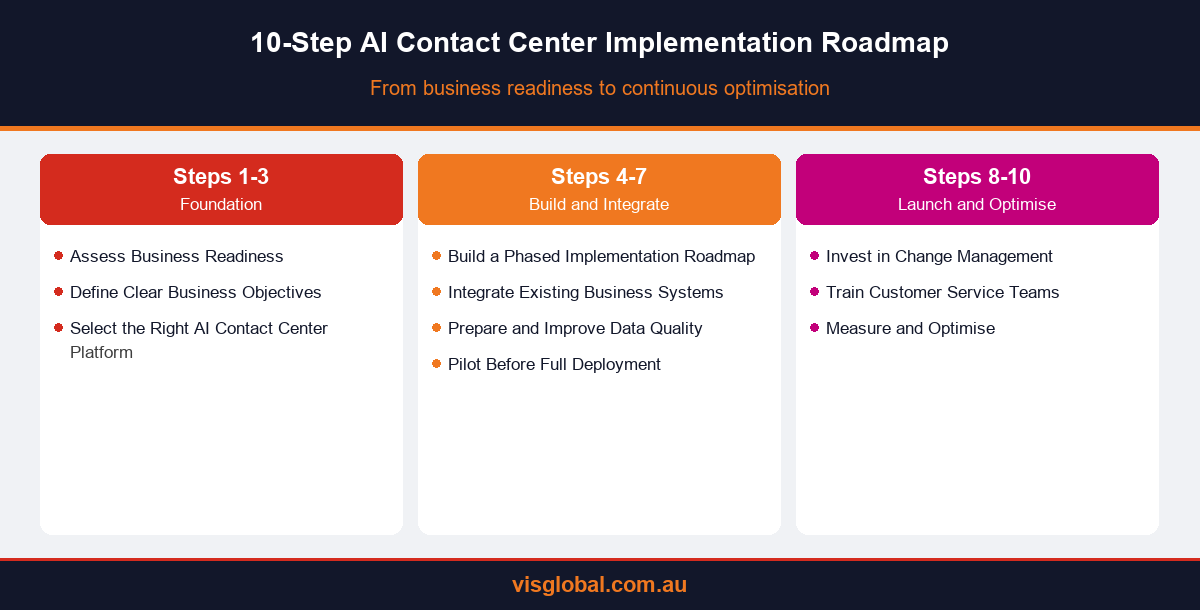
Step 5: Integrate Existing Business Systems
AI performs best when connected to existing enterprise applications.
Typical integrations include:
Customer Relationship Management (CRM)
Enterprise Resource Planning (ERP)
Identity Management
Billing Systems
Ticketing Platforms
Knowledge Bases
Workforce Management
Business Intelligence
Integration enables AI to provide accurate, personalised responses while reducing manual work.
Step 6: Prepare and Improve Data Quality
AI systems depend on high-quality data. Poor or outdated information can lead to inaccurate recommendations, inconsistent customer experiences, and unreliable analytics.
Organisations should:
Remove duplicate records.
Standardise customer information.
Review knowledge base content.
Archive obsolete documentation.
Improve metadata.
Establish data governance policies.
Clean data improves AI accuracy and customer outcomes.
Step 7: Pilot Before Full Deployment
Launching AI across the entire organisation immediately can increase risk.
A pilot program allows organisations to:
Test workflows.
Gather employee feedback.
Identify integration issues.
Measure performance.
Refine customer journeys.
Common pilot groups include a single department, regional office, or specific customer service team.
Step 8: Invest in Change Management
Technology alone does not determine project success.
Employees need to understand:
Why AI is being introduced.
How it supports their work.
What changes to expect.
How new workflows operate.
Effective change management includes:
Leadership communication.
Staff workshops.
Training sessions.
User documentation.
Ongoing support.
Feedback mechanisms.
When employees see AI as a tool that simplifies their work rather than replaces it, adoption is typically much stronger.
Step 9: Train Customer Service Teams
Training should extend beyond system navigation.
Agents should learn how to:
Collaborate with AI.
Interpret AI recommendations.
Escalate conversations appropriately.
Verify AI-generated responses.
Protect customer information.
Maintain empathy during customer interactions.
Continuous learning ensures employees remain confident as AI capabilities evolve.
Step 10: Measure and Optimise
Implementation should be viewed as an ongoing improvement process rather than a one-time deployment.
Regular reviews help organisations identify opportunities to:
Improve AI accuracy.
Expand automation.
Update knowledge content.
Refine workflows.
Improve customer satisfaction.
Increase operational efficiency.
Continuous optimisation ensures AI continues delivering business value.
Common Implementation Challenges
Although AI offers significant advantages, organisations should prepare for several common challenges.
Legacy Infrastructure
Older communication systems may require integration or phased replacement before advanced AI capabilities can be introduced.
Employee Resistance
Some employees may be concerned that AI will replace their roles.
Clear communication and training help demonstrate that AI supports rather than replaces human expertise.
Data Quality Issues
Incomplete or inconsistent customer data can reduce AI effectiveness.
Strong data governance is essential for successful implementation.
Integration Complexity
Large organisations often operate multiple business applications.
Careful planning helps minimise disruption while ensuring reliable integration.
Customer Trust
Some customers may prefer speaking directly with a person.
Providing easy escalation paths ensures customers can quickly reach human agents whenever needed.
Responsible AI Governance
As AI becomes more integrated into customer service, organisations must establish governance frameworks that promote responsible and ethical use.
Key principles include:
Transparency
Customers should understand when they are interacting with AI and when they are speaking with a human representative.
Human Oversight
AI should support decision-making, with human agents reviewing sensitive, high-impact, or complex cases.
Privacy
Customer data should be collected, processed, and stored securely in accordance with applicable privacy regulations and organisational policies.
Fairness
AI systems should be monitored to minimise bias and ensure consistent treatment of customers.
Accountability
Clear ownership should be established for AI performance, security, compliance, and ongoing optimisation.
Security Considerations
Protecting customer information is a critical requirement for every AI contact center.
Organisations should implement:
End-to-end encryption.
Multi-factor authentication.
Role-based access control.
Secure APIs.
Data loss prevention.
Continuous monitoring.
Vulnerability management.
Regular security audits.
These measures help reduce risk while maintaining customer confidence.
Measuring Success
After implementation, organisations should monitor key performance indicators to evaluate business impact.
Common KPIs include:
KPI | Why It Matters |
Customer Satisfaction (CSAT) | Measures overall customer experience |
Net Promoter Score (NPS) | Indicates customer loyalty |
First Contact Resolution (FCR) | Tracks effectiveness of issue resolution |
Average Handle Time (AHT) | Measures operational efficiency |
Average Speed of Answer (ASA) | Evaluates responsiveness |
Self-Service Resolution Rate | Measures AI effectiveness |
Agent Productivity | Assesses workforce efficiency |
Customer Effort Score (CES) | Indicates ease of customer interactions |
Cost Per Contact | Measures financial performance |
AI Containment Rate | Tracks the percentage of enquiries resolved without agent intervention |
Regularly reviewing these metrics enables organisations to identify trends, optimise workflows, and maximise the return on their AI investment.
Best Practices for Long-Term Success
Successful AI contact centre programs share several common characteristics:
Align AI initiatives with business objectives.
Start with high-value use cases and expand gradually.
Keep knowledge bases accurate and up to date.
Continuously train employees.
Monitor AI performance and customer feedback.
Prioritise security, privacy, and compliance.
Use analytics to drive ongoing improvement.
Maintain a balance between automation and human interaction.
Looking Ahead
AI implementation is not the end of the journey—it is the beginning of continuous innovation. As technologies such as generative AI, predictive analytics, and autonomous workflows continue to evolve, organisations that establish strong foundations today will be well positioned to adapt to future customer expectations and business opportunities.
Key Takeaways
Successful AI contact centre projects begin with clear business goals, readiness assessments, and a phased implementation strategy.
Integration with CRM, ERP, Microsoft Teams, and knowledge management systems maximises business value.
Data quality, employee training, and change management are essential for long-term success.
Responsible AI governance ensures transparency, security, fairness, and regulatory compliance.
Continuous measurement and optimisation help organisations improve customer experiences, increase efficiency, and maximise return on investment.
Measuring ROI, Future Trends, and Why VisGlobal Is the Right AI Contact Center Partner
Measuring the Return on Investment (ROI) of AI Contact Centers
For business leaders, investing in an AI contact center is about more than adopting new technology—it is about delivering measurable business value. Whether the objective is improving customer experience, reducing operational costs, increasing agent productivity, or supporting business growth, organisations need clear metrics to evaluate success.
Unlike traditional technology investments, AI contact centers generate value across multiple areas of the business. Financial savings, operational improvements, employee productivity, and customer satisfaction all contribute to a strong return on investment over time.
Financial Benefits
One of the first areas where organisations see measurable improvements is operational efficiency.
AI reduces costs by:
Lowering call handling times
Reducing after-call administrative work
Increasing self-service adoption
Optimising workforce scheduling
Minimising manual data entry
As customer interactions become more efficient, organisations can manage increasing enquiry volumes without significantly expanding customer service teams.
Customer Experience Benefits
Customer satisfaction has become one of the most important business performance indicators.
AI contributes to better customer experiences through:
Faster response times
Personalised interactions
Consistent information across communication channels
Reduced waiting times
Improved customer experiences often lead to stronger loyalty, increased retention, and positive brand perception.
Employee Productivity
AI enhances employee performance by reducing repetitive work and providing intelligent assistance during customer interactions.
Examples include:
Automatic conversation summaries
Knowledge article recommendations
Suggested responses
Workflow automation
Live transcription
When employees spend less time on administrative tasks, they can focus on solving customer problems and delivering more meaningful interactions.
Operational Efficiency
AI also improves day-to-day operations by providing greater visibility into contact center performance.
Leaders can make informed decisions using real-time insights into:
Contact volumes
Queue performance
Customer sentiment
Service levels
Quality assurance
Continuous monitoring enables organisations to identify bottlenecks and optimise processes over time.
Key Metrics to Track
Organisations should establish clear Key Performance Indicators (KPIs) before implementing an AI contact center.
KPI | Business Value |
Customer Satisfaction (CSAT) | Measures customer experience quality |
Net Promoter Score (NPS) | Evaluates customer loyalty |
First Contact Resolution (FCR) | Indicates problem-solving effectiveness |
Average Handle Time (AHT) | Measures operational efficiency |
Average Speed of Answer (ASA) | Tracks responsiveness |
Self-Service Success Rate | Evaluates AI effectiveness |
Customer Effort Score (CES) | Measures ease of customer interactions |
Agent Productivity | Assesses workforce performance |
Cost per Contact | Measures operational efficiency |
Customer Retention | Indicates long-term business value |
Tracking these KPIs regularly helps organisations demonstrate tangible business outcomes and identify opportunities for continuous improvement.
The Future of AI Contact Centers
Artificial Intelligence continues to evolve rapidly, introducing new capabilities that will reshape customer engagement over the coming years.
Forward-thinking organisations are preparing for a future where AI supports not only customer interactions but also strategic decision-making and business optimisation.
Generative AI
Generative AI enables contact centers to create human-like responses, summarise conversations, draft emails, and generate knowledge articles in real time.
Rather than relying on scripted responses, AI can adapt to customer context and provide more natural interactions.
Agentic AI
The next evolution of AI involves intelligent agents capable of independently completing multi-step tasks.
Examples include:
Processing customer requests
Coordinating with multiple business systems
Scheduling appointments
Updating records
Following organisational policies
Escalating only when human expertise is required
These AI agents will work alongside employees rather than replacing them.
Predictive Customer Engagement
Instead of waiting for customers to report problems, AI will increasingly identify potential issues before they occur.
Examples include:
Service disruption notifications
Billing reminders
Maintenance scheduling
Product renewal alerts
Customer retention initiatives
Proactive engagement improves customer satisfaction while reducing inbound contact volumes.
Hyper-Personalisation
AI will continue to deliver increasingly personalised customer experiences based on:
Purchase history
Previous interactions
Communication preferences
Customer behaviour
Business relationships
Personalisation enables organisations to provide more relevant recommendations and stronger customer relationships.
Voice AI
Voice technologies continue to improve through advancements in speech recognition and conversational intelligence.
Future Voice AI capabilities will include:
More natural conversations
Real-time language translation
Emotion detection
Intelligent conversation management
These improvements will further enhance accessibility and customer experience.
Responsible AI
As AI capabilities expand, responsible governance will become increasingly important.
Future AI strategies should continue to prioritise:
Transparency
Human oversight
Security
Privacy
Ethical decision-making
Regulatory compliance
Organisations that adopt responsible AI practices will build stronger customer trust and reduce long-term operational risks.
Why Choose VisGlobal for AI Contact Center Solutions?
Selecting the right technology is only one part of a successful AI transformation. Equally important is choosing an experienced implementation partner that understands your business, your technology ecosystem, and your long-term goals. VisGlobal helps organisations modernise customer engagement by delivering integrated AI contact center solutions that align with enterprise communication strategies and digital workplace initiatives.
Enterprise Communication Expertise
VisGlobal designs and implements scalable communication environments that support modern customer engagement while enabling hybrid and remote workforces.
Microsoft-Centric Solutions
With expertise across the Microsoft ecosystem, VisGlobal helps organisations integrate AI contact center capabilities with:
Microsoft Teams
Teams Phone
Dynamics 365
Azure AI
Power BI
Power Automate
Microsoft Copilot
This unified approach maximises existing technology investments while improving productivity.
Tailored Solutions
Every organisation has unique operational requirements.
VisGlobal works closely with clients to design solutions that align with industry regulations, customer expectations, and business objectives rather than delivering one-size-fits-all implementations.
End-to-End Services
From planning and deployment to user adoption, optimisation, and managed services, VisGlobal supports organisations throughout every stage of their AI transformation journey.
Security and Compliance
Enterprise-grade security, governance, and compliance remain central to every implementation, helping organisations protect sensitive customer information while maintaining regulatory requirements.
Conclusion
AI contact centers are transforming the way Australian organisations engage with customers. By combining automation, conversational AI, analytics, and cloud communications, businesses can deliver faster, more personalised, and more efficient customer experiences while improving operational performance. The most successful organisations recognise that AI is not about replacing people—it is about empowering them. When AI handles repetitive tasks and provides intelligent guidance, employees can focus on empathy, complex problem-solving, and building stronger customer relationships. As customer expectations continue to evolve, organisations that invest in intelligent customer engagement platforms today will be better positioned to compete, innovate, and grow in the years ahead. Whether you are modernising an existing contact center or planning a new digital customer experience strategy, partnering with an experienced technology provider can help ensure your investment delivers long-term business value.